Have you ever played a CD with visible scratches and wondered how it could still produce clear music? A scratched disc might look damaged, yet the songs can play without noticeable interruptions. The secret lies in a technology called error correction, which allows digital devices to recover missing or corrupted information.
Error correction is used in many areas of modern technology, from computer memory and wireless communication to satellite transmissions. CDs provide an especially interesting example of how mathematical techniques can protect digital information from physical damage.
How a CD Stores Digital Music
A compact disc stores music as digital data rather than as a continuous physical recording. The information is encoded in a long sequence of microscopic features pressed into or recorded on the disc’s surface.
When a CD player spins the disc, a laser reads the optical patterns. The player converts these patterns into digital signals, which are then processed and transformed into sound through a digital-to-analog converter.
However, the disc’s surface is not always read perfectly. Dust, fingerprints, scratches, and manufacturing imperfections can interfere with the laser. Some information may be read incorrectly or become impossible to recover directly.
Without a way to handle these errors, even a small scratch could interrupt playback. Error correction helps prevent this from happening.

What Is Error Correction?
Error correction is a method of detecting and repairing errors in digital information. Instead of storing only the original data, a system adds carefully calculated extra information that can help reconstruct damaged portions later.
Imagine sending a message that reads:
THE CAT SAT ON THE MAT
If a few letters become unreadable, the surrounding letters and the structure of the sentence may help you determine what was originally written. Digital systems use a more precise mathematical approach, rather than relying on human interpretation.
Before recording data on a CD, the system encodes it using mathematical rules that introduce redundancy. This additional information makes it possible for the player to detect certain errors and, within the system’s correction limits, recover the original data.
The important point is that the CD does not need to be read perfectly. It needs to preserve enough information for the decoding system to reconstruct the intended digital content.
How CDs Use Mathematical Redundancy
Audio CDs use a technique known as Cross-Interleaved Reed-Solomon Coding (CIRC). This system combines error-correcting codes with a process called interleaving.
Reed-Solomon codes add redundant symbols to the data. These symbols contain mathematical relationships that allow a decoder to identify and correct certain errors in the original information.
Interleaving provides another layer of protection. Rather than placing every consecutive part of a song’s data directly beside the next part, the system rearranges the encoded data before it is recorded.
This matters because a scratch often damages a continuous physical section of the disc. Without interleaving, such damage could destroy a large block of consecutive data. With interleaving, the affected information is distributed across different parts of the original data stream.
The player can then use the error-correction process to recover much of the missing information.
In simple terms, interleaving spreads the risk, while error correction helps repair the damage.
What Happens When a Scratch Crosses a CD?
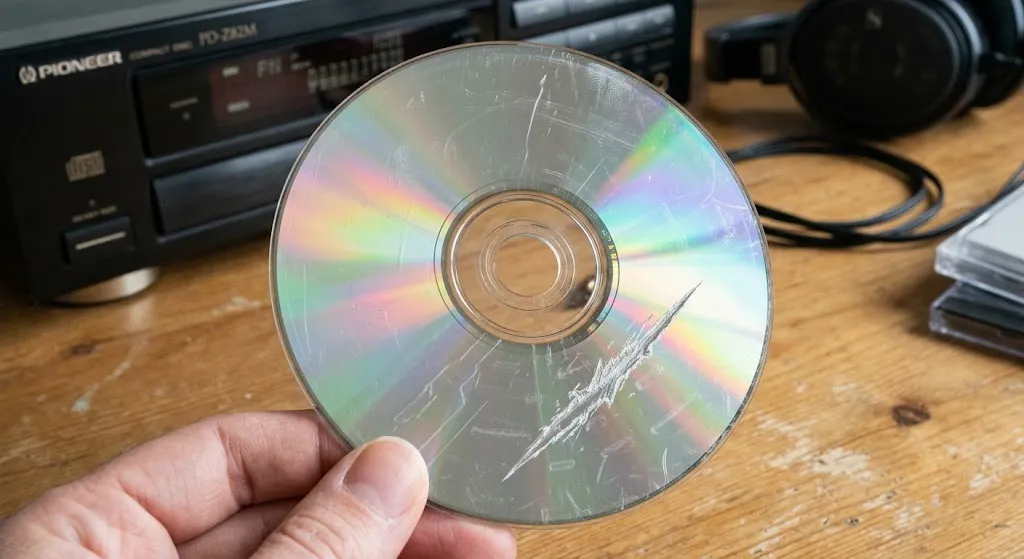
Consider what happens when a scratch interrupts the laser’s ability to read a section of a disc.
First, the CD player’s optical system detects the reflected laser light and converts it into a digital signal. If a scratch prevents the player from reading some of the encoded information correctly, the resulting data may contain errors or missing sections.
The player then processes the data through its decoding system.
Depending on the type and severity of the damage, several outcomes are possible:
- The error is corrected. The redundant information allows the decoder to reconstruct the original data accurately.
- The data is recovered through multiple decoding stages. The CIRC system uses successive error-correction operations to handle errors that remain after an earlier stage.
- The damage exceeds the correction capability. If too much information is missing, the player may be unable to reconstruct the original data reliably. It may conceal a brief defect, repeat or interpolate audio samples, or produce an audible skip or interruption.
This explains why some scratched CDs play normally while others skip, repeat sounds, or stop playing altogether.
Why Interleaving Makes Such a Difference
Interleaving is one of the most important reasons a CD can tolerate physical damage.
Imagine a book in which every sentence is written on a separate card. If a few consecutive cards are damaged, the missing information could make several sentences unreadable.
Now imagine that the sentences have been divided into smaller pieces and distributed across many different groups of cards. Damage to one area would affect parts of several sentences rather than destroying one complete passage.
A decoding system could then reconstruct the original sentences using the information that remains.
CD interleaving works on a related principle, although the actual process is governed by mathematical encoding and carefully designed data arrangements.
By spreading the effects of a localized scratch across the encoded stream, interleaving makes it easier for the error-correction system to handle the damage.
How Much Damage Can a CD Survive?
There is no single scratch size that determines whether a CD will play correctly. The result depends on several factors, including the scratch’s location, depth, direction, and the condition of the disc and player.
The direction of a scratch can make a difference because a scratch running across the disc’s circular data track may interfere with a different sequence of encoded information than one following the track.
The location also matters. Damage near the center or outer edge may affect playback differently depending on the affected data and the player’s ability to read it.
CDs are generally read through their transparent underside, with the laser focused on the data layer. Because of the optical arrangement, some minor surface scratches can be tolerated, while deeper damage or defects affecting the data layer may be much more serious.
Error correction is powerful, but it is not unlimited. If the player cannot obtain enough reliable information, the original data may no longer be recoverable.
What Happens When Error Correction Fails?
When the decoding system cannot correct all the errors, the CD player may still try to produce continuous audio.
For a music CD, the player can sometimes conceal short gaps by estimating missing audio samples from neighboring information. This process is called error concealment or interpolation.
For example, if a very short section of a musical note becomes unreadable, the player may estimate the missing values to avoid a sudden, distracting interruption.
However, error concealment is different from error correction. Error correction reconstructs the original encoded information when possible. Error concealment produces an approximation when the original information cannot be recovered completely.
If the damage is extensive, the approximation may become noticeable, producing clicks, distortion, repeated sounds, or skips.
This distinction explains why a CD can sometimes sound normal even when its player encounters errors that cannot be fully corrected.
Error Correction Beyond CDs

The same general principle appears throughout modern digital technology. Systems add redundancy so that information can survive interference, noise, or damage.
Examples include:
- QR codes: Their built-in error correction allows many codes to remain readable even when part of the printed pattern is obscured or damaged.
- Computer memory: Error-correcting memory can detect and correct certain data errors caused by electrical disturbances.
- Satellite communication: Error-correcting codes help recover transmitted information affected by noise over long distances.
- Wireless networks: Error-control techniques help devices communicate despite interference and unreliable signals.
- Data storage: Some storage systems use error-correcting codes to protect information against defects and read errors.
The specific coding methods differ, but the underlying idea is similar: additional structured information helps a system recover data that would otherwise be lost.
Why This Technology Still Matters
CDs may no longer be the primary format for many listeners, but the engineering principles behind their reliability remain important.
Digital systems rarely operate under perfect conditions. Signals can be weakened, storage media can deteriorate, and physical damage can interfere with information. Error correction helps make these systems more dependable by allowing them to recover from a limited amount of corruption.
A scratched CD demonstrates an important lesson about digital technology: reliability does not always depend on preventing every error. Sometimes it comes from designing a system that can recover when errors occur.
The next time a scratched CD plays your favorite song without an obvious problem, remember the mathematical work happening behind the scenes. Redundant data, Reed-Solomon coding, interleaving, and error handling work together to help turn an imperfect optical reading into recognizable music.
That is the power of error correction: it allows digital information to survive damage without requiring every bit to be read perfectly.
Frequently Asked Questions
A scratched CD can still play because error correction helps recover digital data that the laser cannot read correctly. The system uses redundant information to reconstruct damaged data.
CIRC stands for Cross-Interleaved Reed-Solomon Coding. It combines error-correcting codes and interleaving to help audio CDs recover data affected by scratches and reading errors.
Interleaving rearranges digital data so that a scratch affecting one physical area is less likely to destroy a continuous section of the original information.
Yes. If scratches or other damage exceed the error-correction system’s capabilities, the CD player may produce skips, clicks, distorted audio, or interruptions.
Yes. QR codes, computer memory, wireless communication, and satellite systems use error-correction techniques to protect information from damage or transmission errors.