
Concrete typically takes several hours to dry on the surface, around 24–48 hours before light foot traffic is possible, and about 28 days to reach its specified strength under proper curing conditions. However, drying and curing are different processes: concrete can retain moisture for weeks or months, while curing allows it to develop strength and durability through cement hydration.
Concrete is one of the most widely used construction materials in the world, found in everything from sidewalks and driveways to foundations, bridges, and high-rise buildings. However, after concrete is poured, it needs time to become strong enough for use. One common misunderstanding is that concrete is ready once it looks dry. In reality, drying and curing are two different processes, and understanding the difference is essential for achieving durable, long-lasting concrete.
So, how long does concrete take to dry, and how long does it take to cure? The answer depends on the type of project, the weather, the concrete mixture, and how the surface is maintained after pouring.
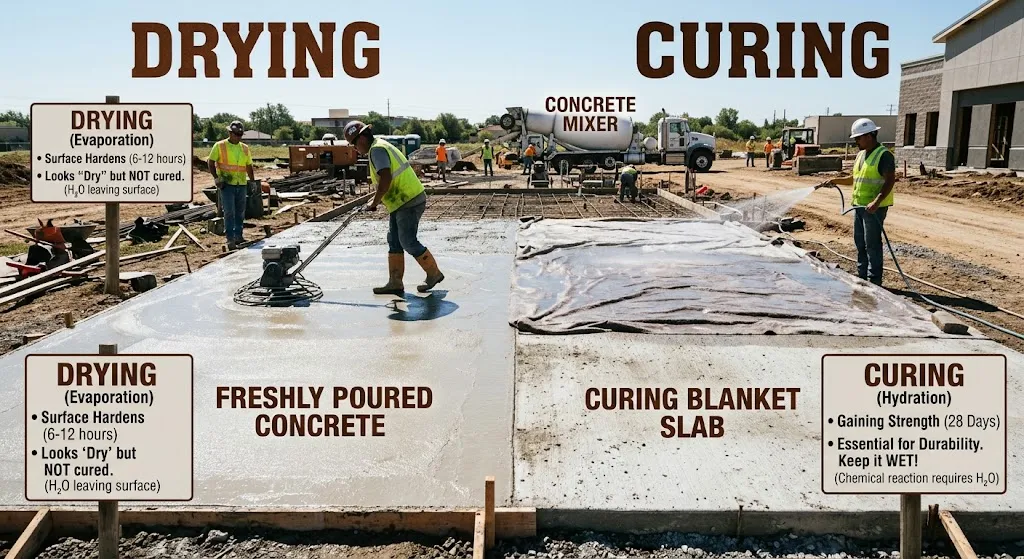
What Is the Difference Between Concrete Drying and Curing?
Although the terms are often used interchangeably, concrete drying and curing describe different processes.
Drying generally refers to moisture leaving the concrete and evaporating into the surrounding air. This process can continue for weeks or months, depending on the thickness of the slab, humidity, temperature, and ventilation.
Curing, on the other hand, is the chemical process through which cement reacts with water, gradually forming the internal structure that gives concrete its strength and durability. This reaction is known as hydration.
Concrete does not become strong simply because its water evaporates. In fact, losing moisture too quickly can interfere with hydration, leading to a weaker surface, shrinkage, and cracking.
For this reason, freshly poured concrete needs appropriate curing conditions to develop its intended strength.
How Long Does Concrete Take to Cure?
Most conventional concrete mixes are designed to reach a significant portion of their intended strength within the first seven days. However, the standard reference point for concrete strength is usually 28 days.
Here is a general timeline of what happens after concrete is poured.
First 24–48 Hours
Concrete begins to harden and develop its initial strength. Depending on the mixture and weather, light foot traffic may be possible after approximately 24–48 hours. The surface can still be damaged easily, so heavy loads and impacts should be avoided.
Days 3–7
Hydration continues, and the concrete becomes considerably stronger. Many standard concrete mixes gain a substantial amount of their eventual strength during this period. Proper moisture management remains important.
Around 28 Days
Concrete commonly reaches its specified 28-day compressive strength under appropriate curing conditions. This is an important engineering benchmark, although actual strength development varies by mix and environment.
After 28 Days
Hydration can continue for months or even years if moisture and temperature conditions permit. Concrete may continue gaining strength, but the rate generally slows over time.
These timeframes are approximate. Structural concrete should not be loaded based solely on its age; the required strength and the project’s engineering specifications must guide the decision.
How Long Does Concrete Take to Dry?
Concrete does not have one universal drying time. Its surface may appear dry within hours, while the interior retains substantial moisture for much longer.
The time required for moisture to leave concrete depends on several factors, including slab thickness, the original water content, ambient humidity, temperature, and air movement.
For example, a thin concrete surface may dry relatively quickly, while a thick foundation slab can retain internal moisture for weeks or months.
It is also important to distinguish between concrete that is dry enough for a particular use and concrete that has completed its curing process. These are not the same condition.
Typical Concrete Drying and Curing Times
| Concrete application | Approximate timeframe |
|---|---|
| Initial surface hardening | Several hours |
| Light foot traffic | Around 24–48 hours |
| Light residential vehicle traffic | Often around 7 days, if the concrete is designed and approved for it |
| Typical reference age for strength | 28 days |
| Drying before moisture-sensitive flooring | Often weeks to months, depending on conditions and flooring requirements |
These are general guidelines, not guarantees. For example, a driveway may be hard enough to walk on after two days but still not be ready for a vehicle. Similarly, concrete that has reached its 28-day strength may still contain too much moisture for certain flooring materials or coatings.
What Factors Affect Concrete Drying and Curing Time?
Several conditions influence how quickly concrete hardens, develops strength, and loses moisture.
1. Temperature
Temperature has a significant effect on the rate of cement hydration. Warm conditions generally accelerate the reaction, while cold conditions slow it down.
However, extremely hot weather can cause moisture to evaporate too quickly, increasing the risk of surface cracking and reducing the quality of the finished concrete.
In cold weather, fresh concrete must be protected from freezing before it develops sufficient strength. Freezing at an early stage can cause lasting damage.
2. Humidity
Humidity affects how quickly moisture evaporates from a concrete surface. In dry conditions, water can leave the surface rapidly, potentially causing plastic shrinkage cracking before the concrete has developed sufficient strength.
High humidity generally slows evaporation, which can help maintain moisture during curing. However, it may also extend the time needed for concrete to reach moisture levels suitable for flooring or protective coatings.
3. Concrete Thickness
The thickness of a concrete slab affects how long moisture remains inside it.
A thin slab generally releases moisture more quickly than a thick slab under otherwise similar conditions. Thick foundations, suspended slabs, and large structural elements can retain moisture for extended periods.
This is particularly important when installing moisture-sensitive flooring, because a surface that feels dry may still contain excess moisture internally.
4. The Concrete Mix
Concrete mixtures contain different proportions of cement, water, sand, aggregate, and sometimes chemical admixtures or supplementary cementitious materials.
A mix designed for rapid strength development may become usable sooner than a conventional mix. Other mixtures are formulated for improved durability, lower heat generation, or specific environmental conditions and may develop strength at a different rate.
The water-to-cement ratio also matters. Excess mixing water can increase porosity and drying shrinkage, while an appropriately designed mix helps balance workability, strength, and durability.
5. Curing Methods
The way concrete is cured can significantly influence its final quality.
Common curing methods include:
- Water curing: Keeping the concrete surface continuously moist using controlled watering, wet coverings, or ponding where suitable.
- Plastic sheeting: Covering the surface to reduce moisture loss.
- Curing compounds: Applying a suitable product that forms a film to limit evaporation.
- Insulated coverings: Helping maintain appropriate temperatures in cold conditions.
Curing should begin as soon as practical after finishing, without damaging the surface. The appropriate method and duration depend on the concrete mixture, weather, and project requirements.
When Can You Walk or Drive on New Concrete?
One of the most common questions after pouring a driveway, patio, walkway, or garage floor is when it will be safe to use.
The answer depends on the concrete’s strength, thickness, mix design, and environmental conditions.
Walking on concrete: Light foot traffic is often possible after 24–48 hours. Avoid dragging heavy objects, using sharp tools, or placing concentrated loads on the surface during early hardening.
Driving a car on concrete: Many standard residential driveways require approximately seven days before light vehicle traffic is permitted. Some projects require a longer waiting period, and the concrete supplier or contractor should confirm when use is appropriate.
Heavy vehicles and equipment: Trucks, construction machinery, and other heavy loads may require substantially longer. The decision should be based on the specified concrete strength and the design of the slab, not a general waiting period.
Placing heavy objects: Hot tubs, large planters, masonry structures, and heavy equipment can impose significant loads. Confirm that the concrete has sufficient strength and that the slab was designed to support the intended weight.
Even when concrete appears hard, its surface and internal structure are still developing. Allowing enough time before applying loads helps reduce the risk of damage.
How Long Should Concrete Be Cured?
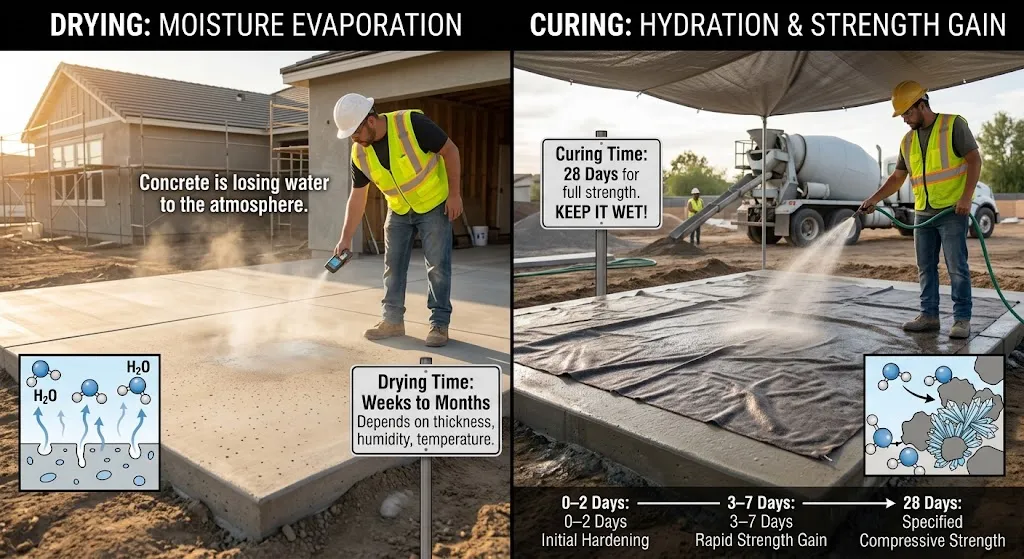
For many conventional concrete applications, a curing period of at least seven days is a common recommendation, although the correct duration depends on the cement type, concrete mixture, exposure conditions, and applicable specifications.
Some mixtures and construction conditions require longer curing periods. Rapid-hardening concrete may follow a different schedule, while concrete exposed to demanding environmental conditions may need more carefully controlled curing.
During curing, the goal is to maintain suitable moisture and temperature conditions so that cement hydration can continue.
Simply leaving concrete exposed to the sun and air is not always sufficient. In hot, windy, or dry conditions, the surface can lose moisture too quickly, increasing the risk of cracking and surface weakness.
For structural projects, follow the engineer’s specifications and the concrete supplier’s curing recommendations.
Can Concrete Cure Too Quickly?
Concrete can harden quickly under certain conditions, but rapid hardening does not necessarily mean the concrete has achieved adequate strength or durability.
When water evaporates rapidly from freshly placed concrete, the surface may shrink while the underlying material remains plastic. This can cause plastic shrinkage cracks.
Rapid moisture loss after the initial setting period can also interfere with hydration near the surface, potentially creating a weak or dusty finish.
To reduce these risks:
- Protect fresh concrete from strong winds and direct sunlight where necessary.
- Use suitable curing methods to limit moisture loss.
- Avoid pouring in extreme weather unless appropriate precautions are in place.
- Follow the recommended finishing and curing procedures.
- Do not add extra water to the surface to make finishing easier unless the specified method permits it.
Good curing practices are especially important for exposed outdoor slabs, driveways, sidewalks, and other surfaces subject to weather and repeated use.
How Can You Tell Whether Concrete Is Dry Enough?
Appearance alone is not a reliable way to determine whether concrete is dry enough for a particular application.
A light-colored surface may still contain significant internal moisture, and the surface can feel dry while the deeper layers remain damp.
For ordinary outdoor applications, the primary concern is often whether the concrete has developed sufficient strength for the intended traffic or load. For flooring, coatings, adhesives, and moisture-sensitive finishes, the moisture content is also critical.
Several methods can help assess readiness:
- Visual inspection: Look for standing water, surface damage, cracking, or other obvious problems. Visual inspection alone cannot establish internal moisture levels.
- Concrete moisture testing: Suitable tests can measure moisture conditions before flooring or coatings are installed.
- Relative humidity testing: In-slab relative humidity testing can help determine whether concrete is suitable for moisture-sensitive flooring systems.
- Manufacturer requirements: Flooring, adhesive, and coating manufacturers often specify maximum allowable moisture levels and approved testing methods.
Before installing wood flooring, vinyl, laminate, epoxy coatings, or similar finishes, verify that the slab meets the product’s moisture requirements. Waiting a fixed number of days is not a substitute for testing when testing is required.
Common Mistakes to Avoid When Concrete Is Drying and Curing
A few avoidable mistakes can reduce concrete quality or lead to expensive repairs.
Assuming hard concrete is fully cured. Concrete may support light traffic before it reaches its specified strength.
Allowing fresh concrete to dry out too quickly. Rapid moisture loss can interfere with hydration and increase the risk of cracking.
Applying heavy loads too soon. Early loading can damage concrete that has not developed adequate strength.
Ignoring cold weather. Fresh concrete exposed to freezing temperatures can suffer serious damage before sufficient strength develops.
Installing flooring too early. Excess moisture trapped beneath flooring or coatings can cause adhesive failure, blistering, warping, or other problems.
Using a single timeline for every project. A patio, a driveway, a thick foundation, and a polished interior floor have different performance requirements. The appropriate waiting period should reflect the actual application.
Frequently Asked Questions
No. Twenty-eight days is a common reference age for measuring concrete’s compressive strength, not a universal drying period. Concrete may retain internal moisture long after 28 days, depending on slab thickness and environmental conditions.
Light rain after concrete has sufficiently set may not cause significant problems, but heavy rain or running water can damage a very fresh surface. Protect newly poured concrete from precipitation until it has hardened enough to withstand exposure.
Concrete generally becomes stronger with time as hydration continues. Seven-day strength can be substantial, but 28 days is a widely used reference point for verifying specified compressive strength.
Water curing can be beneficial when performed correctly. Keeping the concrete appropriately moist supports hydration and helps reduce premature moisture loss. The method should be suitable for the surface and weather conditions.
Yes. Concrete can cure underground, provided that temperature, moisture, and other conditions support hydration. Soil contact does not automatically guarantee proper curing, so the placement and curing requirements still need to be followed.
Hydration can continue for a long time, potentially for years, whenever suitable moisture and temperature conditions allow. However, strength development typically slows considerably after the early curing period.
Key Takeaways
- Drying and curing are different processes: Drying involves moisture leaving concrete, while curing allows cement hydration to develop strength.
- Twenty-eight days is a common strength benchmark: It is not a guarantee that concrete is completely dry.
- Foot traffic may be possible after 24–48 hours: Vehicle traffic often requires around seven days or longer, depending on the project.
- Temperature, humidity, thickness, and mix design matter: These factors affect both moisture loss and strength development.
- Proper curing improves durability: Protecting concrete from premature moisture loss and temperature extremes helps it develop its intended properties.
- Test before installing moisture-sensitive finishes: Flooring and coatings may require verified moisture levels rather than simply waiting a set number of days.
Conclusion
Understanding how long concrete takes to dry versus cure helps homeowners, builders, and contractors make better decisions about construction schedules, maintenance, and long-term durability. While concrete may harden enough for light use within a day or two, its strength continues to develop over time, with 28 days serving as a common reference point for conventional concrete.
The most important principle is to distinguish between a surface that looks dry and concrete that has developed the strength and moisture conditions required for its intended purpose. By following appropriate curing procedures, accounting for weather conditions, and checking project-specific requirements, you can help ensure that concrete performs reliably for years to come.
For more informative articles about construction, technology, engineering, and the world around us, visit serdpestcp.org.


