
Before email, instant messaging, and digital networks, some businesses and cities relied on a surprisingly fast way to move information: pneumatic tubes. These systems used air pressure to transport small containers through networks of pipes, allowing documents, money, prescriptions, and other items to travel from one location to another without anyone carrying them by hand.
Although pneumatic tubes may seem like an invention from a science fiction story, they were once an important part of everyday life. From department stores and banks to hospitals and post offices, these remarkable systems helped people communicate and work more efficiently.
What Are Pneumatic Tubes?
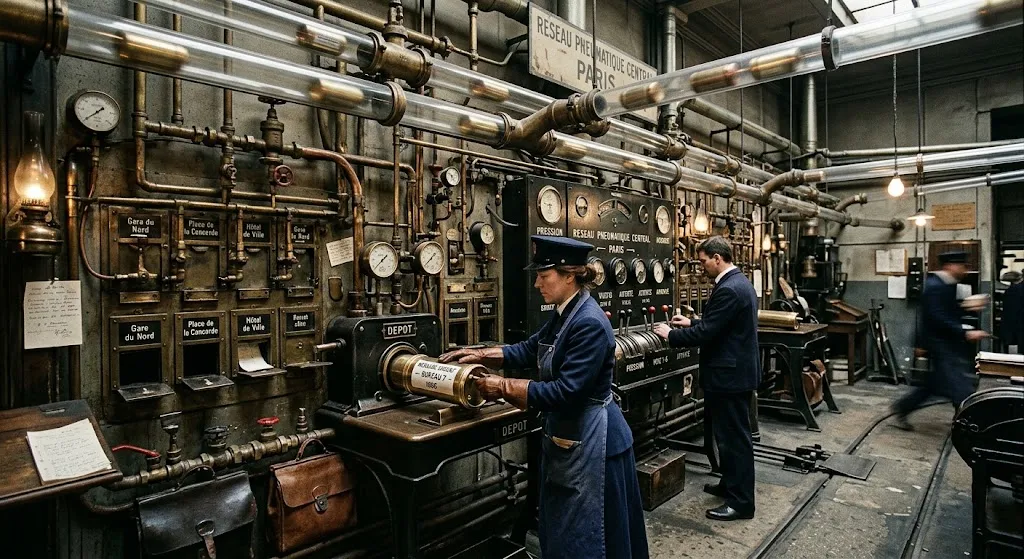
A pneumatic tube system transports small objects through enclosed pipes using differences in air pressure. The objects are placed inside special cylindrical containers, often called carriers or capsules, which fit inside the tubes.
Air pressure then pushes or pulls the carrier through the pipe toward its destination. Depending on the system’s design, air may be blown behind the carrier or sucked from ahead of it to create movement.
The basic principle is simple, but building a reliable network requires careful engineering. Pipes must have suitable diameters, curves must be designed to reduce resistance, and air pressure must be controlled to keep the carriers moving safely.
Some systems connect only two rooms, while others have networks of tubes, switches, and stations serving multiple departments or buildings.
The Early History of Pneumatic Transportation
The idea of using air to move objects through tubes dates back several centuries. Inventors and engineers explored pneumatic transportation during the Industrial Revolution, when growing cities needed faster ways to move goods and information.
In the nineteenth century, pneumatic tube technology became particularly attractive for communication. Telegraph systems were expanding, but not every message required an electrical signal. Sometimes, the fastest practical solution was to send the original document itself through a pipe.
Engineer William Murdoch and other early experimenters helped develop the principles of pneumatic transportation. Later inventors and engineers adapted these ideas for mail delivery, commercial buildings, and urban infrastructure.
By the late nineteenth and early twentieth centuries, pneumatic tubes had become a recognizable feature of modern city life.
How Cities Used Pneumatic Mail Systems
One of the most ambitious applications was the pneumatic postal network. Instead of sending letters through couriers traveling along streets, postal workers could place mail inside cylindrical containers and send it through underground pipes between sorting offices.
Large systems were developed in cities such as Paris, London, and Berlin. These networks connected important postal facilities and allowed certain categories of correspondence to move rapidly across urban areas.
Paris developed an extensive pneumatic postal service that operated for more than a century, beginning in the nineteenth century and continuing until 1984.
The system was especially useful for urgent messages and short-distance communication. A carrier could travel underground without being delayed by traffic, weather, or crowded streets.
However, pneumatic mail required specialized infrastructure, regular maintenance, and staff to load, receive, sort, and redirect the containers. As telephone networks, electronic communication, and modern transport systems improved, many public pneumatic mail networks became too expensive or unnecessary to maintain.
The Pneumatic Tubes Inside Department Stores
Pneumatic tubes also transformed the way large department stores operated.
In the late nineteenth and early twentieth centuries, shopping in a major department store could involve much more than selecting an item and paying at the nearest counter. A customer might choose merchandise in one department, while payment processing and accounting took place elsewhere.

Pneumatic tubes helped connect sales counters with central cash offices. A sales assistant could place a payment slip, receipt, or cash-related document inside a carrier and send it to the appropriate department. The carrier would return with a receipt, change, or confirmation, depending on the system’s arrangement.
This reduced the need for employees to walk repeatedly between floors and departments.
For customers, the process could appear almost magical. A small container disappeared into a wall-mounted tube and returned moments later carrying the information or materials needed to complete a transaction.
As department stores grew larger, these systems became an important example of how mechanical technology could improve the organization of everyday business.
Why Banks and Hospitals Adopted the Technology
Banks and other financial institutions used pneumatic tubes to transport documents, checks, cash-related materials, and internal paperwork between departments. Moving items through a controlled network helped reduce unnecessary trips and could improve workflow.
Hospitals found another valuable application. Medical staff often need to transport laboratory samples, prescriptions, blood collection tubes, and other small items between departments quickly.

Modern hospital pneumatic tube systems can connect laboratories, pharmacies, nursing stations, and other facilities. When appropriately designed and maintained, they help reduce the time staff spend physically transporting materials.
However, not every item is suitable for pneumatic transport. Fragile specimens, certain medications, blood products, and other sensitive materials may require specialized handling or alternative transportation methods. Hospitals must validate their systems and follow appropriate safety procedures.
The survival of pneumatic tubes in healthcare demonstrates that an older mechanical principle can remain useful when it solves a specific problem effectively.
How Pneumatic Tubes Actually Work
Although the technology appears simple, a practical pneumatic tube network involves several coordinated components.
1. The carrier: A cylindrical container holds the documents or objects being transported. Many carriers include soft seals that help maintain an effective fit inside the pipe.
2. The tube network: Pipes connect sending and receiving stations. The network may run through walls, ceilings, floors, or underground passages.
3. The blower or vacuum pump: This equipment creates the pressure difference needed to move a carrier through the system.
4. Switching mechanisms: In a network with multiple destinations, automated or manually controlled switches direct carriers toward the correct station.
5. Control systems: Modern installations can use sensors and computerized controls to monitor carrier movement, identify destinations, and manage traffic within the network.
The carrier’s speed depends on several factors, including air pressure, pipe dimensions, bends, friction, carrier weight, and the design of the system. Efficient operation requires balancing these factors rather than simply increasing air pressure.
Why Pneumatic Tubes Fell Out of Fashion
Pneumatic tubes did not disappear because the underlying technology stopped working. Instead, the world around them changed.
Electronic communication made it possible to transmit information almost instantly without moving paper. Computers replaced many manual accounting procedures, while email and digital document systems reduced the need to transport physical correspondence.
For public postal networks, maintaining miles of underground pipes, stations, compressors, and switching equipment became increasingly difficult to justify. Modern road transport and other delivery methods also offered more flexibility for moving physical goods.
The decline was especially noticeable in public communication networks and traditional retail environments. As businesses redesigned their operations, many older tube systems were removed or abandoned.
Yet the technology never vanished completely. Its continued use in hospitals, drive-through banking facilities, and selected industrial settings shows that pneumatic transportation still offers practical advantages.
The Engineering Challenges Behind the System
Pneumatic tube networks required more than a collection of pipes. Their designers had to solve several engineering problems.
First, carriers needed to travel at a controlled speed. Excessive speed could damage delicate contents or create dangerous impacts at receiving stations.

Second, intersections and branches had to direct carriers correctly. A mistake in routing could send an important document to the wrong department or cause a carrier to become stuck.
Third, the network needed to handle multiple deliveries without creating congestion. More advanced systems introduced scheduling, switching mechanisms, and automated controls to manage traffic.
Maintenance was another major challenge. Dust, worn seals, damaged carriers, blocked pipes, and mechanical failures could disrupt operations. Regular inspection was essential for keeping the system reliable.
These challenges illustrate an important lesson in engineering: a seemingly simple idea can become complex when it must operate continuously across a large network.
Could Pneumatic Tubes Make a Comeback?
Pneumatic tubes are unlikely to replace email or modern parcel delivery, but the principle remains relevant.
Hospitals continue to use them because physical objects sometimes need to move quickly between locations. Banks and other businesses may also use specialized systems when transporting small items through a controlled environment is more efficient than sending employees between stations.
Some modern automated facilities use pneumatic transportation alongside conveyor belts, robotic carts, and computerized inventory systems. Each technology serves a different purpose, depending on the size, weight, sensitivity, and destination of the items being moved.
Future developments may improve carrier tracking, energy efficiency, routing, and integration with automated buildings. However, any new installation must justify the expense of pipes, machinery, maintenance, and building modifications.
The most promising applications are likely to remain those where objects must move frequently between fixed locations.
A Forgotten Technology That Still Has a Future
Pneumatic tubes represent a fascinating chapter in the history of communication and transportation. They connected departments, moved documents across busy cities, and helped businesses operate more efficiently long before digital networks became commonplace.
Their appeal came from a straightforward idea: instead of moving people to the objects they needed, move the objects directly to them.
Although smartphones, computers, and digital networks have replaced many of their original functions, pneumatic tubes have not become completely obsolete. They continue to demonstrate how a well-designed mechanical system can remain valuable even as technology advances.
The next time a small capsule travels through a hospital wall or a bank’s drive-through tube, it is worth remembering that this modern convenience belongs to a much older tradition of using air pressure to make everyday work faster.
For more interesting articles about science, technology, engineering, and the surprising stories behind everyday inventions, visit serdpestcp.org.




4 thoughts on “The Lost Art of Pneumatic Tubes: How Cities Once Sent Messages Through Underground Pipes”