
A meter is the standard SI unit of length, represented by the symbol m, and is equal to 100 centimeters, 1,000 millimeters, or approximately 3.28 feet. It is used to measure distances, heights, widths, and lengths in everyday life, science, construction, and engineering.
Meters are connected to other metric units through powers of ten. This makes the system easy to use for both small and large measurements.
The following table shows common length conversions.
| Unit | Equivalent |
|---|---|
| 1 kilometer (km) | 1,000 meters |
| 1 meter (m) | 100 centimeters |
| 1 meter (m) | 1,000 millimeters |
| 1 meter (m) | 0.001 kilometers |
| 1 meter (m) | Approximately 3.28084 feet |
| 1 meter (m) | Approximately 39.3701 inches |
| 1 meter (m) | Approximately 1.09361 yards |
For example, to convert 4 meters into centimeters, multiply 4 by 100. The result is 400 centimeters.
To convert 2 kilometers into meters, multiply 2 by 1,000, giving 2,000 meters.
Converting meters into feet requires a different conversion factor. Multiply the number of meters by approximately 3.28084 to obtain the equivalent length in feet.
Key Takeaways
- A meter (m) is the standard SI unit of length used to measure distances, heights, and object dimensions.
- One meter equals 100 centimeters or 1,000 millimeters.
- One meter is approximately 3.28 feet, 39.37 inches, or 1.09 yards.
- The modern definition of a meter is based on the distance light travels in a vacuum in 1/299,792,458 of a second.
- The meter is widely used in construction, science, engineering, sports, and everyday measurements.
- A meter is slightly longer than a yard, making accurate conversions important when comparing metric and imperial measurements.
- The symbol for meter is always written as lowercase m, with a space between the number and the unit, such as 5 m.
- A meter measures length, while a square meter (m²) measures area.
How Long Is a Meter?
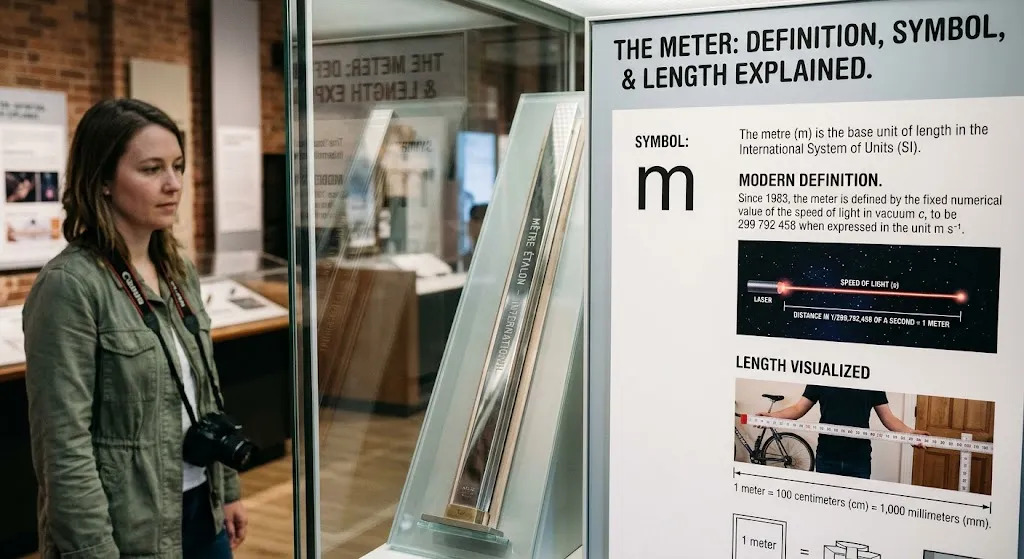
A meter is equal to 100 centimeters, 1,000 millimeters, or approximately 3.28 feet (39.37 inches). It is the standard unit of length in the International System of Units (SI) and is used worldwide to measure distances, heights, and the dimensions of objects. To visualize its length, imagine a meter stick or a distance slightly longer than one yard.
The Origin of the Meter
The meter originated during the French Revolution in the 1790s, when scientists and reformers sought to establish a universal measurement system based on decimal units. At the time, different regions used different measurement standards, making trade, construction, and scientific communication more complicated. The introduction of the meter helped establish a consistent and practical system that could be used across countries and disciplines.
The Original Definition of a Meter
The original definition of the meter was based on the size of the Earth. It was defined as one ten-millionth (\(1/10{,}000{,}000\)) of the distance from the Earth’s equator to the North Pole, measured along the Paris meridian. This approach was intended to connect the unit of length to a natural feature of the planet, providing a universal reference rather than relying on local measurement traditions.
The Modern Definition of a Meter (1983)
In 1983, the General Conference on Weights and Measures adopted a more precise definition of the meter based on the speed of light in a vacuum. Under this definition, one meter is the distance light travels in a vacuum during \(1/299{,}792{,}458\) of a second. This standard makes the meter highly accurate and reproducible anywhere in the world, supporting modern science, engineering, and precision measurement.
What Is the Difference Between a Meter and a Yard?
A meter and a yard are both units of length, but they are not exactly the same size.
One meter is approximately 1.09361 yards, while one yard equals exactly 0.9144 meters.
This means a meter is slightly longer than a yard. The difference is small enough to be difficult to notice in everyday situations, but it matters in activities requiring accurate measurements.
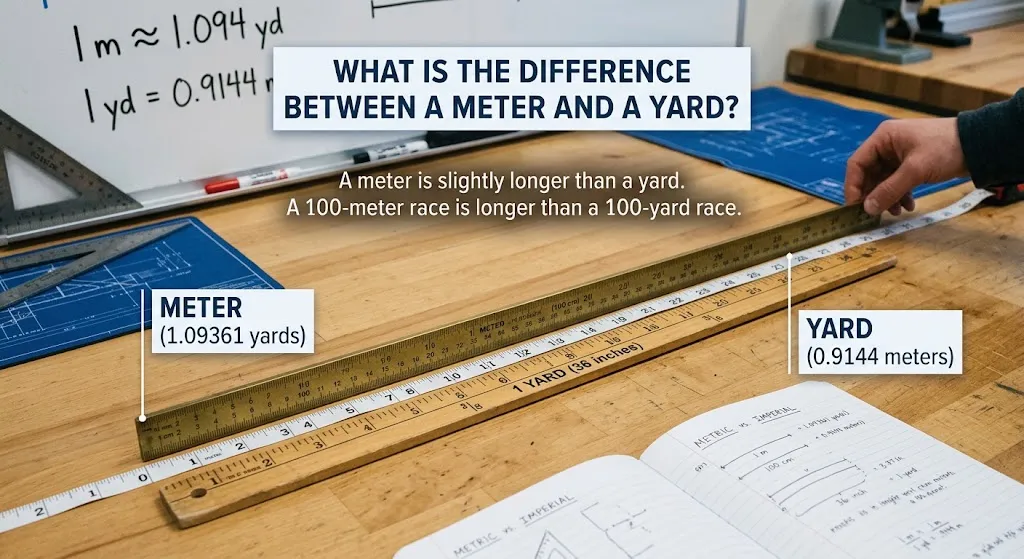
For example, a 100-meter race covers a greater distance than a 100-yard race. Similarly, when converting construction measurements between metric and imperial units, using the correct conversion factor helps prevent errors.
Meters are part of the metric system, while yards belong to the imperial and US customary measurement systems.
Why Is the Meter Important?
The meter provides a common reference for measuring length and distance. Without standardized units, comparing measurements across countries, industries, and scientific disciplines would be much more difficult.
In construction, meters help architects and engineers specify building dimensions, room sizes, and structural components. In manufacturing, precise length measurements ensure that parts fit together correctly.
Meters are also widely used in sports. Track events, swimming competitions, and field measurements often use meters to define distances and performance standards.
In science, the meter supports measurements ranging from laboratory experiments to the dimensions of large physical structures. Combined with other SI units, it helps researchers express and compare physical quantities accurately.
The widespread use of the meter makes it one of the most important measurement units in modern life.
Common Mistakes When Using Meters
Although the meter is a straightforward unit, a few common mistakes can lead to inaccurate measurements.
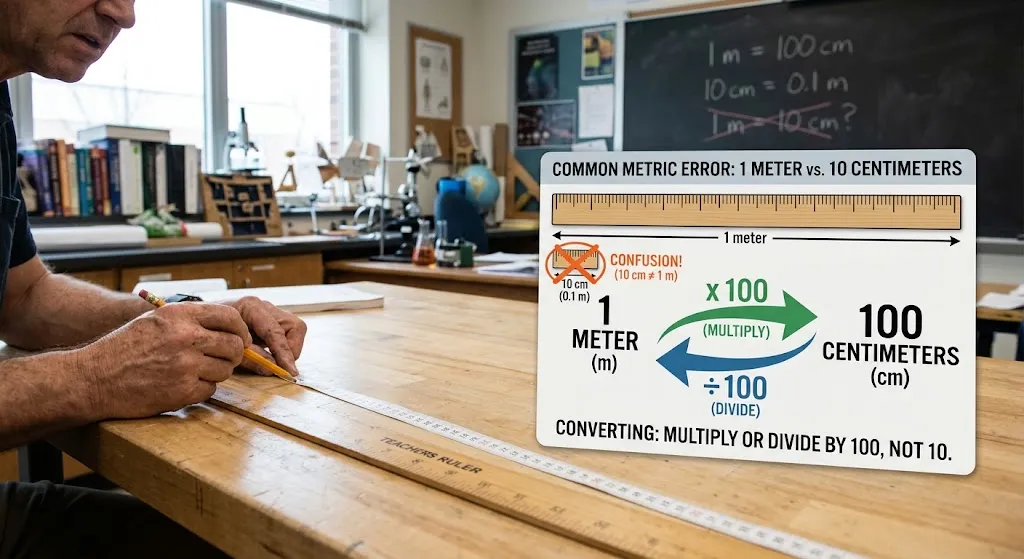
Confusing meters with centimeters: One meter equals 100 centimeters, not 10. Moving between these units requires multiplying or dividing by 100.
Using the wrong symbol: The correct symbol is lowercase m. It should not be confused with other measurement symbols.
Mixing metric and imperial units: Measurements in meters, feet, and yards should be converted carefully before calculations are performed.
Rounding too early: In construction, engineering, and scientific calculations, rounding conversion results too soon can create small errors that accumulate over multiple calculations.
Assuming estimates are exact: Everyday examples help visualize a meter, but actual object dimensions should be measured when accuracy is important.
Understanding these distinctions helps ensure that measurements remain consistent and reliable.
Frequently Asked Questions
Yes. Meter is the spelling commonly used in American English, while metre is used in British English and many other varieties of English. Both refer to the same unit of length.
There are exactly 100 centimeters in one meter.
One meter is approximately 3.28084 feet, or about 3 feet and 3.37 inches.
Yes. One meter is approximately 1.09361 yards, making it slightly longer than one yard.
The speed of light in a vacuum is a constant that provides a precise and reproducible foundation for defining length. Using it allows scientists to realize the meter consistently and accurately.
A meter measures length, while a square meter (m²) measures area. A square with sides measuring one meter each has an area of one square meter.
Conclusion
A meter is the internationally standardized SI unit of length, represented by the symbol m. It equals 100 centimeters, 1,000 millimeters, and approximately 3.28 feet. Its modern definition is based on the distance light travels in a vacuum during a precisely specified fraction of a second.
From measuring household objects to designing buildings and conducting scientific research, the meter provides a reliable and universal way to describe length. Understanding its definition, symbol, and conversions makes everyday measurements easier and supports accurate work across many different fields.




One thought on “Meter Conversions: How It Compares With Other Units”