Nintendo is one of the most recognizable names in the video game industry, known for iconic characters such as Mario, Donkey Kong, and Link. Its consoles and games have entertained generations of players around the world. However, the company’s history began long before home gaming systems, colorful screens, or digital entertainment existed. Nintendo started as a small Japanese business making traditional playing cards in the nineteenth century and gradually transformed itself into a global entertainment powerhouse.
The journey from handmade cards to some of the world’s most successful video games is a story of experimentation, business risks, technological change, and the ability to recognize new opportunities.

Nintendo’s Beginnings as a Playing Card Company
Nintendo was founded on September 23, 1889, by Fusajiro Yamauchi in Kyoto, Japan. At the time, the company produced handmade hanafuda cards, a traditional Japanese playing card design featuring flowers, plants, and seasonal imagery.
Unlike many Western playing cards, hanafuda cards do not rely on numbered suits in the same way. Players use their images and combinations to participate in different traditional games. These cards had a long history in Japan and remained popular despite periods when card games faced government restrictions.
Yamauchi’s business focused on producing attractive, durable cards that appealed to customers. The cards were initially manufactured by hand, requiring considerable skill and attention to detail.
The company gradually established a reputation for quality. As demand increased, Nintendo expanded its operations and eventually began producing other types of playing cards.
At this stage, Nintendo was not involved in electronics or video games. Its business depended on a relatively traditional product, but the experience it gained in manufacturing, branding, distribution, and entertainment would later prove valuable.
Expanding Beyond Traditional Playing Cards
During the first half of the twentieth century, Nintendo continued to develop its playing card business. However, the company eventually faced the challenge of finding new ways to grow.
In 1949, Hiroshi Yamauchi became president of Nintendo. He would lead the company for decades and play a central role in its transformation from a card manufacturer into a major entertainment business.
Under his leadership, Nintendo pursued new commercial opportunities. In 1953, the company became one of the first in Japan to manufacture playing cards using plastic-coated materials on a large scale, helping make its products more durable.
Nintendo also entered a partnership with the Walt Disney Company in 1959 to produce playing cards featuring Disney characters. This move helped introduce its products to families and children, expanding the company’s audience beyond traditional card players.
The partnership demonstrated an important principle: familiar characters and appealing entertainment experiences could help a traditional product reach new customers.
Yet playing cards alone could not provide unlimited growth. Nintendo needed to explore other industries if it wanted to become a larger business.
The Search for New Business Opportunities
During the 1960s, Nintendo experimented with several businesses outside its original card-making operations.
These ventures included toys, instant rice, a taxi company, and other products and services. Many of these experiments failed to achieve lasting success.
Although these attempts were financially challenging, they revealed an important lesson. Nintendo could not depend on its historic reputation alone; it needed products that customers would continue to find exciting and useful.
The company’s experiments eventually brought it closer to the toy industry, where its manufacturing capabilities and understanding of entertainment could be applied in new ways.
One of its most successful early inventions was the Ultra Hand, a mechanical extending arm created by engineer Gunpei Yokoi. Introduced in 1966, the toy allowed children to grab objects from a distance using a simple mechanism.
The Ultra Hand became a commercial success and helped establish Nintendo as a serious toy manufacturer.
Gunpei Yokoi later became one of the company’s most influential innovators. His work demonstrated that an entertaining product did not necessarily need complicated technology. Clever design, affordability, and a satisfying user experience could be just as important.
This philosophy would influence Nintendo’s approach to electronic toys and video games for years to come.
Nintendo Enters the Electronic Gaming Market
By the 1970s, electronic entertainment was beginning to attract growing interest. Nintendo started experimenting with electronic toys and gaming devices, moving closer to the industry that would eventually define its future.
In 1977, Nintendo released the Color TV-Game series in Japan. These home gaming systems offered simple electronic games that players could enjoy on their television sets.

The devices were relatively basic compared with modern consoles, but they represented an important step toward Nintendo’s future in video games.
In 1980, the company introduced Game & Watch, a series of portable electronic games designed by Gunpei Yokoi. Each device typically featured a built-in game and an LCD screen, allowing players to enjoy simple entertainment almost anywhere.
Game & Watch also helped popularize Nintendo’s recognizable cross-shaped directional control pad, which later became influential in the development of video game controllers.
The success of these products showed Nintendo that electronic gaming could become a major business rather than simply another experiment.
Donkey Kong Makes Nintendo a Video Game Powerhouse
Nintendo achieved a major breakthrough in 1981 with the release of Donkey Kong, an arcade game designed by Shigeru Miyamoto.
The game followed a character attempting to rescue a woman from a giant ape while navigating platforms and avoiding obstacles. Its combination of action, humor, and recognizable characters helped distinguish it from many arcade games of the period.
The game’s hero was originally known as Jumpman. He would later become Mario, one of the most famous characters in entertainment history.
Donkey Kong was an important success for several reasons. It introduced players to characters they could recognize, offered a clear objective, and built its gameplay around timing and movement rather than simply shooting targets.
It also demonstrated Miyamoto’s ability to create engaging experiences through character design and imaginative game mechanics.
For Nintendo, Donkey Kong was more than a successful arcade title. It proved that the company could develop original video game properties with international appeal.
The Nintendo Entertainment System Changes Home Gaming
Nintendo’s next major achievement came with the Famicom, short for Family Computer, released in Japan in 1983.
The system offered a way to play multiple games on a home television using interchangeable cartridges. This gave players access to different experiences without purchasing a separate machine for every game.
In 1985, Nintendo launched the Nintendo Entertainment System, or NES, in North America. The system helped revive the American home video game market after the severe industry downturn of 1983.
The NES became particularly successful because of its library of memorable games, including Super Mario Bros., The Legend of Zelda, and Metroid.
Super Mario Bros., released in 1985, became a landmark in side-scrolling platform games. Players guided Mario through colorful environments, jumping across obstacles, defeating enemies, and discovering hidden areas.
Nintendo also introduced a more controlled approach to game publishing, helping establish standards for quality and compatibility on its system.
The NES transformed Nintendo from a company with successful arcade and electronic products into one of the leading names in home video gaming.
From the Game Boy to the Nintendo 64
Nintendo continued to expand its audience throughout the late 1980s and 1990s.
In 1989, the company released the Game Boy, a portable gaming system that allowed players to take their games with them. Although its screen was monochrome, the device offered long battery life, a compact design, and a growing collection of games.
Its popularity increased dramatically with Tetris, a puzzle game that appealed to people who might not otherwise have considered themselves video game enthusiasts.

The Game Boy also became home to the enormously successful Pokémon franchise, which combined collecting creatures, strategic battles, and trading between players.
In 1996, Nintendo launched the Nintendo 64 in Japan, followed by other markets. The console helped bring 3D gaming to a wider audience with games such as Super Mario 64 and The Legend of Zelda: Ocarina of Time.
Super Mario 64 introduced a new approach to platform gaming, allowing players to move freely through three-dimensional environments. Its control system and level design influenced many later games.
These releases showed that Nintendo could adapt its familiar characters and gameplay ideas to new technologies without abandoning the qualities that made its games appealing.
Innovation Through the Wii and Nintendo Switch
In the twenty-first century, Nintendo continued to distinguish itself by experimenting with different ways to play.
The Nintendo DS, released in 2004, featured two screens, including a touch-sensitive display. Its design encouraged developers to create new types of games, while titles such as Brain Age attracted audiences beyond traditional gamers.
In 2006, Nintendo released the Wii, a home console that used motion-sensitive controllers. Players could swing, point, and move the controllers to interact with games, making the system accessible to families and people who had little experience with conventional video games.
The Wii became a major commercial success and helped broaden the public perception of gaming.
Nintendo later faced challenges with the Wii U, released in 2012, which struggled to achieve the same level of commercial success. However, the company continued developing a new approach.
In 2017, Nintendo introduced the Nintendo Switch, a hybrid system that could function as both a home console and a portable gaming device. Players could connect it to a television or use it as a handheld system.
The Switch combined two previously separate ways of playing and supported successful games such as The Legend of Zelda: Breath of the Wild, Animal Crossing: New Horizons, and Mario Kart 8 Deluxe.
Nintendo subsequently released the Nintendo Switch 2 in 2025, continuing its development of hybrid gaming hardware.
Why Nintendo’s Transformation Was So Successful
Nintendo’s journey from playing cards to video games was not simply a matter of adopting new technology. Several business principles helped the company survive and grow through changing markets.
1. A willingness to experiment
Nintendo tried numerous products and industries before finding its long-term direction in electronic entertainment. Not every experiment succeeded, but the company continued searching for new opportunities.
2. A focus on enjoyable experiences
From hanafuda cards to modern video games, Nintendo has built its business around entertainment. Its most successful products tend to emphasize accessible rules, imaginative design, and experiences that people can enjoy repeatedly.
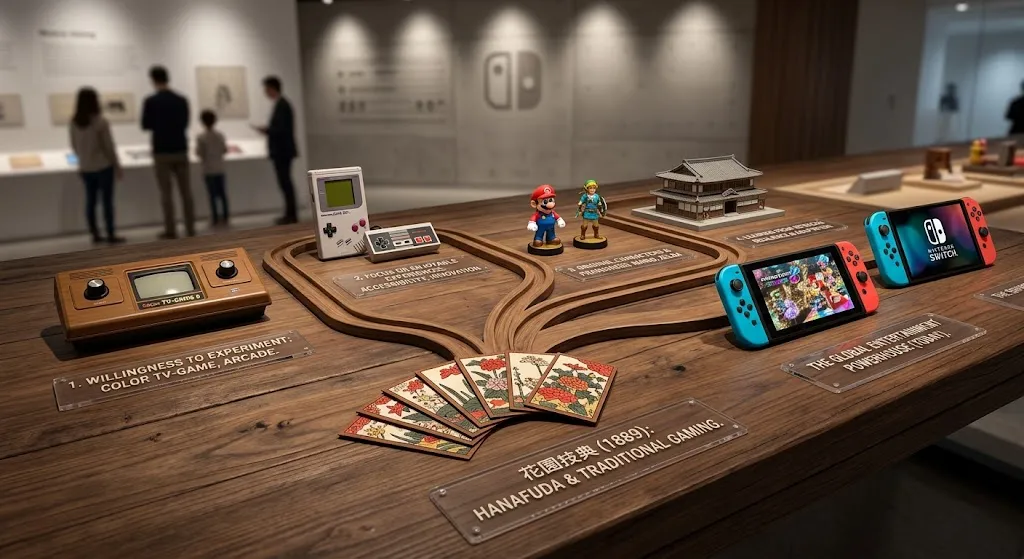
3. Investment in original characters and franchises
Mario, Zelda, Donkey Kong, and Pokémon have helped Nintendo build lasting relationships with audiences. These properties give its games a recognizable identity and encourage players to return to new releases.
4. Hardware designed around new ideas
Nintendo has often differentiated itself through distinctive hardware rather than relying exclusively on processing power. The Game Boy, Wii, and Switch each offered a different way to experience games.
5. Learning from setbacks
The company’s history includes unsuccessful business ventures and underperforming products. Its ability to adjust its strategy and continue developing new ideas has been essential to its long-term survival.
Conclusion
Nintendo’s evolution from a small playing card manufacturer in Kyoto to a global video game company is one of the most remarkable transformations in modern business history.
Founded in 1889, the company spent decades producing traditional cards before exploring toys, electronic devices, arcade games, home consoles, and portable gaming systems. Its eventual success came from combining a willingness to experiment with a lasting commitment to entertainment and creative design.
Today, Nintendo’s history demonstrates that a company’s original product does not have to define its future. By recognizing changing customer interests and adapting its strengths to new markets, a business can reinvent itself while preserving the values that made it successful in the first place.
From handmade hanafuda cards to the Nintendo Switch 2, Nintendo’s story illustrates how imagination, persistence, and a willingness to change can turn a modest family business into an internationally recognized entertainment brand.
For more interesting articles about history, technology, business, and the stories behind everyday innovations, visit serdpestcp.org.
Frequently Asked Questions
Nintendo was founded on September 23, 1889, in Kyoto, Japan, by Fusajiro Yamauchi.
Nintendo originally manufactured traditional Japanese hanafuda playing cards, featuring flowers and seasonal imagery.
Nintendo began exploring electronic gaming in the 1970s, releasing its Color TV-Game systems in Japan in 1977.
Donkey Kong, released in 1981, was a major breakthrough that introduced the character who would later become known as Mario.
The Family Computer (Famicom) launched in Japan in 1983 and was released as the Nintendo Entertainment System (NES) in North America in 1985.
Nintendo combined creative game design, memorable characters, innovative hardware, and a willingness to explore new entertainment markets.