The Roman Empire was famous for its roads, aqueducts, bridges, and monumental buildings, but some of its most remarkable engineering achievements were hidden beneath the sea. Roman engineers developed a special type of concrete that could harden underwater, allowing them to construct massive harbor structures that survived waves, currents, and centuries of exposure to seawater.
Two important examples of this technology were Portus, the imperial harbor near Rome, and Caesarea Maritima, the Mediterranean port built under King Herod the Great. Although these harbors served different purposes, both demonstrate how Roman engineering transformed coastal landscapes and strengthened trade across the ancient world.
The Challenge of Building Harbors in the Ancient World
For ancient civilizations, a reliable harbor was essential for transporting grain, wine, olive oil, building materials, and other goods. However, constructing a harbor in open water presented serious engineering challenges.
Waves constantly struck the coast, currents moved sediment, and saltwater damaged many conventional building materials. Wooden structures could deteriorate, while ordinary lime-based mortar was not suitable for every underwater application.
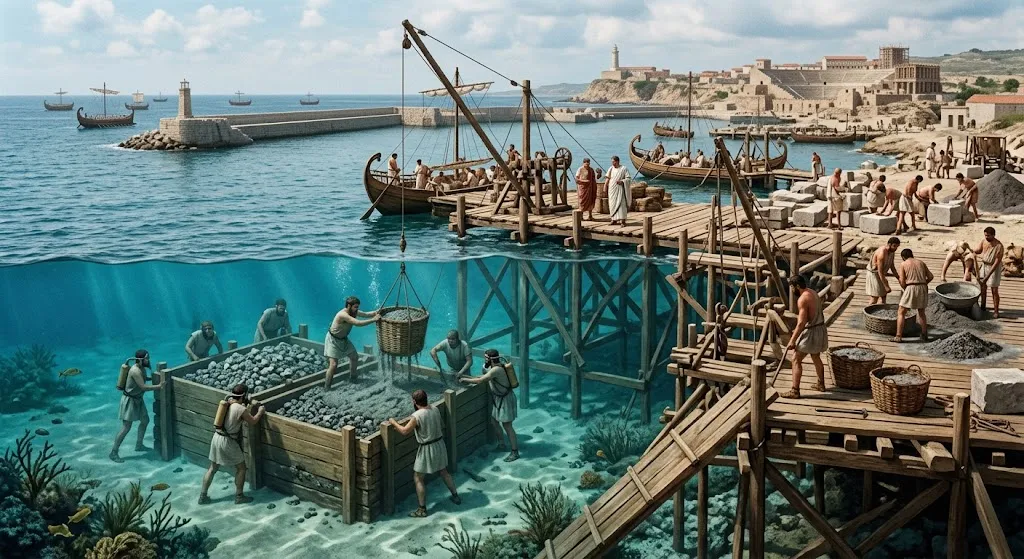
Roman engineers needed a material that could remain stable in seawater and bind large quantities of stone into durable foundations.
Their solution was Roman hydraulic concrete, a mixture that could set and harden in the presence of water. This innovation allowed builders to construct underwater foundations, breakwaters, piers, and artificial harbor basins on a scale that had rarely been attempted before.
What Made Roman Underwater Concrete Different?
Roman concrete was generally made from a combination of lime, volcanic materials, water, and aggregate such as stone or crushed brick. For marine construction, engineers particularly valued volcanic ash, often called pozzolana, which reacted chemically with lime and water.
This reaction formed cementitious compounds capable of binding the aggregate together, even when the mixture was placed underwater.
Unlike ordinary mortar, which can lose strength or wash away if exposed to water before setting, a properly formulated hydraulic mixture could harden in wet conditions.
The science behind the mixture
The key ingredient was reactive volcanic material containing silica and alumina. When combined with lime and water, these substances formed compounds that gave the concrete its binding properties.
Roman builders could obtain suitable volcanic materials from areas around the Bay of Naples and other volcanic regions. The availability of these resources helped make large marine construction projects possible.
The exact recipes varied according to local materials and engineering requirements. Not every Roman concrete structure contained the same ingredients, and the performance of a particular mixture depended on its composition and how it was placed.
Modern scientific research has also shown that certain Roman marine concretes developed mineral structures that contributed to their long-term durability. In some cases, interactions between seawater and volcanic components produced new minerals over time.
This does not mean that every Roman structure became stronger indefinitely. Rather, particular mixtures and environmental conditions helped some marine structures survive exceptionally well.
How Roman Engineers Built Structures Underwater
Building a harbor required more than simply pouring concrete into the sea. Roman engineers had to control the placement of heavy materials, establish stable foundations, and protect their work from waves and moving water.
The construction methods varied with the depth of the water, the condition of the seabed, and the design of the harbor.
1. Preparing the seabed
Before construction began, workers needed a suitable foundation. They could clear loose material, level sections of the seabed, and establish a stable base for the structure.
In shallow water, some tasks could be performed by workers operating from boats or temporary platforms. Deeper or more exposed locations required more elaborate arrangements.
2. Using timber forms and enclosures
In suitable locations, builders constructed wooden frameworks or cofferdam-like enclosures to control the working area. These structures helped contain construction materials and could reduce the influence of surrounding water during parts of the building process.
Timber piles were also useful for establishing boundaries and supporting temporary works. Their precise arrangement depended on the site and the intended structure.
It is important to distinguish between different construction techniques: Roman engineers did not use one universal method for every underwater harbor. Some structures relied on timber enclosures, while others were built through the placement of stone, concrete, or large prefabricated elements.
3. Mixing and placing hydraulic concrete
Once the foundation or enclosure was ready, workers could place the concrete mixture together with stone aggregate.
At marine construction sites, the concrete sometimes had to be placed directly into water or into a partly controlled enclosure. The hydraulic properties of the mixture allowed it to harden without requiring the entire structure to remain dry.
Large quantities of stone could be incorporated into the construction, reducing the amount of fine concrete needed while creating a massive, stable body.
4. Building breakwaters and piers
Harbor breakwaters were designed to reduce the force of incoming waves and create calmer water for ships. These structures could incorporate concrete foundations, large stone blocks, rubble, and other materials.
Piers and quays provided areas where vessels could approach, unload cargo, and transfer goods to shore.
The scale of the work was impressive. Roman engineers combined an understanding of local geography with practical construction experience to create sheltered maritime facilities that supported commercial and military activity.
Portus: The Imperial Harbor of Rome

Portus was one of the most important harbor complexes of the Roman Empire. Located near the mouth of the Tiber River, close to modern Fiumicino, it was developed to improve Rome’s access to maritime trade.
Rome’s population depended heavily on supplies transported by sea, especially grain from provinces such as Egypt and North Africa. The older harbor at Ostia was important, but its limitations and exposure to changing coastal conditions created a need for additional infrastructure.
Emperor Claudius began constructing a major artificial harbor in the middle of the first century AD. The project included an expansive basin protected by substantial breakwaters. Emperor Trajan later developed a more regular, hexagonal inner harbor, generally dated to the early second century AD.
How Portus was constructed
The harbor’s outer works used enormous quantities of stone and other building materials to create protection against the sea. Ancient descriptions and archaeological evidence indicate that concrete and masonry played important roles in the construction of its maritime infrastructure.
The construction of large breakwaters required carefully organized labor, transport systems, and an enormous supply of raw materials. Barges and other vessels were essential for moving heavy loads to the building site.
The hexagonal basin associated with Trajan provided a more organized area for harbor operations. Its geometric shape helped distribute access around the basin, while channels connected the harbor system with the surrounding waterways.
Portus was not simply a place where ships could anchor. It formed part of a larger transport network linking the Mediterranean, the Tiber, warehouses, roads, and the city of Rome.
Why Portus mattered
Portus improved the movement and handling of imported goods. Grain, oil, wine, and other products could be unloaded and transferred toward Rome through an increasingly sophisticated distribution system.
The harbor also illustrates how engineering could respond to practical economic problems. Rather than relying entirely on naturally sheltered coastal locations, Roman authorities invested in infrastructure designed to accommodate the demands of an imperial capital.
Today, archaeological remains of the harbor basins, channels, warehouses, and related structures provide valuable evidence of Roman maritime engineering.
Caesarea Maritima: Herod’s Artificial Harbor
<PRIVATE_PERSON>aesarea Maritima, on the Mediterranean coast of present-day Israel, was another extraordinary example of ancient harbor construction. King Herod the Great developed the city during the late first century BC, establishing it as a major administrative, commercial, and political center.
The city was named in honor of Augustus Caesar. Its harbor, commonly known as Sebastos, was particularly remarkable because it was constructed along a coastline that did not offer the same natural protection as a sheltered bay.
The harbor helped connect Herod’s kingdom with Mediterranean trade routes and demonstrated the ruler’s ambition to create a monumental coastal city.
The massive breakwaters of Caesarea
The harbor’s construction involved the creation of large breakwaters that extended into the sea. These structures incorporated stone, timber, and hydraulic concrete, although the precise construction methods varied across different sections and phases.
Ancient literary accounts, particularly the description by the historian Flavius Josephus, emphasize the impressive scale of the project. Archaeological investigations have revealed substantial submerged remains, allowing researchers to study the harbor’s foundations and construction materials.
The use of hydraulic concrete was especially important because it enabled builders to create massive structural elements in a marine environment. Volcanic material suitable for producing the concrete had to be transported to the site, illustrating the logistical complexity of the undertaking.
How the harbor changed the city
The harbor transformed Caesarea into a major Mediterranean port. Ships could bring merchandise, supplies, and travelers to a city equipped with public buildings, administrative facilities, and commercial infrastructure.
The port also had political significance. By developing an impressive artificial harbor, Herod strengthened connections with the wider Roman world and demonstrated his ability to undertake ambitious building projects.
Caesarea therefore represented more than a technical achievement. It was an expression of economic strategy, royal prestige, and the integration of the eastern Mediterranean into Roman networks.
Portus and Caesarea: Two Different Engineering Solutions
Although both harbors used Roman marine construction techniques, they were built for different geographic and political purposes.
Portus primarily addressed Rome’s enormous demand for imported goods and its need for an efficient maritime supply system. Caesarea, by contrast, helped establish a major coastal city and expand commercial and political connections in the eastern Mediterranean.
Their construction also reflected different local conditions. Portus developed through successive imperial projects, while Caesarea’s harbor was closely associated with Herod’s ambitious urban development.
Both projects required the coordination of skilled labor, specialized materials, shipping, and large-scale construction operations.
They also reveal an important characteristic of Roman engineering: successful projects often combined several techniques rather than relying on one material or method alone. Concrete worked alongside stone, timber, masonry, and carefully planned foundations.
Why Some Roman Concrete Has Survived for Centuries
The durability of Roman marine concrete has attracted considerable scientific attention. Some ancient structures have remained remarkably well preserved despite prolonged exposure to seawater.
Researchers have identified several factors that help explain this longevity.
First, the use of suitable volcanic materials produced hydraulic reactions that allowed concrete to harden underwater.
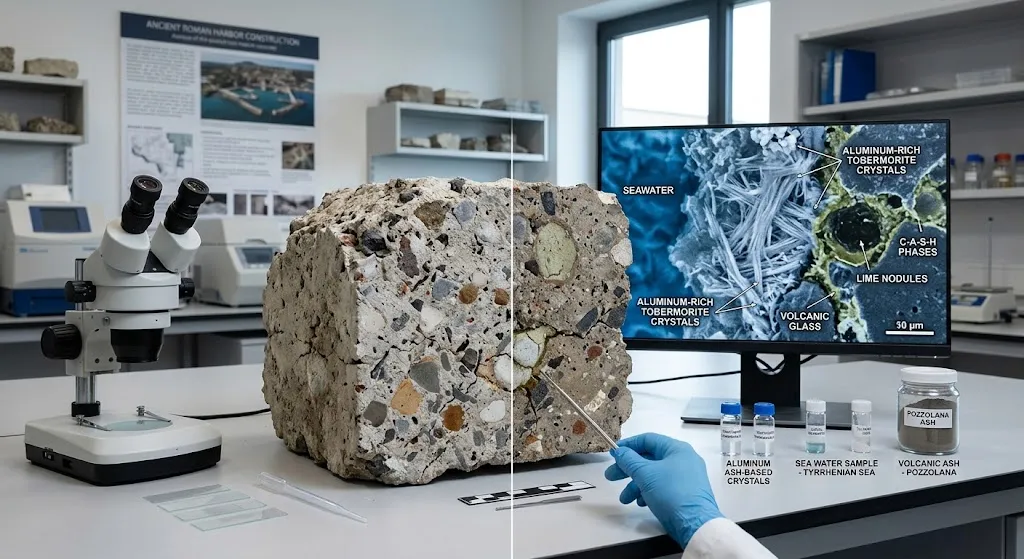
Second, the mineral composition of some mixtures enabled continuing chemical interactions with seawater. In certain marine concretes, minerals such as aluminum-rich tobermorite and other calcium-aluminum-silicate phases have been identified. Their presence can help researchers understand how the material evolved after construction.
Third, the performance of the concrete depended on its environment. The temperature, water chemistry, composition of the aggregate, and movement of seawater all influenced how the material aged.
Modern research has investigated these mechanisms to better understand ancient construction and explore potential improvements in contemporary cement technology.
However, Roman concrete was not universally superior to modern concrete. Modern materials can achieve highly controlled strengths and performance characteristics, while ancient structures also benefited from their massive dimensions, protective geometry, and the particular conditions at their sites.
The important lesson is that Roman builders developed materials and methods suited to the challenges they faced.
What Archaeology Reveals About Ancient Harbor Construction
Underwater archaeology has made it possible to study Roman harbors in ways that were not available to earlier generations of researchers.
At Portus, excavations and surveys have helped reconstruct the harbor’s changing layout, its basins, and its connections with Rome’s transport infrastructure.
At Caesarea, submerged archaeological remains have revealed portions of the artificial harbor and its massive marine structures. Researchers have examined concrete samples, stone blocks, and surviving construction features to understand how the harbor was built.
These investigations also help clarify the limitations of ancient engineering. Harbors could be damaged by storms, changing coastlines, sediment accumulation, and structural deterioration. A project that was impressive at the time of construction could still require maintenance and eventually decline.
The remains of Portus and Caesarea therefore offer evidence of both Roman engineering success and the continuing challenges of managing coastal infrastructure.
The Legacy of Roman Hydraulic Concrete
Roman underwater concrete was an important step in the development of large-scale marine engineering. By combining lime, reactive volcanic materials, aggregate, and practical construction knowledge, Roman builders created structures that could be established in demanding aquatic environments.
Portus demonstrates how harbor engineering supported the supply needs of a vast imperial capital. Caesarea Maritima shows how similar technology could help transform an exposed coastline into a major commercial and political center.
Their surviving remains reveal that Roman engineering was not based solely on monumental architecture above ground. Some of its most consequential achievements were foundations, breakwaters, and harbor structures built partly or entirely beneath the waterline.
Modern engineers continue to study these ancient materials because they provide valuable insights into hydraulic cement, mineral reactions, durability, and the relationship between construction materials and their environment.
The story of Portus and Caesarea ultimately shows how a practical engineering innovation helped reshape trade, urban development, and maritime connectivity across the ancient Mediterranean.
Frequently Asked Questions
Roman marine concrete used lime and reactive volcanic materials, such as pozzolana, to form binding compounds in the presence of water. This hydraulic reaction allowed the material to set underwater.
One important source was pozzolana, a volcanic ash found in regions of Italy, especially around the Bay of Naples. Its reactive silica and alumina helped lime-based mixtures develop hydraulic properties.
Portus was situated near the mouth of the Tiber River, close to modern Fiumicino, west of Rome. It served as a major harbor complex supplying the imperial capital.
King Herod the Great developed Caesarea Maritima and its harbor, Sebastos, during the late first century BC. The project connected the city with Mediterranean maritime trade.
Not in every respect. Some Roman marine concretes have survived exceptionally well because of their composition and environmental conditions, but modern concrete offers carefully controlled properties and can outperform ancient materials in many applications.
They provide evidence of early hydraulic engineering, large-scale maritime construction, and ancient trade networks. Scientific studies of surviving concrete may also contribute to research into durable construction materials.
Conclusion
The underwater harbors of Portus and Caesarea Maritima demonstrate the remarkable capabilities of Roman engineering. Through hydraulic concrete, carefully designed foundations, and massive breakwaters, ancient builders created maritime infrastructure that supported commerce and helped shape the development of important Mediterranean cities.
Their achievements remain valuable subjects of archaeological and scientific research, revealing how knowledge of materials and construction could overcome some of the most difficult challenges of the ancient world.