
Roman concrete is one of the most remarkable construction materials in history. More than 2,000 years after Roman engineers began using it, parts of their buildings, harbors, bridges, and monuments remain standing. Some ancient structures have survived earthquakes, seawater, changing temperatures, and centuries of exposure to the elements.
One of the best-known examples is the Pantheon in Rome, whose enormous concrete dome has endured for nearly two millennia. Ancient Roman harbors also contain concrete structures that have survived in seawater far longer than many modern concrete installations.
What made Roman concrete so durable? Scientists have spent decades investigating its composition and the techniques used to produce it. Their research suggests that the secret lies in a combination of volcanic materials, lime, carefully chosen aggregates, and chemical reactions that can help the material repair some of its own damage.
What Was Roman Concrete Made Of?
Roman concrete, often called opus caementicium, was a building material made by combining a binding mixture with stones, rubble, or other aggregates. Although its basic purpose was similar to that of modern concrete, its ingredients and production methods differed in important ways.
Roman builders commonly used several key materials.
1. Lime
Lime was an essential ingredient in Roman construction. It was produced by heating limestone to create quicklime, which reacts with water and can participate in the chemical processes that make concrete harden.
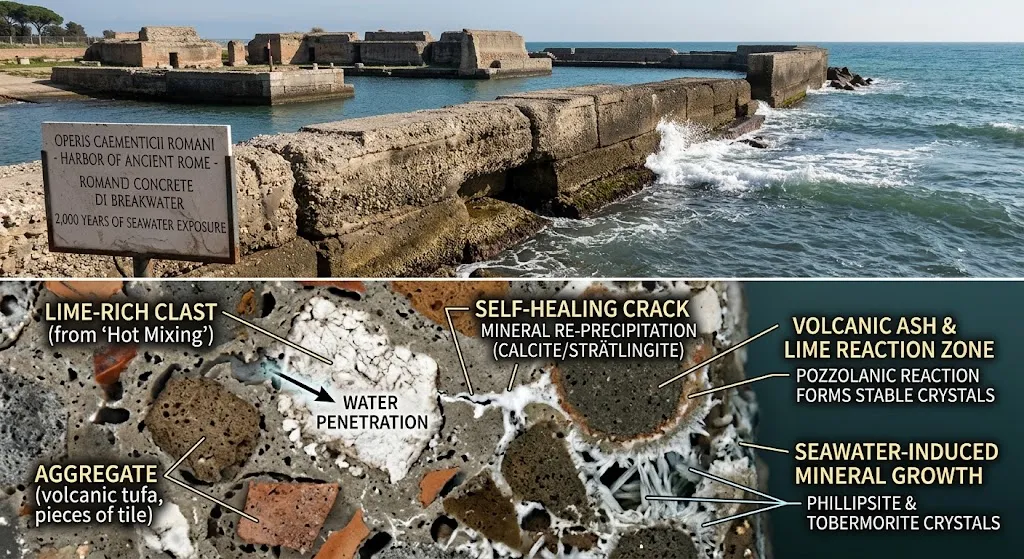
The exact method of preparing and mixing lime varied across different periods and construction projects. Archaeological evidence indicates that some Roman concrete contained distinctive lime-rich fragments, which modern researchers have investigated to understand how the material was produced.
2. Volcanic Ash
One of the most important ingredients was volcanic ash, particularly material obtained from the region around Pozzuoli, near Naples in modern-day Italy.
This ash contained silica and alumina that could react with lime in the presence of water. These reactions produced cementing compounds that helped bind the concrete together.
This type of reaction is known as a pozzolanic reaction, named after Pozzuoli, where the Romans obtained volcanic materials for construction.
Unlike a binder that relies only on conventional lime hardening, a suitable volcanic ash can contribute to the formation of additional compounds that strengthen and stabilize the material.
3. Water
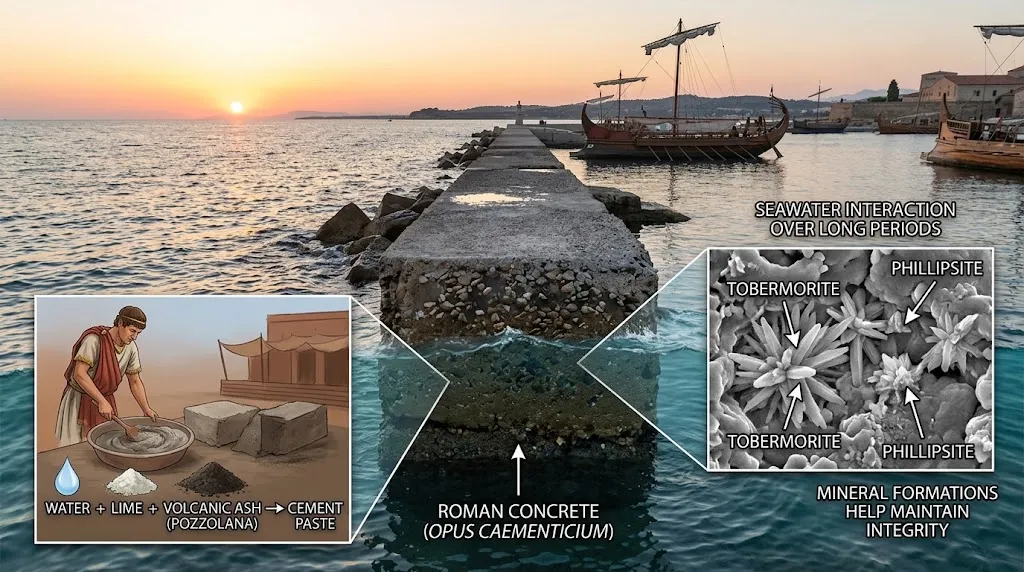
Water was necessary for mixing the ingredients and enabling the chemical reactions that hardened the concrete. In marine environments, seawater could also interact with the volcanic materials and minerals in the concrete over long periods.
These interactions are particularly important because some Roman harbor structures developed mineral formations that helped maintain their integrity.
4. Stone and Other Aggregates
Roman builders mixed their binding materials with pieces of stone, brick, and other aggregates. The choice of aggregate depended on the structure, available resources, and local building traditions.
The Pantheon, for example, contains aggregates of different types and sizes. Its dome becomes progressively lighter toward the top, where lighter materials helped reduce the load carried by the supporting structure.
The durability of Roman concrete therefore did not come from a single ingredient. It resulted from a carefully developed building material combined with construction techniques adapted to each project.
The Secret of Hot Mixing
One of the most important modern discoveries about Roman concrete concerns the way its ingredients may have been mixed.
For many years, researchers assumed that Roman builders generally mixed slaked lime with volcanic ash and other ingredients. However, the discovery of distinctive white lime-rich fragments in ancient concrete led scientists to investigate another possibility: some Roman builders may have mixed quicklime directly with other dry ingredients before adding water.
This technique is often called hot mixing because the quicklime reacts with water and releases heat.
In 2023, researchers published a study examining Roman concrete samples and experimentally recreated a hot-mixing process. Their findings suggested that this technique could explain the presence of the lime-rich fragments found in some ancient structures.
The process may have offered several advantages.
First, the heat generated during mixing could have influenced the formation of cementing compounds. Second, the resulting material could contain lime-rich regions that behave differently from the surrounding concrete when cracks develop.
However, scientists have not established that every Roman structure was made using the same technique. Roman construction methods varied over time and across regions, and some concrete formulations did not necessarily rely on hot mixing.
The discovery nevertheless provides an important clue about how certain Roman buildings achieved their remarkable durability.
How Roman Concrete Can Repair Its Own Cracks
Perhaps the most fascinating explanation for the longevity of some Roman concrete is its potential for self-healing.
Modern concrete can develop small cracks because of temperature changes, structural loads, chemical reactions, or the gradual movement of moisture. If water enters these cracks, it can carry dissolved substances into the material and contribute to further deterioration.
Some Roman concrete appears to respond differently.
When cracks form near lime-rich fragments, water can enter the damaged areas and interact with calcium-containing materials. This process may release calcium that combines with dissolved carbon dioxide or other substances, producing mineral deposits that partially fill the cracks.
Calcium carbonate is one possible product of this process. Other mineral reactions can also contribute to crack filling, depending on the concrete’s composition and environment.
As these deposits accumulate, they can reduce the size of small cracks and limit the movement of water through the material.
This process is not equivalent to a living organism repairing itself. The concrete does not actively detect damage or deliberately send material to a damaged area. Instead, its mineral composition enables chemical reactions that can gradually seal some cracks under suitable conditions.
Scientists have demonstrated this behavior in laboratory experiments using Roman-inspired concrete mixtures. Nevertheless, not every ancient concrete sample contains the same features, and self-healing cannot explain the survival of every Roman structure on its own.
Why Roman Concrete Performs Well in Seawater
Seawater is especially damaging to many modern concrete structures. Salts can penetrate concrete, promote corrosion in steel reinforcement, and contribute to deterioration through repeated wetting, drying, and other chemical processes.
Yet some Roman marine structures have survived for centuries in coastal environments.
Researchers studying ancient harbor concrete have found that seawater interacted with volcanic ash and lime-based materials to produce new minerals over time.
One important example involves aluminum-rich minerals, including forms of phillipsite, as well as other mineral phases that developed within the concrete. In certain Roman marine structures, these reactions helped create a complex internal structure that remained durable despite prolonged exposure to seawater.
A 2017 study published in American Mineralogist investigated Roman marine concrete and described how seawater interaction contributed to mineral growth within the material.
These findings challenged the assumption that water exposure always makes concrete weaker. Under particular conditions, water can participate in chemical reactions that strengthen or stabilize certain materials.
However, the effect depends on the ingredients, temperature, water chemistry, and structure of the concrete. Seawater does not automatically improve concrete, and modern concrete formulations cannot be assumed to benefit from the same reactions.
Why the Pantheon’s Concrete Dome Has Survived
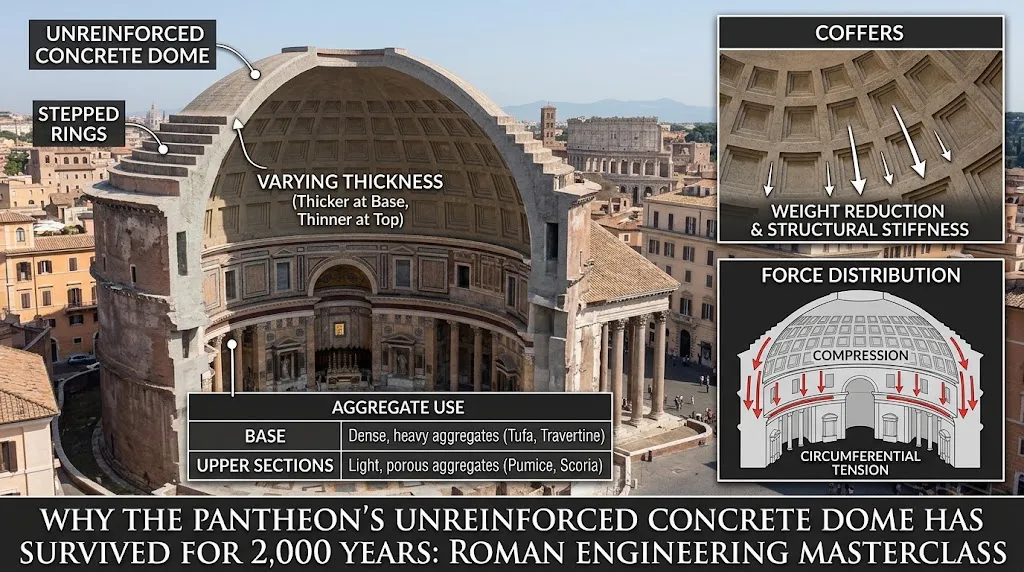
The Pantheon in Rome is among the most impressive examples of Roman engineering. Its great dome, completed in its present form under Emperor Hadrian in the second century AD, remains one of the largest unreinforced concrete domes in the world.
Its survival is not simply a result of unusually durable concrete. The Romans also designed the structure to manage weight and distribute forces effectively.
The dome is thickest near its base, where structural demands are greatest, and becomes thinner toward the top. Roman builders also used lighter aggregates in the upper sections, reducing the amount of weight that the lower portions had to support.
The coffers, which are the recessed square panels visible on the dome’s interior, further reduce the amount of material used while contributing to its distinctive appearance.
The dome’s circular design and supporting walls help distribute structural loads. Its survival reflects the combination of material properties, geometric design, workmanship, and maintenance over time.
The Pantheon therefore demonstrates an important principle of engineering: a durable material is most effective when it is used within a well-designed structure.
Roman Concrete Compared With Modern Concrete
Modern concrete is not necessarily inferior to Roman concrete. It is engineered for different purposes, construction schedules, environmental conditions, and performance requirements.
Portland cement, which is widely used today, typically allows concrete to gain strength relatively quickly and provides predictable performance when properly designed and manufactured. Modern reinforced concrete also makes it possible to build tall buildings, long-span bridges, tunnels, and other structures that would have been difficult or impossible for Roman engineers to construct.
However, modern concrete structures can deteriorate when exposed to unsuitable environmental conditions, inadequate construction practices, insufficient curing, or poor maintenance. Steel reinforcement can also corrode if protective conditions inside the concrete are compromised.
Roman concrete had different strengths and limitations.
Its volcanic materials could produce highly durable binders, while some formulations developed beneficial mineral reactions over long periods. On the other hand, ancient concrete was not designed to meet modern structural codes or the demands of every contemporary application.
The comparison is therefore not a simple contest between ancient and modern technology. Each material reflects the knowledge, resources, and priorities of the civilization that developed it.
| Feature | Roman concrete | Modern concrete |
|---|---|---|
| Main binding materials | Lime and, in many formulations, volcanic ash | Usually Portland cement, sometimes blended with supplementary cementitious materials |
| Strength development | Depends on formulation; some reactions continue over long periods | Often engineered for predictable strength at specified ages |
| Marine performance | Certain formulations develop durable mineral structures in seawater | Depends on mix design, exposure conditions, reinforcement, and protective measures |
| Crack repair | Some lime-rich mixtures can seal certain cracks through mineral reactions | Specialized self-healing mixtures are being developed and used in research and selected applications |
| Common applications | Ancient monuments, harbor structures, walls, foundations, and vaults | Buildings, bridges, roads, dams, tunnels, and many other structures |
What Modern Engineers Can Learn From Roman Concrete
Roman concrete has attracted renewed scientific interest because its longevity may offer lessons for designing more durable construction materials.
One promising direction is the use of supplementary cementitious materials, including certain volcanic materials, to reduce reliance on conventional cement while maintaining suitable performance.
Producing Portland cement requires high-temperature processing and contributes significantly to global carbon dioxide emissions. Replacing a portion of conventional cement with suitable alternative materials can reduce the environmental impact of concrete, although the benefits depend on the material, production process, transportation, and final mix design.
Researchers are also studying self-healing concrete. Some modern approaches use mineral additives, bacteria, capsules containing healing agents, or other mechanisms to seal cracks and reduce the need for repairs.
Roman concrete provides a historical example of how the chemistry of a building material can influence its behavior over long periods. Rather than treating concrete as an entirely passive substance, engineers can design mixtures that respond more favorably to moisture, cracking, and environmental exposure.
Nevertheless, ancient formulations cannot simply be copied for every modern project. Contemporary construction requires careful testing of strength, durability, setting time, safety, and environmental performance.
The most valuable lesson is to understand why a material lasts, then apply that knowledge to the requirements of modern engineering.
Why Has Roman Concrete Lasted 2,000 Years?
The extraordinary longevity of Roman concrete cannot be explained by one secret ingredient or a single lost technique.
Its survival reflects several factors working together: volcanic ash that formed durable cementing compounds, lime-based chemistry, aggregates selected for particular structures, construction techniques that varied by project, and engineering designs that distributed weight effectively.
In some formulations, mineral reactions also helped seal small cracks or improve the material’s long-term stability. Marine concrete, in particular, could benefit from chemical interactions between seawater and volcanic materials.
It is also important to remember that not every Roman building survived. Many ancient structures collapsed, were damaged, or were dismantled and reused for other construction projects. The surviving examples are exceptional, and their materials and environments differ considerably.
Even so, Roman concrete remains a remarkable achievement. It demonstrates that durable construction depends not only on immediate strength but also on how materials change over time.
By studying the chemistry and engineering of these ancient structures, modern researchers are finding new ways to design concrete that lasts longer, requires fewer repairs, and potentially has a lower environmental impact.
The Romans may not have understood every chemical process taking place inside their concrete, but their practical knowledge produced structures that continue to teach engineers valuable lessons more than two millennia later.




2 thoughts on “Why Roman Concrete Has Lasted 2,000 Years”