
Most companies are built with the hope of lasting for decades. A much smaller number survive for a century, and only a remarkable few manage to remain in business for several hundred years. Their stories raise an intriguing question: What allows some companies to survive for 500 years while others disappear within a generation?
The answer is rarely a single product, a brilliant founder, or one lucky business decision. Companies that survive for centuries tend to share a deeper set of characteristics. They adapt to changing technology, respond to new customer needs, protect their reputation, manage succession carefully, and understand that the business must serve more than the generation currently running it.
Some of the world’s oldest businesses began in periods when there were no electric lights, automobiles, telephones, computers, or modern banking systems. Governments changed, borders moved, wars were fought, currencies disappeared, and entire industries were transformed. Yet certain businesses continued operating through these enormous changes.
Their survival offers a fascinating lesson in business: longevity is not necessarily about remaining unchanged. It is often about knowing what must change and what must remain.
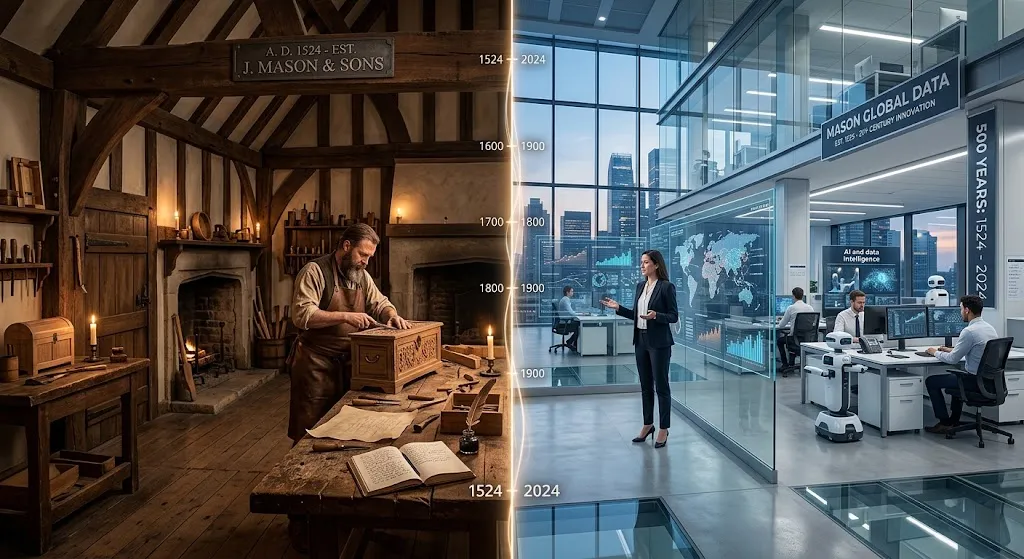
The Difference Between a Long-Lived Company and a Long-Lived Business
Before examining why some companies survive for centuries, it is useful to distinguish between a company and a business tradition.
A company may technically remain registered for hundreds of years while changing its activities completely. Another business may preserve its original craft, family ownership, or location while adapting its products over time.
The most successful long-lived businesses usually preserve a recognizable identity while allowing the practical side of the business to evolve.
A family-owned food producer might begin by selling products locally and eventually operate modern factories. A financial institution might start by serving merchants in a small town and later provide sophisticated international services. A manufacturing company might begin with traditional tools and eventually use automated production.
The outward appearance changes, but certain principles remain.
This balance between continuity and adaptation is one of the central secrets of business longevity.
1. They Understand That Change Is Inevitable
One of the greatest dangers for an old company is becoming too attached to the past.
A company that was successful 100 years ago may assume that the same products, methods, and customers will always exist. History shows otherwise.
Technology changes. Consumer preferences change. Regulations change. Competitors appear. New materials replace old ones. Entire markets can disappear.
Companies that survive for centuries generally accept that change is unavoidable.
They may preserve their name, values, reputation, or craftsmanship, but they are willing to change the way they operate.
This is an important distinction.
Tradition does not necessarily mean doing things exactly as they were done in the past.
Sometimes tradition survives precisely because a company is willing to modernize.
2. They Protect Their Reputation
A company can survive a bad year. It can sometimes survive a financial crisis or the loss of an important product.
What is much harder to recover is a severely damaged reputation.
Businesses that survive for centuries often treat trust as a form of long-term capital.
Customers may not know the founder who established the business hundreds of years earlier, but they may recognize the name and associate it with reliability.
This creates an unusual advantage.
A company with a centuries-old reputation does not have to introduce itself from zero. Its history becomes part of its identity.
That reputation can influence customers, suppliers, employees, investors, and business partners.
Of course, age alone does not guarantee quality. A company can be old and still poorly managed. But when longevity is combined with consistent standards, history can become a powerful competitive advantage.
3. They Think Beyond One Generation
Short-term thinking can be useful in certain circumstances, but companies that survive for centuries must think differently.
A founder may ask:
How much profit can we make this year?
A long-lived organization must ask a different question:
What decisions will allow this business to still exist for the next generation?
That difference can influence almost everything.
Management may choose to invest in equipment rather than distribute all available profits. Owners may accept slower growth in exchange for greater stability. Leaders may protect the company’s reputation even when a faster but riskier strategy could produce more money.
The company becomes something larger than the people currently running it.
This is particularly important in family businesses, where ownership may pass from parents to children, grandchildren, and later generations.
The individual changes.
The institution continues.
4. Succession Is One of the Biggest Challenges
Many companies do not fail because their original idea was bad. They fail when leadership changes.
The founder may have exceptional energy, knowledge, and determination. But the next generation may not possess the same skills or interests.
Successful long-lived companies therefore take succession seriously.
They need to decide who will lead the organization, how leadership will be transferred, and what responsibilities belong to family members, professional managers, or both.
This can be complicated.
Family businesses sometimes face disagreements over ownership, inheritance, management, and strategic direction. Personal relationships can become mixed with business decisions.
Companies that survive for generations tend to develop systems that reduce these conflicts.
They establish rules, responsibilities, governance structures, and methods for resolving disagreements.
In other words, they do not rely entirely on family harmony.
They build institutions.
5. They Know When to Abandon Old Products
One of the most surprising characteristics of long-lived companies is that they often have a history of abandoning things that once made them successful.
A product that was extremely popular in one century may become irrelevant in another.
Imagine a company that once specialized in horse-drawn transportation equipment. When automobiles became dominant, continuing to produce the same equipment would have been disastrous.
The business might instead move into another form of transportation, manufacturing, engineering, or a completely different market.
This requires humility.
Management must be able to say:
“What made us successful in the past may not make us successful in the future.”
That realization can save a company.
6. They Preserve Their Core Identity
Adaptation does not mean changing everything.
Some elements of a company may be so important that they should remain stable.
These can include:
- A commitment to quality
- A recognizable brand
- A particular craft
- A relationship with customers
- A set of ethical principles
- A distinctive company culture
- A long-standing reputation
The challenge is determining what belongs to the company’s core and what is simply a method that can be replaced.
For example, a bakery may preserve its traditional recipe while introducing modern ovens and digital ordering.
The recipe represents continuity.
The technology represents adaptation.
Companies that confuse the two can get into trouble. They may preserve outdated methods simply because those methods are old.
Long-lived organizations tend to preserve the purpose, not necessarily every historical procedure.
7. They Avoid Depending on a Single Person
Young companies often revolve around their founder.
The founder makes the important decisions, understands the customers, knows the suppliers, and may personally control almost everything.
That can work for a small business.
It becomes dangerous when the organization needs to survive for hundreds of years.
A company that depends entirely on one individual is vulnerable when that person retires, becomes ill, dies, or simply makes a serious mistake.
Long-lived organizations gradually transform personal knowledge into institutional knowledge.
Processes are documented. Responsibilities are distributed. Employees are trained. Leadership is developed.
The company becomes capable of functioning even when individual people leave.
This is one of the most important transitions in organizational maturity.
8. Financial Discipline Matters
Romantic stories about old companies often focus on tradition and family history, but financial discipline is just as important.
A company cannot survive for centuries if it repeatedly spends more than it earns.
Long-lived businesses often place considerable importance on maintaining financial stability.
That does not necessarily mean avoiding all borrowing or refusing to invest. Rather, it means understanding the difference between productive risk and destructive risk.
A business may borrow money to expand production because the investment is expected to generate future income.
Another business may borrow heavily simply to maintain an unsustainable lifestyle.
The first can create long-term value.
The second can eventually become a burden.
Financial conservatism can therefore be a survival mechanism, particularly during periods of economic uncertainty.
9. They Survive Difficult Periods
No company survives for centuries without experiencing serious crises.
Businesses that have existed for hundreds of years may have lived through:
- Wars
- Economic depressions
- Banking crises
- Political revolutions
- Epidemics
- Natural disasters
- Inflation
- Changes in government
- Supply shortages
- Technological disruption
- Major changes in consumer behavior
Survival during such periods requires flexibility.
A company may temporarily reduce production, change suppliers, enter a different market, or adjust its workforce.
Sometimes survival itself becomes the primary objective.
The lesson is important: a company does not need to win every year to survive for centuries. It needs to avoid losing everything during its worst years.
10. They Build Relationships, Not Just Transactions
A business transaction can be completed in minutes.
A relationship may last for decades.
Long-lived companies often develop strong relationships with customers, suppliers, employees, communities, and other organizations.
This can create resilience.
A supplier who has worked with a company for generations may be more willing to cooperate during a difficult period. Loyal customers may continue purchasing even when cheaper alternatives appear.
Employees who believe in the organization’s mission may remain committed during periods of uncertainty.
Relationships create a kind of social capital that does not appear on a traditional balance sheet.
Yet it can become extremely valuable during a crisis.
11. They Learn From the Past Without Becoming Trapped by It
A company that has survived for 500 years has an extraordinary archive of experience.
Its history can provide lessons about previous crises, leadership transitions, market changes, and strategic mistakes.
But history can also become dangerous if it is treated as a sacred instruction manual.
The fact that something worked in 1650 does not mean it will work in 2026.
Successful long-lived organizations therefore use history as a source of knowledge rather than a command.
They ask:
What can we learn from what happened before?
rather than:
How can we make the present look exactly like the past?
That distinction allows tradition to remain useful.
12. They Adapt Their Technology
Technology is one of the strongest forces determining whether businesses survive.
The technologies used by a company in the 16th century would be almost unrecognizable today.
Printing changed communication. Steam power changed manufacturing. Electricity transformed factories. Telephones changed business relationships. Computers changed administration. The internet transformed commerce.
A company that refuses every technological innovation eventually becomes inefficient or irrelevant.
Long-lived companies do not necessarily adopt every new technology immediately. Instead, they tend to evaluate whether a new technology can improve their operations or customer experience.
The important principle is not:
Always use the newest technology.
It is:
Never assume the current technology will remain the best forever.
13. They Understand Their Customers
Products can change, but the fundamental needs of customers often remain surprisingly stable.
People have always needed food, shelter, transportation, financial services, clothing, tools, communication, and protection.

A successful old company often understands these enduring needs.
This gives it the ability to change its products without abandoning its market.
For example, people may change from buying goods in physical stores to ordering online. The method of purchasing changes, but the underlying desire for reliable products remains.
A long-lived company can therefore evolve around the customer rather than around a particular product.
14. They Do Not Chase Every Trend
Adaptability does not mean following every fashion.
This is another important lesson.
Companies sometimes destroy their own identity by constantly changing direction.
A new trend appears, and management immediately follows it. Another trend arrives, and the company changes again.
Eventually customers no longer understand what the business represents.
Long-lived organizations often combine flexibility with patience.
They may experiment with new ideas without abandoning the foundation of the business.
This allows them to distinguish between a temporary fashion and a genuine structural change.
15. They Invest in Skills and Knowledge
A company can purchase machines.
It cannot simply purchase centuries of accumulated knowledge.
Traditional businesses often depend on specialized skills that require years to develop.
Craftsmanship, engineering knowledge, financial expertise, manufacturing techniques, and customer relationships can all become valuable forms of institutional knowledge.
Long-lived companies therefore have an incentive to train younger employees.
The purpose is not merely to fill today’s vacancies.
It is to ensure that knowledge survives when experienced workers retire.
In this way, training becomes a form of continuity.
One generation teaches the next.
16. They Understand That Ownership and Management Are Different
A company may be owned by a family but managed by professional executives.
This distinction can become increasingly important as organizations grow.
A founder may be an excellent entrepreneur but a poor administrator. A descendant may inherit ownership without inheriting the skills required to run the company.
The healthiest long-lived organizations can separate ownership from day-to-day management when necessary.
Family members can remain involved in the organization’s values and long-term direction while professional managers handle specialized operations.
This can prevent the company from becoming a victim of inheritance.
17. They Maintain a Strong Sense of Purpose
Profit is essential to business survival, but profit alone does not always create long-term identity.
Companies that survive for generations often develop a clear understanding of what they exist to do.
For some, it is craftsmanship.
For others, it is service.
For others, it is protecting a family tradition or serving a particular community.
Purpose can provide continuity when products and markets change.
Employees can understand what the organization stands for. Customers can develop an emotional connection with the brand.
This does not mean that every old company has an inspiring mission statement.
Often the purpose is much simpler:
Make something well. Serve people honestly. Protect the reputation of the business. Pass it on in good condition.
That philosophy can be remarkably powerful.
18. Why Most Companies Never Reach 500 Years
It is easier to understand extraordinary longevity by looking at the opposite.
Most companies eventually disappear because of some combination of:
- Poor management
- Financial problems
- Failure to innovate
- Excessive debt
- Internal conflict
- Weak succession planning
- Loss of customers
- Technological disruption
- Regulatory changes
- Competition
- Reputation damage
- Overexpansion
- Economic crises
Sometimes the cause is simply bad timing.
A perfectly competent company can be destroyed by a major external event.
This means that surviving 500 years requires not only good management but also resilience, adaptability, and a considerable amount of favorable circumstance.
Longevity should therefore not be interpreted as proof that every decision made by an old company was correct.
It means that the organization was capable of recovering from its mistakes.
The Remarkable Power of Institutional Memory
One of the greatest advantages of an old organization is institutional memory.
A new company may encounter a problem for the first time.
An old organization may have experienced something similar generations earlier.
It may know what happened, what decisions were made, and what consequences followed.
Institutional memory can prevent organizations from repeatedly making the same mistakes.
However, memory must be organized.
If knowledge exists only in the minds of a few elderly employees, it can disappear when they leave.
The strongest organizations transform experience into systems, records, training, procedures, and culture.
That is how memory becomes an asset.
Family Businesses and the Five-Hundred-Year Challenge
Family businesses face a particularly difficult problem.
A company can survive for centuries, but families change dramatically over the same period.
A founder may have three children.
Those children may have several children of their own.
Eventually dozens or even hundreds of descendants may have some claim to ownership.
At that point, managing the family relationship can become as complicated as managing the company.
Successful multigenerational businesses often develop clear structures for ownership, voting rights, succession, and management.
They may also establish family councils or other governance systems.
The goal is simple:
The family should support the business rather than allowing family disagreements to destroy it.
This is one reason why institutional structures become increasingly important as generations pass.
The Importance of Knowing What Not to Change
Perhaps the most fascinating lesson from centuries-old companies is that survival involves two opposite abilities.
They must know when to change.
And they must know when not to change.
A company that changes nothing eventually becomes obsolete.
A company that changes everything eventually loses its identity.
The strongest organizations therefore distinguish between the permanent and the temporary.
The permanent might be:
- Quality
- Trust
- Craftsmanship
- Service
- Integrity
- Purpose
The temporary might be:
- Technology
- Packaging
- Distribution
- Office structure
- Marketing
- Production methods
Once this distinction is understood, adaptation becomes much easier.
Longevity Is Not the Same as Perfection
It is tempting to romanticize companies that have existed for hundreds of years.
But age should not be confused with perfection.
An old organization can make mistakes. It can experience periods of poor management. It can lose customers and recover them. It can make strategic decisions that later prove unsuccessful.
What distinguishes long-lived companies is not the absence of failure.
It is the ability to survive failure.
This may be the most important lesson of all.
A company that expects perfection can become fragile.
A company that expects difficulty can prepare for it.
What Modern Companies Can Learn
A business does not need to be 500 years old to benefit from the principles of longevity.
A company founded today can ask the same questions:
Would this business still make sense if the market changed?
What happens when the founder leaves?
Which parts of our identity are essential?
Are we protecting our reputation?
Are we investing in the next generation of employees?
Are we financially strong enough to survive a difficult period?
Are we adapting to technology without blindly following every trend?
These questions encourage a longer perspective.
Instead of asking only how quickly a company can grow, leaders can also ask how durable that growth will be.
The Five-Hundred-Year Mindset
Perhaps the greatest difference between ordinary companies and exceptionally long-lived ones is their sense of time.
Modern business often emphasizes quarterly results, annual targets, rapid expansion, and immediate returns.
Those measures have their place.
But a five-hundred-year-old business cannot think only in quarters.
It must think in generations.
A decision made today may affect the organization decades later.
A reputation built over 100 years can be damaged by one careless decision.
A training program started today may produce leaders 20 years from now.
An investment made today may support the company for generations.
This is a fundamentally different way of thinking.
It replaces the question “What do we gain now?” with “What are we building that can outlast us?”
The Real Secret of Centuries-Old Companies
There is no single formula for creating a company that lasts 500 years.
Some businesses survive because they occupy a unique market. Others benefit from strong family traditions, valuable locations, specialized knowledge, or exceptional brands.
But beneath these differences, several common principles appear again and again.
They protect their reputation.
They plan for succession.
They maintain financial discipline.
They preserve valuable knowledge.
They invest in people.
They adapt to technology.
They understand changing customers.
They avoid unnecessary risks.
They learn from history.
And perhaps most importantly, they understand that the business does not belong entirely to the generation currently running it.
It is something received from the past and, ideally, passed forward into the future.
Real Examples: What Centuries-Old Companies Got Right—and Wrong
The best way to understand business longevity is to look at companies that actually survived for hundreds of years. Their histories show that there is no single formula for staying in business. Some succeeded because they protected a specialized skill, others because they adapted to changing markets, and some survived for centuries before eventually running into serious financial problems.
Kongō Gumi: More Than 1,400 Years of Adaptation
One of the most extraordinary examples is Kongō Gumi, a Japanese construction company traditionally traced back to 578 AD. The company became famous for building and maintaining Buddhist temples and other traditional wooden structures. Its knowledge was passed from generation to generation, with specialized carpentry skills becoming one of its greatest assets.
What did it do well? It stayed close to a specialized market while continuously preserving and developing its expertise. Instead of competing in every possible area of construction, it developed deep knowledge of traditional architecture. Its apprenticeship system helped transfer that knowledge across generations.
But Kongō Gumi also demonstrates an important limitation of longevity. The company eventually experienced serious financial difficulties and was taken into the Takamatsu Construction Group in 2006. In other words, surviving for more than 1,400 years did not make the company immune to modern financial pressures.
Its story provides a powerful lesson: specialization and tradition can preserve a company for centuries, but financial discipline and adaptation to modern business conditions remain essential.
Beretta: Preserving Craftsmanship While Modernizing
Another remarkable example is Beretta, the Italian manufacturing company whose documented history dates to 1526. The company began with the Beretta family’s production of firearm barrels and has remained under family leadership for 15 generations.
Beretta’s strength was not simply its age. The company repeatedly modernized its manufacturing methods while maintaining its emphasis on precision and craftsmanship. During the early 20th century, the business introduced more modern production methods, developed patents, and expanded internationally. Today it combines traditional gunsmithing knowledge with modern technology and manufacturing systems.
This illustrates an important principle of longevity: the company preserved the quality associated with its name, but it did not preserve every old method of production.
Its potential weakness is the other side of specialization. A company that remains strongly associated with a particular industry can become exposed to changes in regulation, consumer preferences, politics, and market conditions. Beretta has reduced some of that risk by expanding its product portfolio and developing a broader international business.
What These Two Companies Have in Common
Kongō Gumi and Beretta operate in very different industries and come from completely different historical periods, yet their stories reveal a similar pattern.
Neither survived simply by repeating what the founders did.
They survived by protecting valuable knowledge while changing the way that knowledge was used.
Kongō Gumi preserved traditional construction expertise while incorporating new approaches when necessary. Beretta preserved its reputation for precision while modernizing manufacturing and expanding internationally.
At the same time, both examples show that longevity has limits. A company can possess an extraordinary reputation and hundreds of years of accumulated knowledge and still face serious financial or competitive challenges.
That may be the most useful lesson for modern businesses: a long history is an advantage, but it is not a guarantee. The ability to adapt that history to a changing world is what gives longevity its real value.
Conclusion
A company that survives for 500 years has experienced a world that changed almost beyond recognition.
The people who founded it are long gone. The original buildings may have disappeared. The technologies have changed. The markets have transformed. Governments and currencies may have come and gone.
Yet the organization remains.
That kind of longevity is not achieved simply by refusing to change. In fact, the opposite is usually true.
The companies that last longest are often those that change continuously while protecting the principles that give them their identity.
They understand that products have lifespans, technologies become obsolete, leaders retire, and markets transform.
But trust, knowledge, adaptability, discipline, and a strong sense of purpose can be passed from one generation to another.
Perhaps that is the real secret behind companies that survive for 500 years:
They do not try to remain the same forever. They learn how to remain relevant forever.
For more interesting articles, ideas, and insights on a wide range of topics, visit serdpestcp.org.
Frequently Asked Questions
Ironically, success can be one of the biggest threats. A company may become so comfortable with a successful product or business model that it stops preparing for change.
Yes. Size is not necessarily the key factor. A small business with a specialized skill, loyal customers, careful finances, and strong succession planning can sometimes be more resilient than a large corporation.
No. Age only shows that an organization has survived. It does not necessarily mean that it has always been profitable, innovative, or well managed.
Family businesses can benefit from a strong sense of continuity. Owners may think about what they are leaving for the next generation rather than focusing entirely on short-term returns.
It cannot guarantee survival for that long, but it can adopt a long-term mindset. Strong governance, financial discipline, employee development, and succession planning can make a company much more resilient.
Not necessarily. Tradition can preserve valuable knowledge, but excessive attachment to old methods can prevent innovation. The most useful traditions are usually those that support the company’s purpose rather than simply preserving old habits.
One important lesson is to build an organization that can function without its founder. A business becomes more durable when knowledge, responsibility, and leadership are distributed rather than concentrated in one person.
Markets, technology, leadership, competition, and customer expectations continually change. Many businesses fail because they cannot adapt quickly enough or because internal problems become more damaging than external competition.
Not necessarily. Rapid expansion can create opportunities, but it can also increase debt, complexity, and management problems. Sustainable growth may provide a stronger foundation for long-term survival.
Perhaps it is that longevity is less about preserving the past and more about successfully connecting the past with the future. A durable company knows what is worth keeping—and what must be changed.




One thought on “Why Some Companies Last 500 Years”