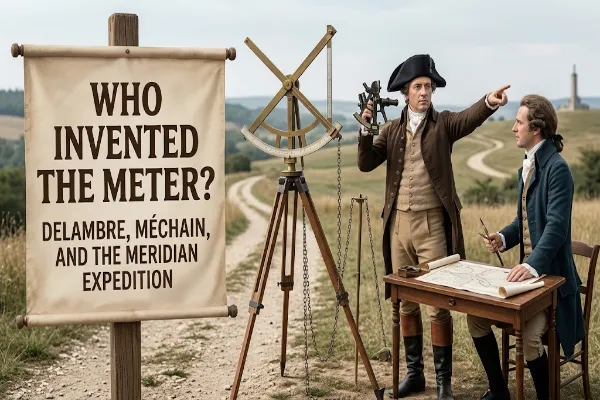
The meter is one of the most widely used units of measurement in the world. It is used to measure everything from the length of a room to the distance between cities and the dimensions of scientific instruments. Today, the meter has an extremely precise scientific definition, but it did not always work this way.
The history of the meter reflects humanity’s efforts to replace inconsistent local measurements with a universal standard. Over more than two centuries, scientists redefined the meter several times as new discoveries and better measurement technologies became available.
Why the World Needed a Standard Unit of Length
Before the meter was introduced, many communities used traditional units such as feet, inches, cubits, and locally defined versions of yards. These measurements often differed between countries and even between towns.
A unit might originally have been based on a body part, such as a foot or the length of a forearm. Although these references were convenient for everyday use, they were not sufficiently consistent for international trade, engineering, or scientific research.
The problem became increasingly important as commerce expanded and scientific instruments grew more sophisticated. Merchants needed reliable measurements, engineers needed consistent dimensions, and scientists needed results that could be compared across borders.
During the French Revolution, the idea of creating a universal unit of length gained political and scientific support. Instead of relying on a ruler, a monarch, or a local tradition, the new unit would be based on a measurable feature of nature.
The First Definition: A Fraction of Earth’s Meridian
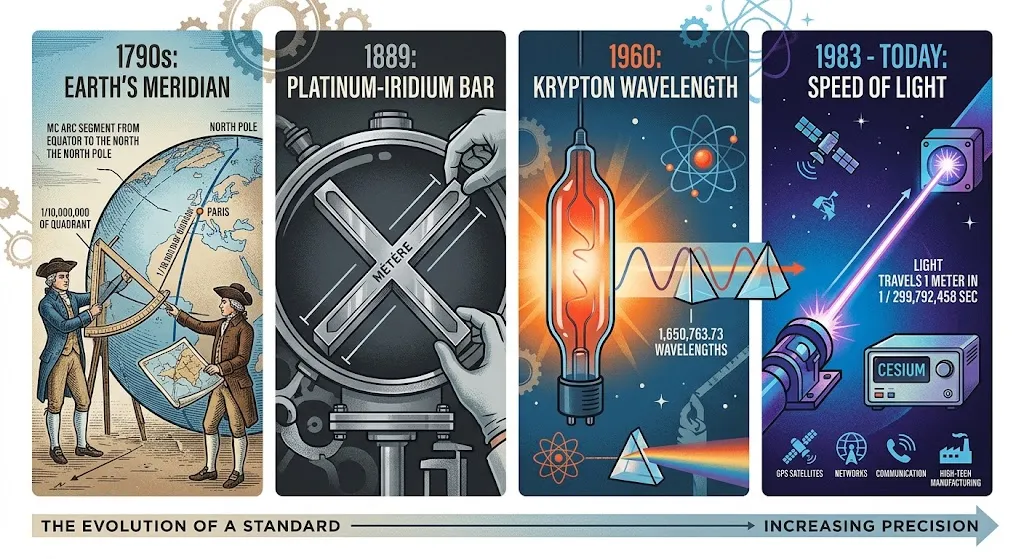
In 1791, the French Academy of Sciences supported the proposal that the meter should represent one ten-millionth of the distance from the equator to the North Pole along a meridian passing through Paris.
The concept was ambitious. By connecting the unit to the dimensions of Earth, scientists hoped to create a standard that would not depend on any particular country or individual.
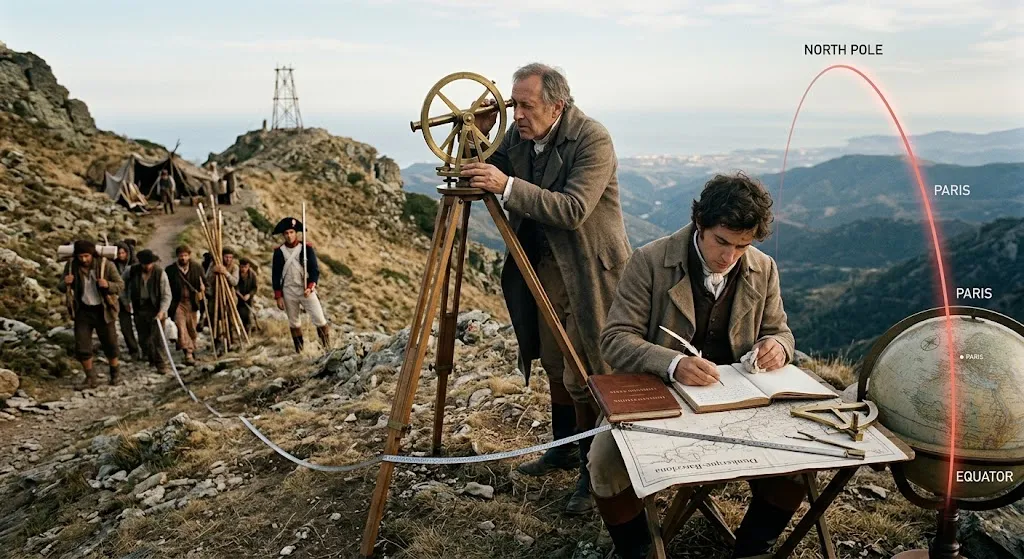
To determine the length of the meridian, French astronomers and surveyors Jean-Baptiste Delambre and Pierre Méchain conducted extensive measurements between Dunkirk in northern France and Barcelona in Spain. Their work involved measuring distances on the ground and using astronomical observations to calculate the Earth’s curvature.
The surveying project was difficult and took several years to complete. Political instability, challenging terrain, and the limitations of eighteenth-century instruments complicated the process.
In 1799, a platinum bar representing the meter was produced and deposited in France as a physical standard.
However, the Earth’s shape is not a perfect sphere, and measuring a long section of a meridian is an extraordinarily demanding task. Later improvements in geodesy also revealed that the original measurement was not perfectly consistent with the intended fraction of Earth’s meridian.
The first definition established an important principle, but it was not the final answer.
The Second Definition: A Physical Metal Bar
As practical measurement became more important, scientists needed a standard that could be reproduced and used without repeating a massive geographical survey.
In 1889, the first General Conference on Weights and Measures adopted a new international prototype meter made from a platinum-iridium alloy. The bar was designed to resist corrosion and maintain its dimensions over time.
The meter was defined by the distance between two engraved lines on the bar when it was held under specified conditions.
This was a major improvement for laboratories, manufacturers, and national standards organizations. Instead of trying to measure a fraction of Earth’s circumference, they could compare their instruments against a carefully maintained reference.
Nevertheless, a physical object had limitations. The bar could be damaged, and its dimensions could be affected by temperature, handling, or material changes. Most importantly, countries that needed the highest accuracy depended on comparisons with a single international artifact.
Scientists wanted a definition that could be reproduced anywhere without requiring access to the original bar.
The Third Definition: The Wavelength of Light
During the twentieth century, advances in atomic physics and spectroscopy made it possible to measure the wavelengths of light with exceptional precision.
Atoms emit and absorb light at specific wavelengths associated with transitions between their energy levels. These wavelengths provide reproducible references that do not depend on the dimensions of a metal object.
In 1960, the meter was redefined using the wavelength of a particular orange-red spectral line emitted by krypton-86.
The new definition specified the meter as 1,650,763.73 wavelengths of that radiation in a vacuum.
This change represented a significant advance because scientists could reproduce the reference using suitable laboratory equipment. The standard was no longer tied to a single metal bar.
However, scientific technology continued to improve. Lasers provided highly stable light sources, and increasingly accurate measurements of the speed of light made another definition possible.
The Modern Definition: The Speed of Light
In 1983, the meter was redefined using the speed of light in a vacuum.
Today, the meter is defined as the distance light travels in a vacuum during a time interval of exactly 1/299,792,458 of a second.
This definition relies on two important facts: the speed of light in a vacuum has an assigned exact value of 299,792,458 meters per second, and the second is itself defined using the frequency of radiation associated with a transition in the cesium-133 atom.
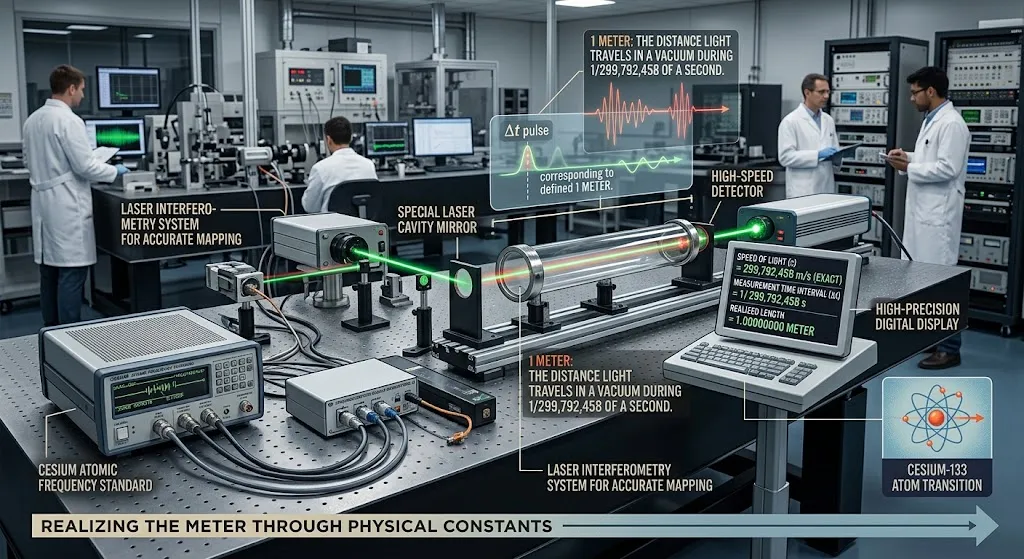
Because the speed of light is fixed by definition, the meter can be realized through precise measurements of time and the propagation of light.
Scientists can use lasers, optical interferometry, and advanced time-measuring equipment to establish lengths with extraordinary accuracy.
Unlike the earlier standards, the modern meter does not depend on a physical bar or a particular wavelength of light. Instead, it relies on universal physical constants and a reproducible definition of the second.
Why Has the Meter Been Redefined So Many Times?
The meter changed because scientific knowledge and measurement technology improved. Each new definition addressed limitations in the previous one.
The main reasons include:
- Greater accuracy: Better instruments made it possible to establish length more precisely.
- Reproducibility: Scientists needed standards that laboratories around the world could independently realize.
- Independence from physical objects: A metal bar can be damaged or change, whereas a definition based on fundamental physical constants is not tied to one artifact.
- International consistency: A universal standard makes measurements comparable across countries, industries, and scientific disciplines.
- Advances in physics: Discoveries about atomic spectra, lasers, time measurement, and the speed of light created opportunities for better standards.
Importantly, redefining the meter did not mean that everyday objects suddenly changed size. A one-meter ruler remained approximately the same length throughout these transitions. The changes improved the scientific definition and the accuracy with which the unit could be reproduced.
How the Modern Meter Is Used in Science and Everyday Life
The modern definition supports a vast range of applications.
In construction, the meter provides a consistent basis for building dimensions and structural calculations. In manufacturing, precise length measurements help ensure that components fit together correctly. In medicine, accurate measurements are important for imaging equipment, laboratory instruments, and medical devices.
In astronomy and physics, the meter helps researchers describe distances, test theories, and compare experimental results. In telecommunications, precision measurements of optical systems help engineers develop and maintain fiber-optic networks.
The definition is especially important in advanced research, where even a tiny measurement error can affect the outcome of an experiment.
Most people do not need to know the exact definition to measure a table or estimate the height of a building. However, the reliability of everyday measuring tools ultimately depends on the international measurement system that establishes what a meter means.
The Meter as an Example of Scientific Progress
The history of the meter illustrates how scientific standards evolve. The original idea connected length to the size of Earth. The next stage used a carefully manufactured metal bar. Later, the wavelength of light provided a more reproducible reference. Finally, the speed of light and the definition of the second made it possible to establish the modern meter.
Each transition reflected a broader scientific goal: to make measurements more accurate, universal, and independent of individual objects.
The meter was not redefined because the previous versions had become useless. They were replaced because science developed better ways to realize the same unit.
Today, the meter remains a foundation of the International System of Units (SI), helping scientists, engineers, manufacturers, and ordinary people measure the world using a common standard.
For more informative articles on science, technology, history, and everyday discoveries, visit serdpestcp.org.