Starting a business can be an exciting opportunity to achieve financial independence, build a career, and create something of your own. However, every business involves risk. Entrepreneurs must consider startup costs, customer demand, competition, operating expenses, and the time it may take to become profitable.
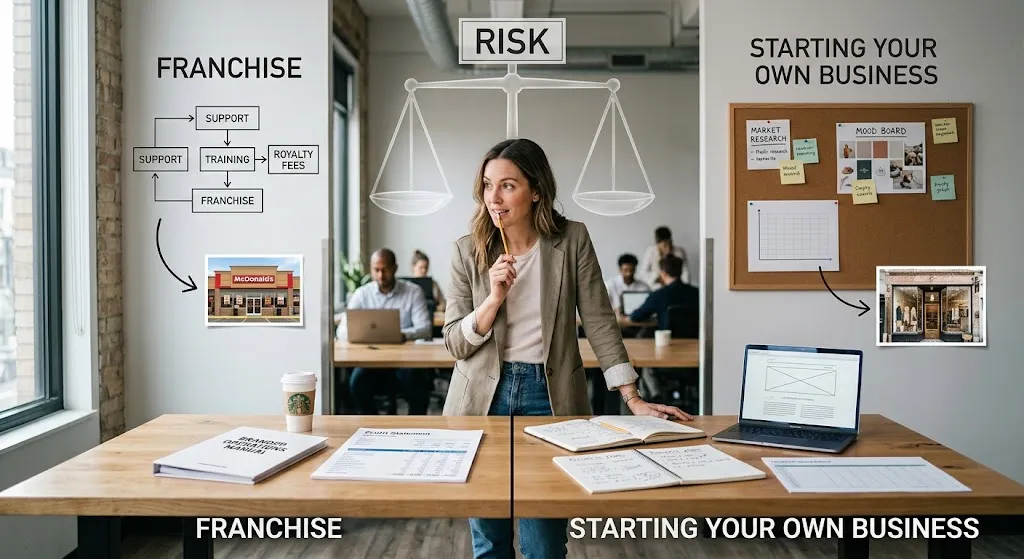
One of the first decisions aspiring business owners face is whether to purchase a franchise or start an independent business from scratch. Both options have advantages and disadvantages, but they differ significantly in terms of financial risk, flexibility, support, and control.
Understanding these differences can help entrepreneurs choose the business model that best fits their goals, experience, and available resources.
What Is a Franchise?
A franchise is a business arrangement in which an individual, known as the franchisee, pays for the right to operate a business using an established company’s brand, products, services, and operating system.
Franchises are common in industries such as fast food, fitness, hospitality, cleaning services, education, and retail. The franchisee typically receives guidance on operating procedures, marketing, employee training, and customer service.
In exchange, the franchisee usually pays an initial franchise fee and ongoing royalties. Depending on the agreement, additional payments may be required for advertising, technology, equipment, supplies, or other services.
The main attraction of franchising is that the entrepreneur does not have to develop every aspect of the business independently. The brand may already be recognized by customers, and the operating model may have been tested in other locations.
However, an established brand does not guarantee success. A franchise can still struggle because of poor location selection, weak local demand, high operating costs, or ineffective management.
What Does It Mean to Start Your Own Business?
Starting an independent business means creating and operating a company without purchasing the rights to another company’s established business model.
The owner decides what products or services to offer, how to price them, which customers to target, and how to promote the business. They also develop the brand identity, operating procedures, and long-term strategy.
This approach offers considerable freedom. An entrepreneur can experiment with different products, adjust prices, change suppliers, and respond to customer feedback without needing approval from a franchisor.
Independent businesses can also be less expensive to launch, particularly when they operate online, provide professional services, or begin on a small scale. However, the owner must usually conduct their own market research, build a reputation, attract customers, and develop reliable business processes.
Without an established system to follow, mistakes can be more costly in terms of both money and time.
Franchise vs. Independent Business: Key Differences
The following comparison highlights the main factors that influence the level of risk associated with each option.
| Factor | Franchise | Independent Business |
|---|---|---|
| Brand recognition | May benefit from an established brand | Must build recognition from scratch |
| Startup costs | Often includes a franchise fee and setup requirements | Varies widely by business type |
| Business model | Uses an established operating system | Owner develops the business model |
| Training and support | Often provided by the franchisor | Owner arranges training and support |
| Creative freedom | Limited by franchise rules | Greater flexibility and control |
| Ongoing fees | Royalties and other contractual fees may apply | No franchisor royalties |
| Marketing | May receive brand-level marketing support | Owner manages marketing independently |
| Financial risk | Reduced uncertainty in some areas, but substantial costs remain | Depends on planning, experience, and market demand |
| Potential profitability | Shared with the franchisor through fees and royalties | Owner generally retains profits after expenses |
| Exit options | May require approval or follow transfer restrictions | Generally more flexible, subject to legal obligations |
Neither model is automatically safer. The outcome depends on the specific opportunity, the financial resources available, and the quality of the decisions made by the business owner.
Why a Franchise May Be Less Risky
1. An Established Business Model
One of the biggest advantages of franchising is access to a business model that has already been developed. The franchisor may provide operational procedures, supplier relationships, pricing guidance, and standards for delivering products or services.
This can reduce the need to develop every business process through trial and error.
For example, someone opening a franchise restaurant may receive established recipes, employee training procedures, equipment specifications, and guidelines for managing inventory. These resources can make the early stages of running the business more structured.
However, a business model that works in one location may not perform equally well in another. Local demographics, competition, rental costs, and customer preferences remain important.
2. Brand Recognition and Customer Trust
Building customer trust can take considerable time for a new independent business. A recognized franchise brand may already have a reputation, marketing presence, and loyal customer base.
This familiarity can make it easier to attract initial customers, although results vary by brand and market.
An established name does not eliminate the need for good service or effective local marketing. Customer expectations may also be higher when a business operates under a well-known brand.
3. Training and Ongoing Support
Many franchisors provide initial training and continuing assistance with business operations, marketing, technology, and management.
This support can be particularly valuable for first-time entrepreneurs who have limited experience running a company.
Nevertheless, the level of assistance differs between franchise systems. Prospective franchisees should investigate what support is actually included in the agreement rather than assuming that every franchisor provides comprehensive help.
4. Access to Established Suppliers and Systems
Some franchise networks negotiate with suppliers, use centralized purchasing systems, or provide established inventory and management software.
These arrangements may simplify purchasing, improve consistency, and help franchisees avoid certain operational mistakes.
However, franchisees may be required to purchase products from approved suppliers, even when alternative suppliers offer lower prices. The financial benefit depends on the actual terms and costs.
Why Starting Your Own Business Can Be Less Risky
Although franchising provides structure and support, an independent business can sometimes offer a lower overall level of financial exposure.
1. Lower Initial Investment
Franchises can require substantial upfront investment, including franchise fees, equipment, premises, inventory, training, and opening expenses.
Some also require ongoing royalty payments based on revenue. This means that fees may remain payable even when the business has a narrow profit margin.
An independent business can often start on a smaller scale. A consultant might begin working from home, an online retailer might test a limited product range, or a service provider might acquire a few customers before investing in additional equipment.
Starting small can limit the amount of money at risk and provide an opportunity to test demand before expanding.
2. Greater Control Over Business Decisions
Independent owners can change their products, services, prices, suppliers, and marketing strategies according to market conditions.
If a particular product is not selling, the owner can replace it. If customers respond positively to a new service, the business can expand that offering.
Franchisees, by comparison, may be required to follow brand standards and obtain approval for certain changes.
Greater flexibility can help independent businesses respond quickly to challenges. However, freedom also means the owner must make important decisions without relying on a franchisor’s established procedures.
3. No Franchise Royalties
Independent business owners do not pay franchise royalties simply for using their own brand.
They can reinvest the money that would otherwise go toward royalties or other franchise-specific fees into marketing, equipment, staffing, or product development.
This does not mean that independent businesses have no ongoing expenses. Advertising, software, professional services, rent, insurance, and other operating costs can still be substantial.
The important distinction is that the owner chooses how to allocate those resources rather than being bound by a franchise agreement.
4. The Ability to Test an Idea Before Expanding
An independent entrepreneur can often validate a business idea with a limited initial investment.
For example, someone considering a home cleaning business could begin with a small number of clients, evaluate demand, and gradually expand the service area. An online business owner could test a product with a small inventory before making a larger purchase.
This approach allows the entrepreneur to learn from real customer behavior without committing to an expensive location or long-term franchise contract.
Testing demand does not eliminate risk, but it can prevent a large investment in a business concept that customers do not want.
The Biggest Financial Risks of Each Model
Understanding the potential disadvantages is just as important as considering the benefits.
Risks of Buying a Franchise
High startup costs: The initial investment may include a franchise fee, premises, equipment, inventory, and working capital. Borrowing to cover these expenses can increase financial pressure.
Ongoing royalties: Payments based on sales can reduce profitability, particularly when operating expenses rise or revenue falls.
Limited control: Franchise rules may restrict pricing, suppliers, advertising, product selection, and other business decisions.
Dependence on the franchisor: Problems affecting the parent company, such as reputational damage, poor management, or financial difficulties, can influence individual franchise locations.
Contractual restrictions: Franchise agreements may contain renewal conditions, territory limitations, transfer requirements, and post-termination restrictions. The details vary by jurisdiction and agreement.
Risks of Starting an Independent Business
Unproven demand: The owner may invest in products or services that attract fewer customers than expected.
Limited experience: Without an established operating system, entrepreneurs must learn how to manage pricing, cash flow, marketing, staffing, and customer relationships.
Marketing challenges: An unfamiliar business must develop brand recognition and establish credibility.
Operational mistakes: Poor inventory management, inaccurate cost estimates, weak pricing, or ineffective processes can reduce profitability.
Uncertain revenue: A new business may take longer than expected to attract enough customers to cover its expenses.
These risks can be reduced through careful planning, customer research, realistic budgeting, and gradual growth.
How to Decide Which Option Is Right for You
The best choice depends on the entrepreneur’s experience, financial position, personality, and long-term objectives.
A franchise may be suitable for someone who prefers a structured system, values formal training, and is comfortable following established operating standards. It can also appeal to entrepreneurs who want to enter an industry where an established brand has a meaningful competitive advantage.
An independent business may be more suitable for someone who values autonomy, wants to develop a unique product or service, or prefers to start with a smaller investment.
Before making a decision, consider the following questions:
- How much money can you invest without endangering your personal financial security?
- Do you have enough savings to cover living expenses and business costs during a slow start?
- Is there proven demand for the product or service in your target market?
- Do you have the skills needed to manage the business, or will you need training?
- Would an established brand provide a meaningful advantage over local competitors?
- Are you comfortable paying ongoing fees and following contractual requirements?
- Can you test the business idea on a smaller scale before making a major commitment?
These questions help shift the decision away from general assumptions about franchising and toward a realistic assessment of the specific opportunity.
How to Reduce Risk Before Investing
Regardless of which model you choose, preparation can make a substantial difference.
Research the market. Identify your target customers, examine competitors, and estimate realistic sales rather than relying on optimistic projections.
Prepare a detailed financial plan. Include startup expenses, monthly operating costs, taxes, insurance, loan repayments, and a reserve for unexpected expenses.
Calculate the break-even point. Determine how much revenue the business must generate to cover its fixed and variable costs. For a franchise, include royalties and advertising contributions in the calculation.
Review the agreement carefully. If you are considering a franchise, examine all fees, territorial rights, renewal terms, termination provisions, transfer restrictions, and required purchases. Obtain independent legal and accounting advice before signing.
Speak with existing business owners. For a franchise, contact current and former franchisees where possible. Ask about actual operating costs, the quality of support, profitability, and unexpected difficulties.
Keep sufficient working capital. A business can fail even when its underlying idea is sound if it runs out of cash before sales become consistent.
Avoid excessive debt. Large loan repayments can turn a manageable business challenge into a serious financial problem.
Final Verdict: Which Is Less Risky?
A franchise may be less risky from an operational perspective because it can offer an established brand, a tested business model, training, and ongoing support. These advantages may reduce some of the uncertainty associated with launching a new venture.
However, franchising can involve greater financial commitments, ongoing fees, and contractual restrictions. An independent business may offer a lower-risk path when it can be launched gradually, tested with real customers, and expanded only after demand has been demonstrated.
The distinction is important: an established business model does not necessarily mean a safer financial investment.
For an entrepreneur with limited capital, a small independent business with low fixed costs may be safer than an expensive franchise requiring significant borrowing. For someone with adequate capital who prefers structured operations, a carefully evaluated franchise may be the more appropriate choice.
Ultimately, the less risky option is the one that combines realistic customer demand, manageable expenses, sufficient working capital, and a business model suited to the owner’s abilities. Careful research and conservative financial planning matter more than the label attached to the business.