When people think of McDonald’s, they usually imagine hamburgers, French fries, drive-through windows, and the famous Golden Arches. However, behind the fast-food chain is a business strategy that helped transform McDonald’s into one of the world’s most successful restaurant companies: real estate ownership and property leasing.
The company’s success was not built on selling burgers alone. By acquiring or controlling the land and buildings where its restaurants operate, McDonald’s developed a business model that generates rental income, collects franchise fees, and gives the company greater control over its locations.
The story began in the 1950s, when the company faced a financial challenge that threatened its ability to expand.
Key Takeaways
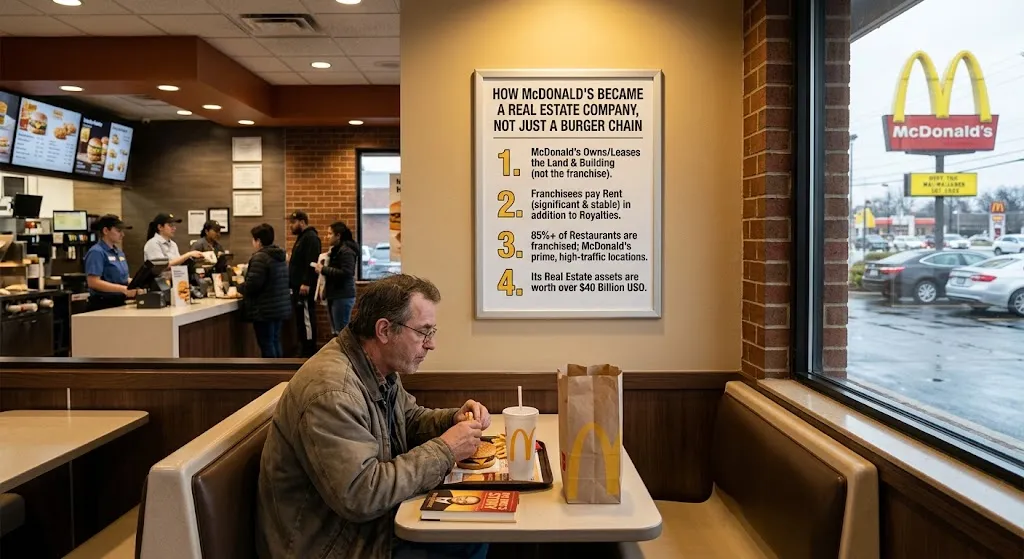
- Real estate is central to McDonald’s business model. The company generates income not only through its restaurant network but also through property ownership, leasing, and franchise agreements.
- Harry Sonneborn helped reshape the company’s strategy. His financial approach helped McDonald’s use real estate to support expansion and create additional revenue streams.
- Franchising and property work together. McDonald’s can earn franchise fees, royalties, and rental income, depending on the agreements and location.
- Location creates a competitive advantage. Access to busy streets, major roads, and high-traffic commercial areas can help restaurants attract customers and strengthen long-term property value.
- Property control supports consistency. Real estate arrangements can help McDonald’s manage its locations and protect its brand standards.
- The model supports global expansion. Combining franchising with strategic property management allows McDonald’s to grow without directly operating every restaurant.
- The broader lesson is to look beyond the product. McDonald’s demonstrates how controlling valuable assets and building multiple revenue streams can create a stronger, more scalable business.
The Early Challenges of McDonald’s Expansion
McDonald’s was founded by brothers Richard and Maurice McDonald, who opened their first restaurant in San Bernardino, California, in 1940. They later developed a streamlined restaurant system focused on a limited menu, quick service, and consistent food preparation.
In 1954, businessman Ray Kroc visited the restaurant after learning that the brothers had ordered several milkshake machines. Impressed by the efficiency of their operation, he saw an opportunity to bring the concept to customers across the United States.
Kroc began expanding McDonald’s through franchising. Independent operators could open restaurants using the company’s name, operating procedures, and established business model.
However, franchising created a financial problem. McDonald’s received only a relatively small share of the revenue generated by each restaurant. Although franchisees could earn money from selling food, the company needed additional income to finance its own expansion and support its growing network.
Opening more restaurants required capital, and relying primarily on franchise fees and royalties made rapid growth difficult.
The solution came from an unexpected direction: commercial real estate.
Harry Sonneborn’s Revolutionary Idea
In 1956, Ray Kroc brought in Harry Sonneborn, a finance executive who recognized an opportunity to change how McDonald’s made money.
Instead of allowing franchisees to independently secure all the property needed for their restaurants, Sonneborn proposed that McDonald’s acquire or lease suitable locations and then rent them to franchise operators.
This strategy transformed the relationship between the company and its franchisees. McDonald’s would no longer depend solely on the success of individual restaurants to generate income. It could also earn money from controlling the land and buildings those restaurants occupied.
To implement the strategy, McDonald’s established the Franchise Realty Corporation, which focused on obtaining and managing restaurant properties.
The arrangement gave the company two important sources of revenue: income connected to the restaurant’s sales and rental payments associated with its location.
Sonneborn’s approach is often summarized by the famous idea that McDonald’s was in the real estate business as much as it was in the hamburger business. Although the precise wording commonly attributed to him is difficult to verify, the underlying strategy is well documented.
How the McDonald’s Real Estate Model Works
The business model is relatively straightforward. McDonald’s identifies locations with strong commercial potential, obtains the necessary property rights, and makes those locations available to franchisees under contractual arrangements.
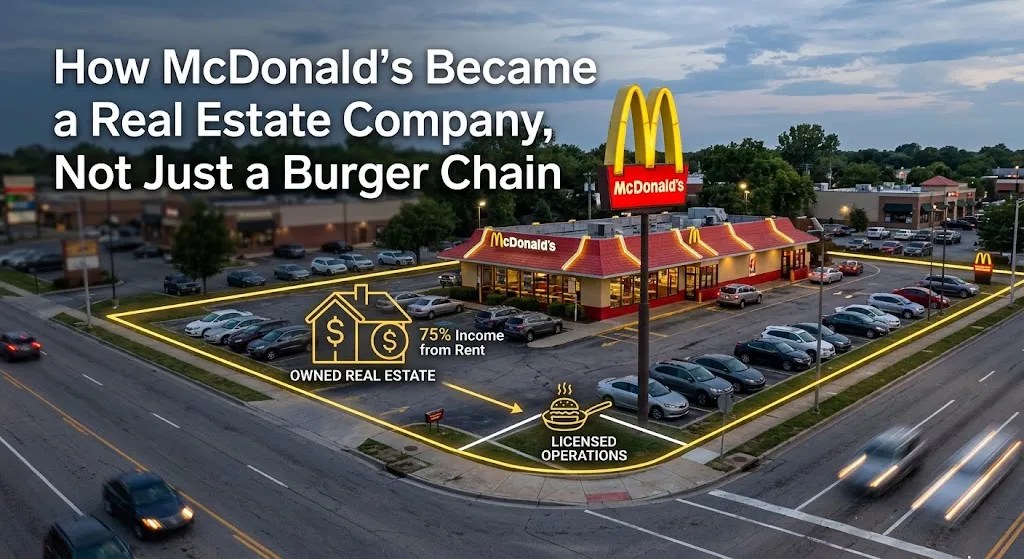
Depending on the location and agreement, McDonald’s may own the land and building, own the land while leasing other parts of the property, or control a site through a long-term lease.

The franchisee operates the restaurant, employs staff, purchases ingredients, serves customers, and manages daily business activities. Meanwhile, the franchise arrangement provides McDonald’s with fees and, in many cases, rental income.
This creates a relationship in which the company can benefit from both the restaurant’s commercial activity and the property on which it operates.
Consider a simplified example.
Imagine that McDonald’s controls a property in a busy commercial district. An independent franchisee operates a restaurant at that location and pays rent under the agreed contract, alongside other franchise-related fees.
The franchisee must attract customers and manage operating costs to make a profit. McDonald’s, however, benefits from its contractual income and its interest in a strategically located property.
Actual agreements vary, and rental payments may depend on fixed amounts, sales-based formulas, or other contractual terms.
Why Owning Property Creates a Competitive Advantage
Real estate provides several advantages that extend beyond rental income.
1. More Predictable Revenue
Restaurant sales can fluctuate because of economic conditions, changing consumer preferences, competition, and seasonal demand.
Rental agreements can provide a more predictable income stream than relying exclusively on a percentage of food sales. The precise stability depends on the contract, the tenant’s ability to pay, and the performance of the location.
For a company operating thousands of restaurants, this additional source of income can make financial planning easier.
2. Greater Control Over Franchise Locations
McDonald’s has built its brand around consistency. Customers generally expect similar service standards, menu options, and restaurant experiences wherever they visit.
Controlling the property can strengthen the company’s ability to manage its franchise network. Lease agreements and franchise contracts can establish requirements relating to the premises, maintenance, operating standards, and permitted uses.
If a franchisee seriously violates contractual obligations, the company may have remedies under the relevant agreements.
This does not mean that McDonald’s can automatically remove any operator at will. Its rights depend on the terms of the contracts and applicable law. Nevertheless, property control gives the company an additional means of protecting its business model.
3. Valuable Long-Term Assets
Commercial property can become more valuable over time, particularly when it is located near growing residential communities, major roads, shopping districts, or other busy commercial areas.
When McDonald’s owns land, it may benefit from increases in property values as well as income generated by the restaurant operating there.
Property ownership also gives the company strategic flexibility. Depending on market conditions and legal restrictions, it may be possible to redevelop a site, renegotiate a lease, or use the property as part of a broader financial strategy.
Real estate is not guaranteed to appreciate, however. Poor locations, declining commercial areas, financing costs, and property maintenance can create substantial risks.
4. A Foundation for Continued Expansion
McDonald’s real estate strategy helped establish a repeatable method for opening new restaurants.
Rather than leaving every franchisee to negotiate independently for a suitable location, the company could play a central role in identifying sites and arranging property access.
This made it easier to coordinate expansion with the company’s standards and long-term objectives.
The approach also helped align the interests of the franchisor and franchisee: both parties had a financial reason to operate successful restaurants in commercially attractive locations.
Why the Location Matters as Much as the Burger
In the restaurant industry, location can determine whether a business attracts a steady stream of customers or struggles to survive.
A restaurant near a busy intersection, highway exit, shopping center, or densely populated neighborhood may have advantages over one in a less accessible area.
McDonald’s understood that selecting the right property was not simply a matter of finding space for a kitchen and dining room. It was part of building a competitive advantage.
The company could evaluate traffic patterns, population growth, visibility, accessibility, and the surrounding commercial environment before committing to a location.
Over time, this approach helped McDonald’s establish a network of restaurants in places where customers could easily recognize and access the brand.
The property itself became an important component of the business strategy.
How Franchising and Real Estate Work Together
McDonald’s does not operate every restaurant directly. A significant portion of its global network is run by independent franchisees, while the company provides the brand, operating system, standards, and broader business framework.
The combination of franchising and real estate creates a distinctive financial structure.
Franchisees contribute capital, manage employees, serve customers, and take responsibility for many day-to-day operating expenses. McDonald’s can receive franchise fees and royalties, as well as rent where its property arrangements provide for it.
This arrangement allows the company to expand without having to operate every restaurant using its own employees and resources.
It also means that the company can benefit from the growth of its restaurant network through several connected revenue streams.
However, the model is not risk-free. Franchisees can experience financial difficulties, restaurants can underperform, and property costs can rise. The company must also invest in maintaining its locations and selecting sites carefully.
The strength of the model comes from combining property strategy with an established brand and a scalable franchise system.
From a Small Restaurant Business to a Global Brand
Ray Kroc’s expansion strategy took McDonald’s far beyond its original California operation. The company acquired the McDonald brothers’ business rights in 1961, providing a foundation for further growth.
McDonald’s subsequently expanded across the United States and entered international markets, including Canada and Puerto Rico in 1967.
As the restaurant network grew, the company’s real estate strategy became part of a much larger global operation. Property decisions had to account for different markets, legal systems, consumer habits, and commercial conditions.
Today, McDonald’s operates through a combination of company-owned restaurants and independently operated franchised locations. Its property arrangements vary across countries and individual sites, but real estate remains an important part of its business model.
The company is therefore more than a food retailer. It combines restaurant operations, franchising, brand management, supply-chain coordination, and commercial property strategy.
What Other Businesses Can Learn from McDonald’s
The McDonald’s story illustrates a business principle that applies well beyond fast food: a company’s most important source of long-term value may be different from the product customers see.
A customer purchases a burger, but the company benefits from an entire system that includes brand recognition, standardized operations, franchise agreements, and property arrangements.
Several lessons stand out.
Think beyond the immediate product. Businesses should examine whether they can develop additional sources of revenue that complement their main activity.
Control strategically important assets. Property, distribution networks, technology, and intellectual property can strengthen a company’s competitive position when managed effectively.
Build repeatable systems. A business becomes easier to scale when its operations, agreements, and standards can be applied consistently across multiple locations.
Balance growth with financial discipline. Expansion requires capital, careful site selection, and an understanding of long-term obligations. Rapid growth is not valuable if the underlying economics are weak.
Understand the difference between revenue and profit. A restaurant may generate substantial sales without producing enough profit for its owner. A strong business model must account for operating costs, financing, rent, and other obligations.
Conclusion
McDonald’s became a global powerhouse through more than its popular menu and recognizable Golden Arches. A crucial part of its development was the decision to treat restaurant property as a strategic business asset.
Harry Sonneborn’s financial insight helped Ray Kroc build a model in which franchising and real estate supported one another. By obtaining control over important restaurant locations and earning income through franchise relationships, McDonald’s created a foundation for expansion that went beyond selling hamburgers.
The company’s experience demonstrates how a seemingly ordinary asset, such as a piece of commercial land, can become central to a much larger business strategy.
The next time you see a McDonald’s restaurant on a busy street corner, remember that the business behind the counter may be managing much more than food sales. It is also managing locations, contracts, and property interests that help keep a global enterprise running.