Saying “thank you” seems like one of the simplest and most universal acts of human communication. In many languages, there is a familiar word or phrase used to express gratitude, whether it is thank you in English, merci in French, gracias in Spanish, or danke in German.
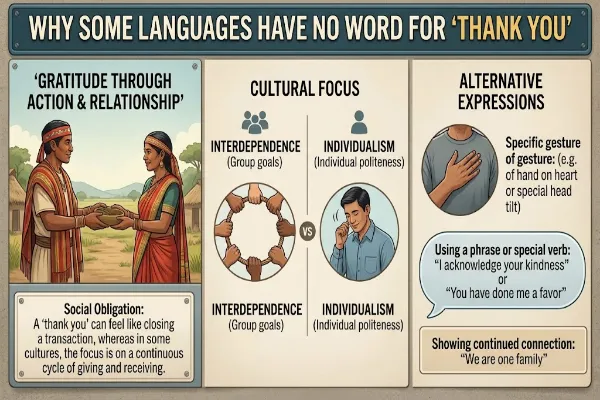
Yet not every language has a direct equivalent of “thank you.” This does not mean that speakers of these languages are ungrateful, impolite, or incapable of expressing appreciation. Instead, it reveals something much more interesting: languages do not all organize social relationships and politeness in the same way.
In some cultures, gratitude is expressed through actions, tone, gestures, reciprocal behavior, or phrases that do not translate literally as “thank you.” In others, constantly acknowledging favors verbally may even feel unnecessary or unusual.
Understanding this difference provides a fascinating glimpse into how language reflects culture, relationships, and social expectations.

Does Every Language Have a Word for Gratitude?
The short answer is no—not necessarily a single, conventional word that functions exactly like English “thank you.”
Most human societies have ways of recognizing kindness, assistance, generosity, or favors. But the linguistic form this takes can vary dramatically.
One language may have a short expression used dozens of times a day. Another may rely more heavily on phrases meaning something like:
- “I appreciate it.”
- “You have helped me.”
- “May you be well.”
- “I am grateful.”
- “You have done me a kindness.”
- “I am indebted to you.”
- “It is good that you did this.”
- “May your generosity return to you.”
And sometimes gratitude may not be expressed verbally at all.
This distinction is important because having no direct translation for a phrase does not mean having no concept behind it.
Languages regularly express the same human idea in different ways. Some languages have one word where another language needs an entire sentence. Others distinguish between concepts that English combines into a single word.
The Difference Between a Word and a Concept
One of the biggest misunderstandings about language is the idea that if a language lacks a particular word, its speakers must lack the corresponding concept.
That is not how languages work.
English, for example, has the word “siblings,” which conveniently refers to brothers and sisters without specifying gender. Some languages do not have an exact equivalent and instead normally use separate words for “brother” and “sister.”
That does not mean speakers of those languages do not understand the concept of siblings.
The same principle applies to gratitude.
A language might not have a simple everyday equivalent of “thank you,” while its speakers still have sophisticated ways of expressing appreciation, obligation, generosity, respect, and reciprocity.
The absence of one convenient word tells us more about how a language packages meaning than about what its speakers can think.
Gratitude Can Be Expressed Through Relationships
In many societies, social relationships are based heavily on reciprocity.
If a person helps a friend, neighbor, relative, or colleague, the response may not be an immediate verbal “thank you.” Instead, the person may remember the favor and return it later.
The underlying message is essentially:
“I recognize what you have done, and I will respond appropriately.”
In such a social environment, repeatedly verbalizing gratitude may be less important than demonstrating it through behavior.
This can be difficult for speakers of languages such as English to understand because English-speaking cultures often place considerable importance on explicit verbal politeness.
A person holds the door open.
“Thank you.”
Someone passes the salt.
“Thanks.”
A cashier hands over a receipt.
“Thank you.”
A colleague helps with a task.
“Thanks, I appreciate it.”
These expressions are so routine that they can sometimes function almost automatically.
Other cultures may use different social conventions.
When Saying “Thank You” Feels Unnecessary
Imagine two close friends who have known each other for decades.
One friend helps the other carry furniture into a house. The second friend does not say “thank you,” but later prepares a meal, helps with another task, or simply acknowledges the favor through warmth and familiarity.
From an English-speaking perspective, the absence of “thank you” might appear rude.
But within the relationship, it may communicate nothing negative at all.
The assumption may be:
“We help each other. This is what friends do.”
In that context, an explicit expression of gratitude could even feel overly formal or distant.
This demonstrates an important principle of communication:
Politeness is not universal in form, even when the intention behind it is universal.
The Japanese Example
Japanese is a particularly interesting example because it certainly has expressions commonly translated as “thank you,” such as arigatō and the more polite arigatō gozaimasu.
However, Japanese gratitude is closely connected with a much broader system of politeness, social hierarchy, obligation, and interpersonal relationships.
Another expression, sumimasen, literally associated with meanings such as “I am sorry” or “excuse me,” can also be used when expressing gratitude.
Why?
Because receiving someone’s help can create a feeling of indebtedness or inconvenience to the other person. Saying sumimasen can therefore communicate something closer to:
“I am sorry that you had to go to this trouble for me.”
The English translation may simply become “thank you,” but the social meaning is more complicated.
This illustrates why direct translation can sometimes hide important cultural information.
The Korean Example
Korean also has several ways of expressing gratitude, with the appropriate expression depending heavily on the relationship between speakers and the level of politeness required.
Expressions such as gamsahamnida and gomapseumnida are commonly translated as “thank you,” but Korean communication pays close attention to age, status, familiarity, and social hierarchy.
The exact form used can therefore communicate more than gratitude.
It can also communicate:
- respect,
- distance,
- familiarity,
- humility,
- social position,
- and the relationship between the speakers.
A simple translation into English can lose some of these distinctions.
Some Languages Emphasize Reciprocity

In certain cultures, gratitude is strongly connected to reciprocity.
The important question is not necessarily:
“Did you say thank you?”
but rather:
“Did you acknowledge the favor and respond appropriately?”
This is particularly important in communities where relationships are built around mutual assistance.
A neighbor might help repair a roof today, knowing that the other family will help with harvesting tomorrow.
No elaborate verbal expression may be necessary.
The exchange itself communicates appreciation.
The social message becomes:
“We are part of the same community, and we take care of one another.”
In such circumstances, gratitude is not merely a word. It is a continuing relationship.
The Importance of Context
Languages also differ in how much meaning they expect listeners to infer from context.
English often prefers explicit communication.
If someone gives you a gift, saying “thank you” clearly signals your reaction.
Other communication systems may depend more heavily on context, facial expression, body language, or shared understanding.
A smile, bow, gesture, reciprocal gift, or respectful response can sometimes communicate appreciation without a specific word meaning “thank you.”
This does not make the communication less meaningful.
It simply means that gratitude is distributed across several parts of communication rather than concentrated in one word.
Why Translation Can Be Misleading
Dictionaries often give neat equivalents:
English: thank you
French: merci
Spanish: gracias
German: danke
But real communication is rarely that simple.
A translator has to consider:
- Who is speaking?
- Who is listening?
- What happened?
- What is the relationship between them?
- How formal is the situation?
- Is the speaker expressing gratitude, apology, respect, obligation, or all four?
- Is the expression conventional or emotionally meaningful?
This is why two expressions that dictionaries translate as “thank you” may not actually be interchangeable.
Translation transfers words, but communication transfers meaning within a social context.
The Myth of the “Untranslatable” Word
People often say that a language has “no word” for a particular concept when what they really mean is that there is no single word with exactly the same range of meaning.
Almost every language can describe almost any concept when necessary.
English does not have to borrow a word from another language simply because the concept does not exist in English. It can use a phrase or explanation.
For example, if English lacked a word for a particular cultural practice, speakers could still describe the practice.
The same is true in reverse.
When a language lacks a direct equivalent of “thank you,” speakers can still express gratitude through other linguistic or social forms.
Words Can Reveal Cultural Priorities
Vocabulary sometimes provides clues about what a society pays particular attention to.
Languages may have highly specific vocabulary relating to family relationships, landscapes, food, social status, emotions, weather, or customary behavior.
That does not mean speakers of other languages cannot understand those things.
Rather, some distinctions become so useful within a particular culture that they receive convenient linguistic labels.
The same applies to politeness.
If a society places strong emphasis on explicit verbal appreciation, expressions of thanks may become highly conventionalized.
If relationships depend more strongly on reciprocity and shared obligations, gratitude may be expressed differently.
Gratitude Is More Than Politeness
There is also an important distinction between gratitude and politeness.
A person can say “thank you” without feeling particularly grateful.
For example, people routinely say “thanks” when someone hands them a pen or holds a door open. The expression is often simply a social convention.
Conversely, someone can feel profound gratitude without immediately saying anything.
A person may remember someone’s kindness for years and repay it through actions.
This shows that the word “thank you” is only one possible expression of a much larger human experience.
Why English Uses “Thank You” So Frequently
The English expression itself has an interesting history.
“Thank” is related to the idea of thought or remembrance. Historically, to thank someone involved recognizing a kindness and holding it in one’s thoughts.
Over time, “thank you” became a standard formula for expressing gratitude.

Today, it is used in an enormous range of situations, from extremely casual interactions to highly formal occasions.
Its frequency makes it easy for English speakers to assume that every language should have an equivalent.
But languages develop according to their own histories and social systems.
There is no universal rule requiring every culture to package gratitude into the same grammatical form.
When Silence Can Communicate Gratitude
Silence is often mistakenly interpreted as the absence of communication.
In reality, silence can carry considerable meaning.
In some situations, a person may respond to a meaningful favor with a pause, a smile, a gesture, a bow, or a change in behavior rather than a verbal expression.
Among close friends or family members, an elaborate verbal acknowledgment may even seem unnecessary.
The silence can communicate:
“You know that I appreciate this.”
Again, whether that interpretation is appropriate depends entirely on cultural context.
Does Language Shape the Way We Think About Gratitude?
Language and culture influence one another, but it would be too simplistic to claim that a missing word prevents people from experiencing an emotion.
People everywhere can experience gratitude, even if they describe it differently.
However, language can influence which aspects of an experience become especially easy to express.
A language with numerous levels of politeness may make speakers more attentive to social relationships.
A language that frequently uses explicit expressions of gratitude may make verbal acknowledgment an important part of everyday etiquette.
A culture emphasizing reciprocal obligations may place greater importance on remembering and returning favors.
Language does not imprison thought, but it can influence what we habitually notice and how easily we express it.
Gratitude Without a Single Word
Perhaps the most fascinating lesson is that gratitude does not actually require a word.
A person can express gratitude through:
- returning a favor,
- offering a gift,
- helping someone in return,
- showing respect,
- remembering a kindness,
- changing one’s behavior,
- sharing resources,
- offering hospitality,
- or simply being present when someone needs help.
Words are only one part of human communication.
Sometimes the most meaningful “thank you” is something a person does rather than something a person says.
The Real Lesson Behind Languages Without a Direct “Thank You”
When we discover that a language does not have a direct equivalent of “thank you,” it can be tempting to conclude that something is missing.
But nothing is necessarily missing.
Instead, the language may be revealing a different understanding of how people relate to one another.
One society may emphasize verbal acknowledgment.
Another may emphasize reciprocity.
Another may combine gratitude with humility or apology.
Another may rely heavily on context and shared relationships.
All of these systems can communicate appreciation.
The important lesson is that language does not simply label the world—it reflects the way communities interact within it.
So the next time someone says that a particular language has “no word for thank you,” the more accurate question may be:
How does that language and culture express gratitude instead?
The answer can reveal far more about a society than a dictionary ever could.
For more interesting articles, ideas, and insights on a wide range of topics, visit serdpestcp.org.