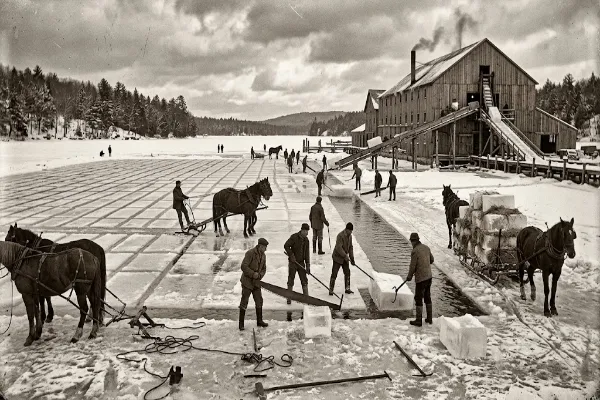
Today, ice is so easy to obtain that it is difficult to imagine a time when people had to wait for winter, cut enormous blocks from frozen lakes, store them in insulated buildings, and transport them hundreds or even thousands of miles.
For much of human history, naturally frozen ice was a seasonal resource. People used snow and ice for cooling food and drinks, preserving meat, making frozen desserts, and providing relief from heat. But during the nineteenth century, something extraordinary happened: ice became an international commodity.
Entrepreneurs developed methods for harvesting ice from lakes and ponds on a huge scale. Workers cut frozen surfaces into enormous blocks, moved them from the water using horses and specialized equipment, packed them into insulated warehouses, and loaded them onto ships and railway cars. From there, natural ice could travel to cities that had never experienced a reliable winter supply.
The story of the ice trade is one of the fascinating chapters of industrial history. It combines technology, transportation, commerce, climate, and human ingenuity—and it eventually helped create the modern expectation that cold food and drinks should be available at any time of year.
Key Takeaways
- Before modern refrigeration, people harvested natural ice from frozen lakes and ponds during winter.
- Large blocks of ice were cut, stored in insulated ice houses, and protected with materials such as sawdust.
- Frederic Tudor helped transform natural ice into a major commercial industry and expanded the ice trade to warm regions.
- Ice was transported over long distances by horse-drawn vehicles, railroads, and ships.
- Natural ice became an important part of food preservation, cooling, beverage service, and everyday household life.
- The ice trade created jobs and supported entire industries built around harvesting, storage, transportation, and delivery.
- Warmer winters, artificial ice, and eventually mechanical refrigeration gradually reduced the demand for naturally harvested ice.
- The history of the ice trade shows how people once used seasonal resources and ingenious transportation methods to solve problems that modern refrigeration makes easy today.

Before the Ice Trade
People have been using natural ice for thousands of years.
Ancient civilizations discovered that snow and ice could be collected during winter and stored for later use. In parts of the ancient world, specially designed structures were built to preserve frozen material through warmer seasons.
One of the best-known examples is the ancient Persian yakhchal, a large domed structure designed to store ice and keep food cool.
The basic principle was remarkably simple: collect ice or produce it during cold weather, protect it from heat, and minimize melting.
Other civilizations developed their own approaches. Snow could be packed into pits, underground chambers, or specially constructed storage rooms. In wealthy households, rulers’ courts, and commercial establishments, access to ice could be a luxury.
But there was an important limitation.
Ice was usually local.
If you lived somewhere without a reliable supply of winter ice or snow, keeping food cold was extremely difficult.
That would eventually change.
The Birth of a Global Ice Industry
The modern natural ice trade developed particularly rapidly during the nineteenth century.
One of the most important figures in this transformation was Frederic Tudor, a businessman from Boston, Massachusetts.
Tudor became fascinated by the idea that ice from New England’s frozen ponds could be sold to people living in warmer climates.
The idea initially seemed absurd.
Why would someone in a hot place pay money for something that nature provided for free somewhere else?
But Tudor believed that people would pay for the ability to cool food and drinks.
His business eventually helped establish a commercial system that could harvest, store, transport, and sell natural ice on a massive scale.
Cutting Ice From Frozen Lakes
Harvesting ice was far more complicated than simply walking onto a frozen lake with a saw.
Workers needed sufficiently thick ice, generally produced during a period of sustained freezing weather.

Once the ice was strong enough, workers cleared snow from the surface.
Then they marked the frozen surface into a grid.
The result could look surprisingly similar to a giant outdoor checkerboard.
Special tools were used to score and cut the ice.
One of the most recognizable tools was an ice plow.
Horse-drawn equipment could create long grooves across the frozen surface. Workers then made additional cuts until the ice was divided into large rectangular blocks.
The frozen lake essentially became a temporary factory floor.
How the Blocks Were Separated
Once the ice had been scored, workers used saws and other tools to deepen the cuts.
Eventually, the blocks could be separated from the surrounding ice.
A typical commercial block could weigh hundreds of pounds.
Large blocks were difficult to handle manually, so the ice industry developed ingenious mechanical systems.
Workers used hooks, tongs, ramps, conveyors, and other equipment to move the blocks from the lake to storage buildings.
The entire operation required careful coordination.
One mistake could send an enormous block sliding in the wrong direction—or put a worker in serious danger.
The Ice House
Harvesting the ice was only half the problem.
The next challenge was keeping it frozen.
For this purpose, businesses built enormous ice houses.
These structures were designed to slow melting as much as possible.
The walls were often thick and heavily insulated. Ice could be packed tightly together, while materials such as sawdust or straw were used to reduce heat transfer.
Sawdust became particularly important to the industry.
It was inexpensive, widely available from sawmills, and surprisingly effective as insulation.
Large piles of sawdust could be placed around blocks of ice, separating the frozen material from warmer air.
The objective was not to prevent melting completely. That would have been impossible.
The objective was to make the ice melt slowly enough that a large portion survived until it could be sold.
Sawdust: An Unexpected Hero
Modern people might think of sawdust as waste.
During the nineteenth-century ice trade, however, it became a valuable industrial material.
Ice companies could acquire enormous quantities of sawdust from nearby lumber operations.
It could be packed between blocks and around the walls of storage structures.
The insulation was so effective that ice harvested during winter could sometimes remain available well into the warmer months.
This was one of the key discoveries that made the entire business possible.
The less ice that melted before reaching the customer, the greater the profit.
From Frozen Lake to Horse-Drawn Sled
After being cut, ice blocks had to be transported from the harvesting site.
At first, horses were essential.
Teams of horses could pull sleds loaded with ice across the frozen surface and toward storage facilities.
The process was much easier when the ice house was located directly beside the lake.
Some harvesting operations were carefully designed so that the blocks could be moved efficiently from the water into storage.
In large operations, the movement of ice became almost an assembly line.
Ice was cut.
Blocks were separated.
They were moved toward an elevator or conveyor.
Then they entered the storage building.
The scale of some operations was remarkable.
The Ice Trade Takes to the Railroad
Railroads transformed the natural ice business.
Once railway networks expanded, ice could be moved much farther and much faster.
Special railway cars were designed to transport ice while limiting melting.
This opened up enormous new markets.
Ice harvested in colder regions could be shipped to cities hundreds of miles away.
Urban populations no longer had to depend entirely on local winter conditions.
The railroad effectively connected frozen northern lakes with warm metropolitan markets.
Shipping Ice Across the Ocean
The most remarkable part of the story was the international trade.
Natural ice was shipped by sea from colder regions to warmer parts of the world.
New England became one of the most important sources.
Ships carried enormous quantities of ice to destinations including the Caribbean, southern parts of the United States, and eventually other international markets.
At first glance, shipping ice across warm seas sounds ridiculous.
But carefully packed ice could survive the journey.
The ship’s cargo hold could be insulated, and the blocks were packed tightly with insulating material.
Some melting was inevitable.
But if enough ice survived the voyage to be sold at a profitable price, the operation made economic sense.
Why Would Tropical Countries Buy Ice?
The answer was simple: ice was extraordinarily valuable in hot climates.

Before mechanical refrigeration, people living in tropical regions had very few ways to obtain reliable cold storage.
Imported ice could transform everyday life.
It could be used to:
- cool drinking water,
- chill beverages,
- preserve meat,
- preserve fish,
- store dairy products,
- cool fruit,
- make frozen desserts,
- and provide temporary refrigeration.
Restaurants, hotels, hospitals, wealthy households, and food businesses became important customers.
For people accustomed to warm temperatures year-round, a shipment of natural ice could seem almost miraculous.
Ice Changed the Way People Ate
The ice trade was not simply about cold drinks.
It also transformed food preservation.
Before refrigeration, meat and fish were difficult to store for long periods, especially in hot climates.
Ice provided a temporary solution.
Food could be packed in containers surrounded by ice, slowing spoilage.
But the system had limitations.
Ice eventually melted.
The temperature was not as precisely controlled as it is in a modern refrigerator.
And transporting food long distances remained difficult.
Nevertheless, the ice trade represented an enormous improvement over having no artificial cooling at all.
Ice and the Growth of Cities
Urbanization made ice increasingly important.
Large nineteenth-century cities had growing populations and increasingly complex food distribution systems.
Food was no longer always produced close to the people who consumed it.
Meat, fish, dairy products, and other perishable goods might travel considerable distances.
Cold storage helped make these distribution networks more practical.
The ice industry therefore became connected to the development of modern urban life.
The story was not simply about keeping drinks cold.
It was also about changing how food moved from farms, fisheries, and slaughterhouses to consumers.
Iceboxes Enter American Homes
Eventually, natural ice moved from commercial warehouses into ordinary homes.
The icebox became a familiar household appliance.
Unlike today’s refrigerator, an icebox did not produce cold.
It contained a compartment for a block of ice.
The melting ice lowered the temperature inside the box, while insulation helped keep the interior cool.
The homeowner therefore needed a continuing supply of ice.
This created another industry: ice delivery.
The Ice Man Comes to Town
For generations, the delivery of ice was a familiar part of urban life.
An ice company would deliver blocks directly to homes and businesses.
The delivery worker became known in many places as the ice man.
People might place a small sign or card in a window indicating how much ice they wanted.
The delivery worker would arrive with a large block and carry it inside using tongs.
The block could then be placed in the household icebox.
As it melted, the water collected in a drainage pan that had to be emptied.
For modern households accustomed to refrigerators that operate continuously and automatically, the routine seems extraordinary.
Cold food required a regular delivery.
The Ice Pick Was a Household Tool
Iceboxes came with their own accessories.
One of the most recognizable was the ice pick.
Large blocks had to be broken into smaller pieces that would fit inside the icebox.
A household member—or the delivery worker—could use an ice pick or similar tool to break the block apart.
This made ice handling a normal domestic activity.
Children growing up during the icebox era might have considered the sound of an ice delivery just as ordinary as the hum of a modern refrigerator.
The Ice Trade Created Jobs
The industry supported a surprisingly large workforce.
People were needed to:
- harvest ice,
- operate cutting machinery,
- maintain ice houses,
- transport blocks,
- load railway cars,
- load ships,
- unload cargo,
- deliver ice,
- repair equipment,
- manage warehouses,
- and sell ice to customers.
Entire communities could become economically connected to winter ice harvesting.
A frozen lake was not simply a natural feature.
During winter, it could become an industrial resource.
A Business Built Around Winter
One of the unusual characteristics of the natural ice trade was that it depended on weather.
A mild winter could be a serious economic problem.
If lakes failed to freeze sufficiently, there might not be enough ice to harvest.
Businesses therefore had to plan carefully.
They needed large storage facilities capable of preserving supplies from previous winters.
A successful company could build up reserves.
A poor winter, however, could threaten the entire operation.
This made the industry unusually dependent on climate long before modern businesses began discussing climate risk.
What Happened When Winters Were Too Warm?
Warm winters could create shortages.
If the ice was too thin, harvesting became dangerous or impossible.
If freezing conditions arrived late, the harvesting season became shorter.
If temperatures rose too early in spring, stored ice could disappear faster than expected.
This created significant uncertainty.
The industry’s dependence on natural weather patterns was one of its greatest weaknesses.
And eventually, technology offered a solution.
The Rise of Artificial Ice
The natural ice industry faced growing competition as people learned how to manufacture ice.
Artificial ice production had existed in various forms before becoming commercially practical, but technological improvements eventually made mechanical ice production increasingly reliable.
Factories could freeze water regardless of the weather.
This changed everything.
Instead of waiting for a lake to freeze, a company could manufacture ice whenever electricity, machinery, water, and suitable equipment were available.
The source of ice was no longer the winter landscape.
It was the factory.
Refrigeration Changes the World
Mechanical refrigeration eventually became the natural ice industry’s greatest competitor.
Rather than storing food next to a block of natural ice, businesses could use refrigeration systems to maintain controlled temperatures.
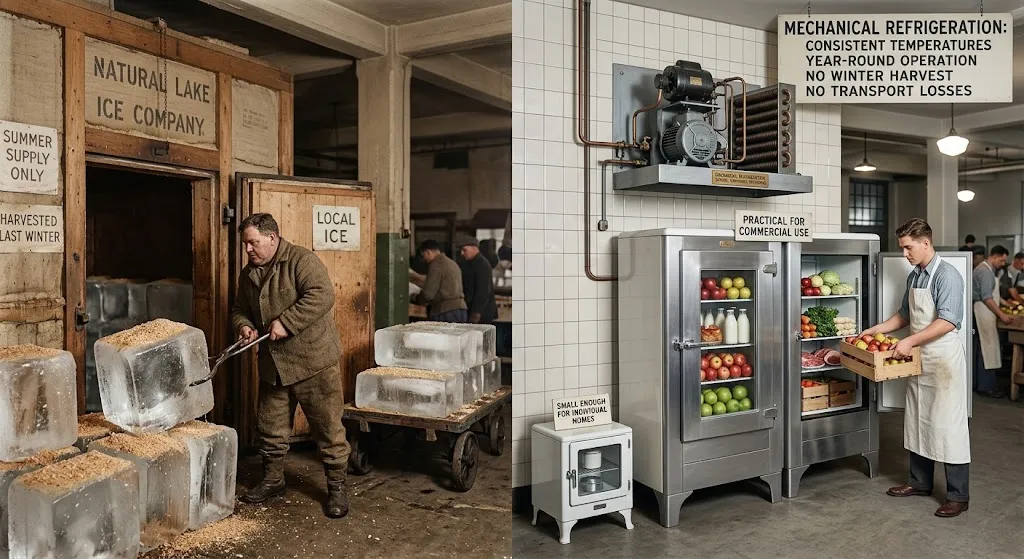
Refrigerators became increasingly practical for commercial and household use.
The advantages were obvious.
Mechanical refrigeration could:
- operate year-round,
- provide more consistent temperatures,
- eliminate dependence on winter harvesting,
- reduce transportation losses,
- and eventually become small enough for individual homes.
The ice industry had difficulty competing with a technology that could create cold wherever it was needed.
The End of an Extraordinary Industry
By the twentieth century, natural ice harvesting had declined dramatically in many parts of the world.
Refrigerators replaced iceboxes.
Artificial ice replaced much of the harvested natural ice.
Electricity and refrigeration technology transformed food storage.
The enormous ice houses that once stored thousands of tons of frozen lake ice became obsolete.
The ice man disappeared from most neighborhoods.
And the idea that cold should be manufactured locally replaced the idea that winter itself had to be transported.
Why Natural Ice Was Once So Valuable
It is easy to look back at the ice trade and wonder why anyone would spend so much effort moving frozen water around the world.
But the value was not really in the water.
The value was in cold.
Today, cold is produced almost invisibly.
A refrigerator maintains a low temperature day and night.
A supermarket freezer keeps food frozen.
An air conditioner cools a room.
A freezer produces ice in a few hours.
Because these technologies are so ordinary, it is easy to forget how extraordinary controlled cooling once was.
For earlier generations, cold was something nature provided only at certain times and in certain places.
The ice industry turned that natural resource into a commercial product.
Ice Made Global Trade More Practical
The nineteenth-century ice trade also demonstrated something important about globalization.
A product does not have to be rare in absolute terms to become valuable.
Ice was abundant in northern regions during winter.
But in tropical regions, naturally occurring ice was extremely difficult to obtain.
Transportation created a connection between these two environments.
Cold northern lakes could supply warm southern markets.
The same principle would later become even more powerful with refrigeration.
Instead of shipping ice to food, businesses could eventually refrigerate the food itself.
That was a major step toward today’s global food system.
The Strange Economics of Shipping Frozen Water
Few historical industries sound stranger than the business of transporting something that melts.
Imagine loading a ship with thousands of tons of ice knowing that part of the cargo would disappear before reaching its destination.
The entire business depended on careful calculations.
Companies had to consider:
- harvesting costs,
- storage losses,
- transportation expenses,
- insulation,
- labor,
- shipping distances,
- local demand,
- and selling prices.
If too much ice melted, the voyage could become unprofitable.
If enough survived, however, the profits could be substantial.
The success of the industry demonstrated that something apparently worthless in one location could become highly valuable somewhere else.
Ice as a Symbol of Industrial Ingenuity
The natural ice trade represents an unusual stage in technological history.
It did not eliminate nature.
Instead, it learned how to organize nature commercially.
Winter freezing became an industrial resource.
Frozen lakes became sources of raw material.
Sawdust became insulation.
Railroads became transportation systems for frozen goods.
Ships became floating cold-storage networks.
Iceboxes brought the system into people’s homes.
Eventually, refrigeration replaced the entire process.
In this sense, the history of ice is also the history of humanity’s gradual transition from depending on natural conditions to creating controlled environments.
What Happened to the Old Ice Houses?
Many commercial ice houses disappeared as refrigeration became dominant.
Some were demolished.

Others were converted to different uses.
In a few places, remnants of the old industry survived as historical structures or archaeological evidence.
Today, an old ice house can be difficult to recognize.
It may look like an ordinary warehouse, barn, or industrial building.
But historically, such structures could represent an essential part of a regional economy.
The Environmental Side of the Ice Trade
Natural ice harvesting did not require the energy-intensive refrigeration systems used today.
The freezing was done by nature.
However, the industry still had environmental consequences.
Large-scale harvesting altered frozen lake surfaces and required transportation networks.
The use of horses, railroads, and ships also involved considerable resource consumption.
At the same time, the industry eventually declined partly because industrial refrigeration offered a more reliable alternative.
Modern refrigeration has its own environmental costs, including electricity consumption and refrigerant use.
The transition from natural ice to mechanical cooling therefore represents not simply technological progress, but a changing relationship between humans, energy, and the natural environment.
Why the Story Still Matters
The history of ice harvesting can teach us something surprisingly relevant to modern life.
Many things that seem ordinary today were once difficult to obtain.
Cold is one example.
Clean running water, electricity, rapid transportation, instant communication, and year-round food availability all depend on systems that earlier generations could scarcely imagine.
The natural ice trade reminds us that convenience is often the result of enormous infrastructure.
When we open a refrigerator and find ice inside, we are benefiting from centuries of experimentation and technological development.
From Frozen Lakes to Refrigerators
The journey of ice from a frozen lake to a tropical city was one of the nineteenth century’s great logistical achievements.
Workers cut massive blocks from frozen water.
Horses moved them to storage.
Sawdust protected them from heat.
Railways carried them across continents.
Ships transported them across oceans.
Ice houses preserved them.
Delivery workers brought them into homes.
And eventually, machines made the entire process unnecessary.
What began as an attempt to sell winter to people living in warm climates helped accelerate the development of modern refrigeration.
The Remarkable Legacy of the Ice Trade
Today, ice is almost invisible as a commodity.
We make it at home, buy bags of it at stores, receive it in restaurants, and store it in freezers without giving it much thought.
But there was a time when obtaining ice required an enormous seasonal industry.
Men and horses worked on frozen lakes.
Huge blocks were cut, transported, stacked, insulated, shipped, and sold.
Natural ice crossed borders and oceans.
It became part of international commerce.
And for a period of history, winter itself was something that could be harvested and exported.
The story eventually ended when technology learned to create cold independently of the seasons.
But the old ice trade remains a remarkable example of human ingenuity: a time when people discovered that something as simple as a frozen lake could become the foundation of a worldwide business.
For more interesting articles, ideas, and insights on a wide range of topics, visit serdpestcp.org.



One thought on “How Ice Was Once Harvested and Shipped Around the World”