
Today, scientists can measure a kilogram using electricity, magnetism, gravity, and incredibly precise measurements. The instrument that makes this possible is called a Kibble balance.
For centuries, measuring a kilogram seemed like a straightforward task: place an object on a scale and compare its weight with a known standard. However, creating an accurate and universally reliable definition of a kilogram has been one of the most important challenges in modern science.
Unlike an ordinary weighing scale, a Kibble balance does not simply compare the weight of an object with another mass. Instead, it connects mechanical force with electrical power to determine mass using fundamental constants of nature.
But how can electricity measure something as familiar as a kilogram? And why did scientists develop such a sophisticated instrument in the first place?
Let’s explore how a Kibble balance works, why it changed modern measurement science, and what makes it so remarkably accurate.
What Is a Kibble Balance?
A Kibble balance is an extremely precise scientific instrument used to measure mass by comparing mechanical power with electrical power.
It was originally developed by British physicist Bryan Kibble in the 1970s. Initially known as the watt balance, the instrument was later renamed the Kibble balance in his honor.
Its main purpose is to provide a reliable way to realize the kilogram without depending on a physical reference object.
Traditional weighing scales measure mass by comparing an unknown object with a known mass. A Kibble balance takes a different approach. It uses electromagnetic forces to balance the gravitational force acting on an object.
The instrument combines several scientific principles, including:
- Electromagnetism, which describes the relationship between electricity and magnetic fields.
- Gravity, which determines the downward force acting on an object.
- Electrical resistance and voltage, which can be measured with extraordinary precision.
- Quantum physics, which provides highly accurate electrical measurement standards.
By combining these principles, scientists can determine mass through measurements linked to fundamental constants rather than relying on a physical kilogram artifact.
Why Did Scientists Need a New Way to Define the Kilogram?
For more than a century, the kilogram was defined by a physical object known as the International Prototype of the Kilogram.
This small cylinder, made from platinum and iridium, was kept under carefully controlled conditions at the International Bureau of Weights and Measures (BIPM) in France.
It served as the international reference for the kilogram. National measurement laboratories maintained copies and periodically compared them with the original.
Although the cylinder was designed to be extremely stable, it had one important limitation: it was still a physical object.
Over time, even tiny changes in its surface, contamination, cleaning, or handling could affect its mass. This created a fundamental problem. If the reference object changed, the definition of the kilogram could no longer be considered perfectly stable.
Scientists wanted a definition that would remain constant regardless of where or when measurements were performed.
In November 2018, representatives of the international scientific community approved a major change to the International System of Units (SI).
On May 20, 2019, the kilogram was officially redefined using the Planck constant, a fundamental constant of quantum physics.
The kilogram no longer depended on a physical metal cylinder. Instead, its definition became connected to an unchanging numerical value of a natural constant.
How Does a Kibble Balance Work?
At first, the idea of weighing something with electricity might sound complicated. However, the basic principle is surprisingly understandable.
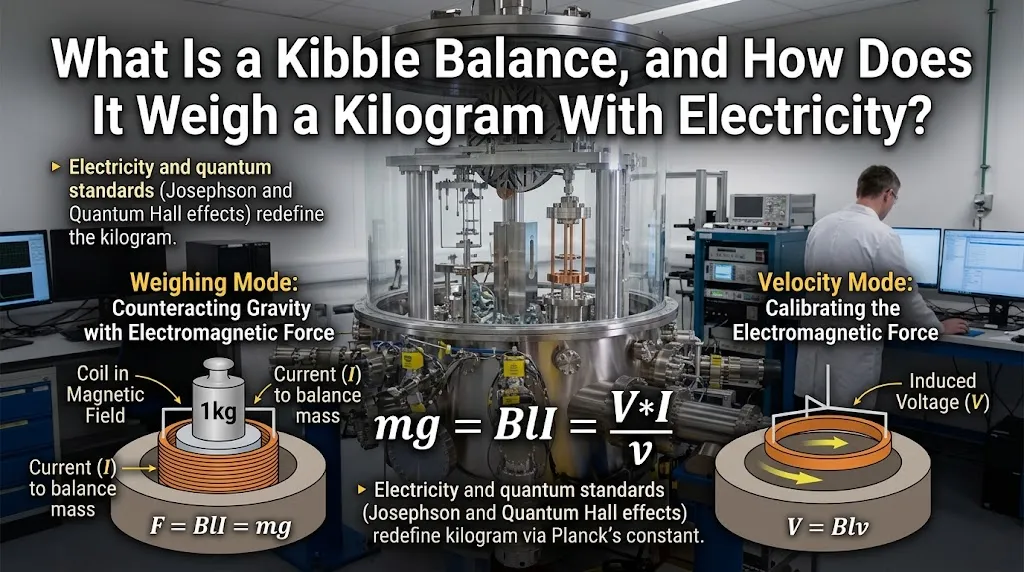
A Kibble balance uses a coil of wire positioned inside a magnetic field. When electric current flows through the coil, it produces an electromagnetic force.
That force can be used to counteract the gravitational force acting on a mass.
The instrument operates through two separate measurement stages.
1. The Weighing Mode: Balancing Gravity With Electromagnetic Force
Imagine placing a one-kilogram mass on a weighing platform connected to a coil of wire.
Gravity pulls the mass downward with a force equal to:
\[ F=mg \]
Where:
- F represents gravitational force.
- m represents the mass of the object.
- g represents the local acceleration due to gravity.
The coil is positioned inside a magnetic field. When an electric current passes through it, an electromagnetic force is generated.
This force acts in the opposite direction to gravity.
Scientists carefully adjust the current until the electromagnetic force balances the downward gravitational force.
At this point:
\[ mg=BLI \]
Where:
- B represents magnetic field strength.
- L represents the effective length of the wire inside the magnetic field.
- I represents electric current.
The mass is now balanced by an electromagnetic force rather than by another physical weight.
However, measuring the magnetic field and coil geometry with sufficient accuracy is extremely difficult. This is where the second measurement stage becomes essential.
2. The Velocity Mode: Measuring the Coil’s Movement
In the second stage, the same coil is moved vertically through the magnetic field at a carefully measured velocity.
As the coil moves, it generates an electrical voltage through electromagnetic induction.
The induced voltage is described by:
\[ U=BLv \]
Where:
- U represents the induced voltage.
- B represents magnetic field strength.
- L represents the effective wire length.
- v represents the velocity of the coil.
This measurement is extremely important because it allows scientists to determine the relationship between the magnetic field and the coil’s geometry.
The same magnetic field and coil arrangement are involved in both measurement stages.
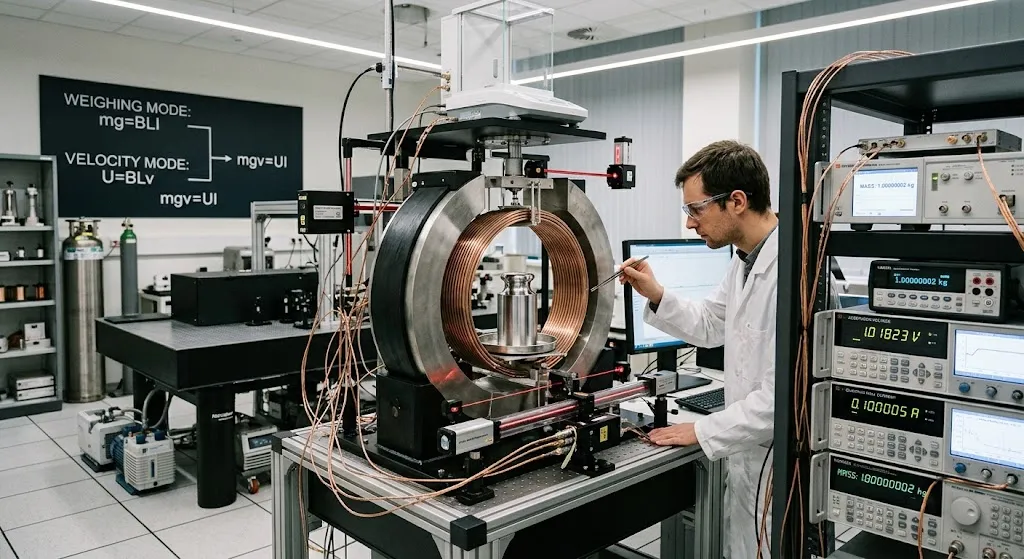
By combining the two equations, scientists can eliminate the difficult-to-measure magnetic field and coil geometry.
The resulting relationship is:
\[ mgv=UI \]
In simple terms, the mechanical power associated with lifting the mass equals the electrical power measured in the instrument.
This is the fundamental principle behind the Kibble balance.
How Can Electricity Actually Determine a Kilogram?
The key to understanding the Kibble balance is recognizing that electrical measurements can be connected to fundamental constants of nature.
Modern electrical metrology uses two important quantum effects:
The Josephson effect
This effect allows scientists to establish extremely accurate voltage measurements using the Josephson constant and precisely controlled electromagnetic radiation.
The Quantum Hall effect
This phenomenon provides an exceptionally accurate way to determine electrical resistance through the von Klitzing constant.
Both effects are connected to two fundamental constants:
- The Planck constant (h).
- The elementary electric charge (e).
The Josephson effect provides a highly accurate voltage standard, while the quantum Hall effect provides a highly accurate resistance standard. Together, they allow electrical power to be measured with extraordinary precision.
Since electrical power can be expressed as:
\[ P=UI \]
And resistance and voltage can be measured using quantum electrical standards, scientists can establish the electrical power needed for the Kibble balance calculation.
The Planck constant has an exact defined value in the International System of Units:
\[ h=6.62607015\times10^{-34}\ J\cdot s \]
This exact numerical value helps establish the kilogram through the relationship between mechanical and electrical power.
The instrument does not directly detect a kilogram through electricity. Instead, it uses precisely measured electrical quantities, gravity, and the defined Planck constant to calculate mass.
Why Is the Planck Constant So Important?
The Planck constant is one of the fundamental constants of quantum physics.
It describes the relationship between the energy of a photon and its frequency:
\[ E=hf \]
Where:
- E is energy.
- h is the Planck constant.
- f is frequency.
Although the Planck constant is incredibly small, it plays a central role in describing how energy behaves at the quantum level.
By assigning it an exact numerical value, scientists established a stable foundation for defining the kilogram.
This was a major scientific achievement because fundamental constants are not dependent on a particular laboratory, physical object, or geographical location.
The same definition can be used anywhere in the world, provided the necessary measurement equipment and techniques are available.
How Accurate Is a Kibble Balance?
A Kibble balance is designed for extremely precise measurements, far beyond the capabilities of ordinary commercial weighing scales.
Depending on the instrument and experimental conditions, advanced Kibble balances can achieve relative measurement uncertainties at the level of a few parts in 100 million or better.
This means that even very small differences in mass can be detected and investigated.
However, achieving this accuracy requires careful control of numerous factors, including:
- Local gravitational acceleration.
- Air buoyancy and environmental conditions.
- Temperature variations.
- Mechanical vibrations.
- Magnetic field stability.
- Electrical voltage and resistance measurements.
- Precise measurement of the coil’s velocity.
Gravity itself varies slightly depending on geographical location and altitude. Therefore, scientists must determine the local gravitational acceleration with exceptional accuracy.
Every part of the measurement process matters because even a tiny experimental error can influence the final result.
Where Are Kibble Balances Used?
Kibble balances are primarily used by national metrology institutes and advanced scientific laboratories.
Their importance extends across several areas of science and technology.
1. National measurement standards
They help national laboratories establish and maintain accurate mass standards based on the modern definition of the kilogram.
2. Scientific research
Researchers use them to investigate fundamental physical relationships and improve the accuracy of measurements.
3. Industrial calibration
Highly accurate mass standards support industries that depend on precise measurements, including pharmaceutical manufacturing, electronics, aerospace, and advanced engineering.
4. International measurement consistency
Kibble balances help laboratories around the world maintain compatible measurement standards, supporting international scientific cooperation and reliable trade.
Although these instruments are expensive and technically complex, their contribution to measurement science is significant.
Kibble Balance vs. Traditional Weighing Scales
The difference between an ordinary scale and a Kibble balance is not simply accuracy. It is the fundamental principle used to determine mass.
| Feature | Traditional scale | Kibble balance |
|---|---|---|
| Measurement principle | Compares masses or measures force | Compares mechanical and electrical power |
| Main mechanism | Weights, springs or load cells | Electromagnetic coil and magnetic field |
| Reference | Calibrated mass or force standard | Planck constant and electrical standards |
| Accuracy | Depends on instrument type | Extremely high scientific precision |
| Main application | Everyday and industrial weighing | National scientific mass standards |
A traditional scale remains perfectly suitable for everyday tasks, from weighing groceries to measuring industrial materials.
A Kibble balance, on the other hand, is designed for applications where the highest possible measurement accuracy is essential.
The Future of Mass Measurement
The redefinition of the kilogram represents an important step toward a measurement system based entirely on fundamental constants of nature.
Scientists no longer need to preserve a single physical object as the ultimate reference for mass. Instead, they can reproduce the kilogram through carefully designed experiments and internationally agreed measurement procedures.
Kibble balances are an important part of this transformation.
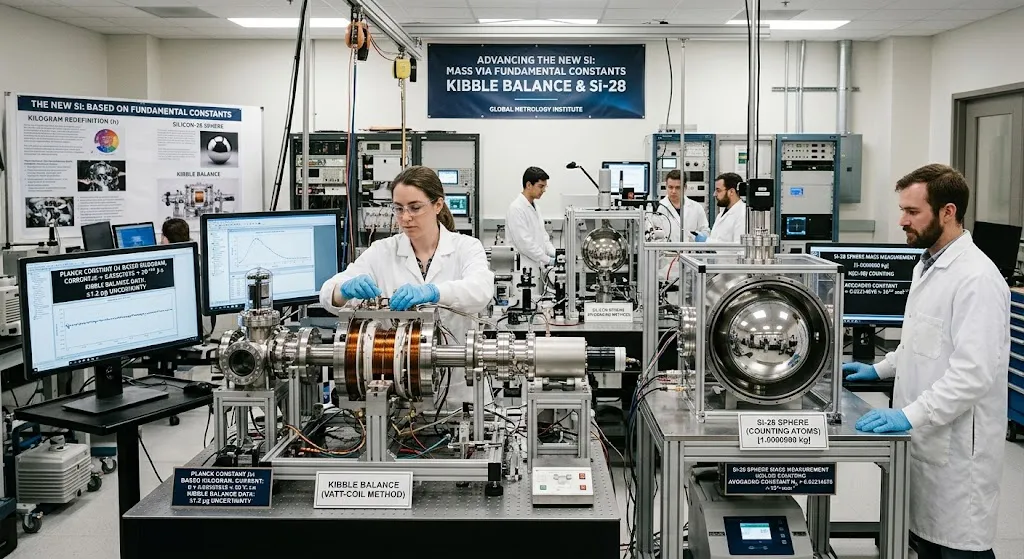
As technology advances, researchers continue to improve their stability, reduce measurement uncertainty, and explore ways to make highly accurate mass measurements more accessible.
Other experimental approaches, including silicon-28 sphere measurements, also contribute to realizing and verifying the kilogram under the modern SI definition.
Together, these developments demonstrate how fundamental physics can improve something as practical and universal as measuring weight.
Final Thoughts
A Kibble balance demonstrates how seemingly different areas of physics can work together to solve a fundamental scientific problem.
By combining gravity, electromagnetism, electrical power, and quantum physics, scientists can determine a kilogram without relying on a physical metal reference.
The idea is remarkable: electricity does not simply power the instrument; precisely measured electrical quantities become part of the process used to establish mass itself.
What began as an effort to create a more reliable definition of one kilogram has become an extraordinary example of modern measurement science.
The Kibble balance reminds us that even the simplest units we use every day can have surprisingly complex scientific foundations.


One thought on “What Is a Kibble Balance, and How Does It Weigh a Kilogram With Electricity?”