
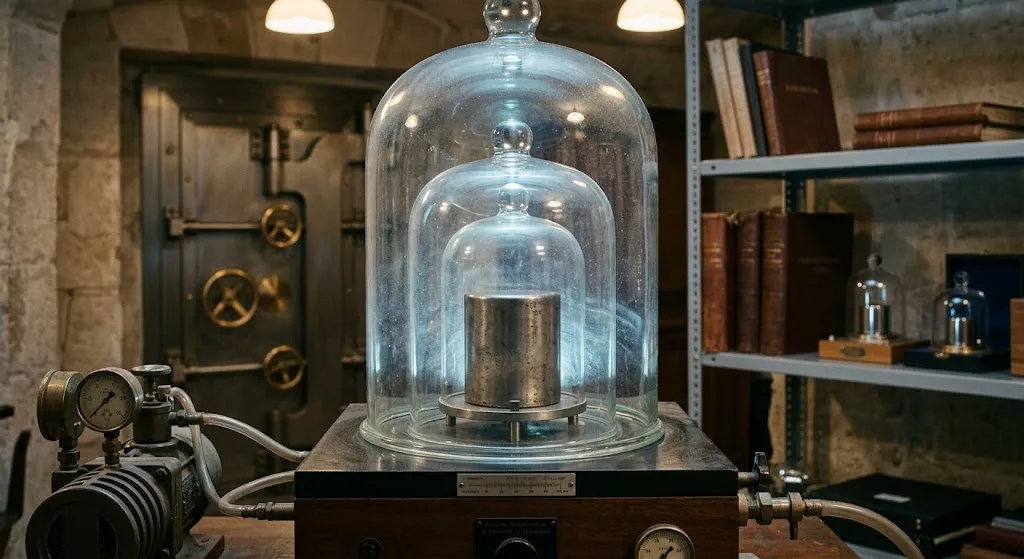
For more than a century, the kilogram was defined by a small metal cylinder stored inside a secure vault in France. This unusual arrangement might sound like something from a spy movie, but it was once the foundation of the world’s system of mass measurement. Scientists, manufacturers, laboratories, and governments relied on this physical object to establish what one kilogram meant.
The cylinder was known as the International Prototype of the Kilogram, and its history reveals why scientists eventually decided that even the most carefully protected object was not reliable enough to define a fundamental unit of measurement.
Why the World Needed a Standard Kilogram
Before modern measurement systems were established, people used different units to measure the mass of goods. These units varied between countries, cities, and even individual markets. A pound in one location might not have represented exactly the same mass as a pound somewhere else.
This inconsistency created practical problems for international trade, scientific experiments, and industrial production. Scientists needed measurements that could be reproduced accurately, regardless of where or when they were performed.
During the late eighteenth century, France played an important role in developing the metric system. The kilogram became its basic unit of mass, originally connected to the mass of a cubic decimeter of water under specified conditions.
Although this approach offered a scientific foundation, measuring water precisely enough for the highest levels of accuracy was difficult. Scientists therefore moved toward a physical standard that could be manufactured, preserved, and compared with other masses.
The Creation of the International Prototype of the Kilogram
In 1889, the first General Conference on Weights and Measures officially adopted the International Prototype of the Kilogram as the international standard for the kilogram.
The prototype was a small cylinder made primarily of platinum, with approximately 10 percent iridium. This alloy was chosen because it was highly resistant to corrosion, durable, and suitable for maintaining a stable physical form over long periods.
The cylinder measured approximately 39 millimeters in both height and diameter. Despite its modest size, it represented the internationally recognized kilogram.
The prototype was kept at the International Bureau of Weights and Measures, known by its French abbreviation, BIPM, in Sèvres near Paris. It was protected in a specially controlled environment and stored under secure conditions to minimize the risk of contamination, damage, or other changes.
The object became the ultimate reference against which official copies could be compared. Those copies, in turn, helped countries maintain consistent mass measurements within their own national measurement systems.
Why Was the Kilogram Kept in a Vault?
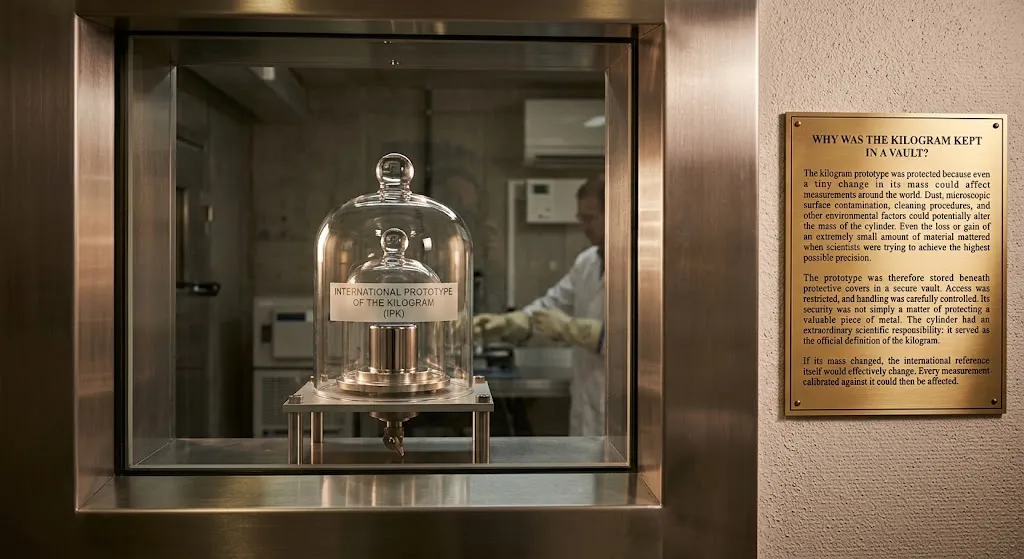
The kilogram prototype was protected because even a tiny change in its mass could affect measurements around the world.
Dust, microscopic surface contamination, cleaning procedures, and other environmental factors could potentially alter the mass of the cylinder. Even the loss or gain of an extremely small amount of material mattered when scientists were trying to achieve the highest possible precision.
The prototype was therefore stored beneath protective covers in a secure vault. Access was restricted, and handling was carefully controlled.
Its security was not simply a matter of protecting a valuable piece of metal. The cylinder had an extraordinary scientific responsibility: it served as the official definition of the kilogram.
If its mass changed, the international reference itself would effectively change. Every measurement calibrated against it could then be affected.
This arrangement worked remarkably well for many decades, but it also revealed a fundamental weakness in defining a unit through a physical object.
The Problem With Defining Mass Through a Physical Object
A physical object may appear permanent, especially when made from a highly stable metal alloy and stored under controlled conditions. However, no material object can be guaranteed to remain absolutely unchanged forever.
Over time, the International Prototype of the Kilogram and its official copies showed small differences in their measured masses relative to one another. Scientists could not simply assume that the prototype had changed, because the copies might also have gained or lost material.
The difficulty was that the prototype itself was the reference. There was no independent definition that could conclusively establish which object had changed.
This created a scientific limitation. The kilogram was supposed to be a universal unit, but its definition depended on a single object in one location.
A measurement system intended for use throughout the world would be more reliable if its fundamental units were based on natural constants that could be reproduced through experiments rather than on the condition of a particular artifact.
How Scientists Replaced the Metal Cylinder
Scientists spent decades developing methods to define mass with greater precision and independence from physical objects.
One important breakthrough involved the Planck constant, a fundamental constant of quantum physics. The constant connects the energy of a quantum of electromagnetic radiation with its frequency and plays a central role in modern physics.
By the twenty-first century, scientists had developed experimental techniques capable of linking mass measurements to the Planck constant. One of the most important instruments was the Kibble balance, which compares mechanical power with electrical power to determine mass using precisely measured physical quantities.
Another technique involved highly accurate measurements of silicon spheres, which helped researchers determine the number of atoms in a carefully characterized crystal.
Together, these methods provided the experimental foundation needed to redefine the kilogram without relying on the metal cylinder.
On May 20, 2019, the revised definition of the kilogram officially took effect. Instead of being defined by the International Prototype of the Kilogram, the kilogram was defined by fixing the numerical value of the Planck constant at exactly 6.62607015 × 10⁻³⁴ joule-seconds.
The new definition connects the kilogram to a fundamental constant of nature and allows suitably equipped laboratories to realize the unit through validated experimental methods.
Does the New Definition Mean That a Kilogram Changed?

No. The redefinition did not mean that a kilogram of flour suddenly became heavier or lighter.
For everyday purposes, a kilogram before 2019 and a kilogram today represent the same familiar amount of mass. The change concerned how the unit is scientifically defined and reproduced, not the quantities used in ordinary life.
The new system was designed to maintain continuity with the previous definition while improving the long-term reliability of high-precision measurements.
Most people will never need to use a Kibble balance or understand the Planck constant to weigh groceries, prepare a recipe, or measure luggage. However, advanced scientific research, pharmaceutical manufacturing, semiconductor production, and precision engineering benefit from measurement standards that can be reproduced with exceptional accuracy.
Why This Change Matters Today
Replacing the metal prototype represented a major achievement in the history of measurement science.
A unit defined through a fundamental constant does not depend on the survival, location, or physical condition of a particular artifact. Instead, its realization depends on reproducible experiments and established scientific procedures.
This principle also reflects a broader development in modern measurement. Scientists increasingly seek definitions grounded in universal constants, making measurements more consistent across laboratories and countries.
The kilogram’s history illustrates how scientific standards evolve. A metal cylinder was once the most practical way to establish a shared international reference. As measurement technology improved, scientists found a more fundamental and reproducible alternative.
Conclusion
For more than a century, a small platinum-iridium cylinder in a secure vault near Paris served as the world’s official kilogram. Its stability and careful protection made international mass measurements possible, but its dependence on a single physical object eventually became a limitation.
In 2019, scientists replaced that definition with one based on the Planck constant, creating a measurement standard that can be realized through precise experiments rather than comparison with a unique artifact.
The story of the kilogram demonstrates that scientific progress is not always about inventing a new instrument or discovering a new material. Sometimes, it means finding a better way to define something the world has used for generations.
For more interesting articles about science, technology, history, and everyday discoveries, visit serdpestcp.org.
Sources
- International Bureau of Weights and Measures (BIPM): information on the International Prototype of the Kilogram, the 2019 redefinition of the SI, and the history of the metric system
- BIPM, The International System of Units (SI Brochure), 9th edition: official definitions of the kilogram, the Planck constant, and the other SI base units
- General Conference on Weights and Measures (CGPM): resolutions from the 1st meeting (1889) and the 26th meeting (2018), which adopted the revised SI
- National Institute of Standards and Technology (NIST): explanations of the kilogram redefinition and the Kibble balance
- National Physical Laboratory (NPL), UK: background on how mass is realized and measured with the new definition

5 thoughts on “Why a Kilogram Used to Be a Metal Cylinder in a Vault in France”