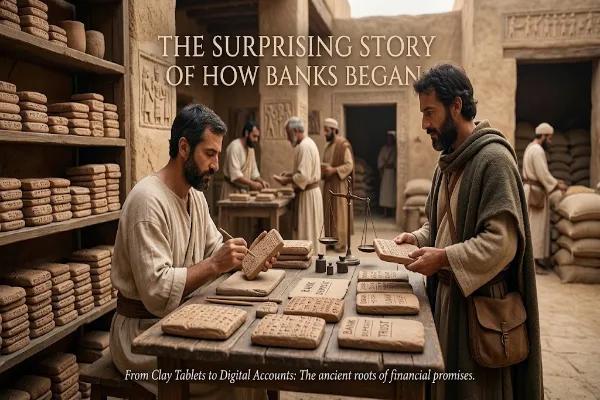
When people think about banks, they usually imagine modern buildings, ATMs, online banking apps, credit cards, and complicated financial systems. Today, banks are deeply connected to everyday life, helping people save money, borrow funds, make payments, and run businesses.
But banking did not begin with computers, paper money, or even modern coins. Its origins reach back thousands of years, to a time when people stored valuable goods in temples, merchants financed long-distance trade, and written records were carved into clay tablets.
The story of banking is therefore much older—and more surprising—than many people realize.
Before Banks, There Was Barter
The earliest human communities generally relied on direct exchange. A farmer might exchange grain for tools, livestock, clothing, or other goods.
This system worked reasonably well when communities were small, but it had an obvious problem: both sides had to want what the other person possessed.
If a farmer had wheat but wanted a pair of shoes, the shoemaker had to want wheat at the same time. This problem encouraged societies to develop objects that could function as more widely accepted forms of value.
Grain, livestock, precious metals, and other commodities were used in different places. Eventually, standardized pieces of metal became increasingly important in trade.
But another problem remained: how could people safely store valuable goods, and how could they borrow what they needed?
That is where some of the earliest forms of banking began to appear.
Ancient Temples Were More Than Places of Worship
One of the most fascinating parts of banking history comes from ancient Mesopotamia.
Thousands of years ago, temples and large institutions in Mesopotamian cities played important economic roles. They could store grain, precious metals, and other valuable goods. Because these institutions were trusted and protected, people could deposit goods there.

Records were kept to document what had been deposited and what had been taken out.
In this sense, some ancient institutions performed functions that resemble those of modern financial organizations.
Loans also existed.
Farmers and merchants could borrow grain, silver, or other resources and agree to repay them later, sometimes with an additional amount. Written records helped establish the terms of these arrangements.
The system was obviously very different from modern banking, but the basic idea was familiar: one party provided resources to another with the expectation of repayment.
The First Bankers Were Often Merchants
Banking did not develop only inside temples.
Merchants also became important financial intermediaries because long-distance trade created a constant need for credit and payment services.
Imagine a merchant living thousands of years ago who wanted to purchase goods from a distant city. Carrying large amounts of precious metal over long distances could be dangerous.
A financial arrangement could make trade much easier.
Instead of transporting all of his wealth, a merchant might use a written document or an arrangement with another trusted merchant. Such systems gradually made it possible to separate the movement of money from the physical movement of valuable objects.
This was an important step toward modern banking.
Ancient Greece Added New Financial Services
Banking practices became increasingly sophisticated in the ancient Greek world.
Greek bankers, sometimes known as trapezitai, accepted deposits, exchanged currencies, transferred money, and provided loans.
The word itself is interesting because it was associated with the Greek word for a table. A banker could conduct business from a table where money was counted and exchanged.
Greek city-states used different currencies, which created opportunities for money changers.
A traveler or merchant arriving from another city might need to exchange one type of coin for another. Money changers therefore became important figures in commercial life.
Some also provided credit.
Banking was becoming more than simply storing valuable objects. It was becoming a service that connected people who had money with people who needed it.
Rome Took Banking Even Further
The Romans developed sophisticated commercial and financial practices of their own.
Roman bankers handled deposits, loans, payments, and currency exchange. Financial records were important because Roman commerce could involve large sums and transactions across considerable distances.
Roman banking also demonstrates something that would become a recurring theme throughout financial history: banking grows when trade grows.
The more people buy, sell, travel, build businesses, and conduct transactions across long distances, the greater the need for reliable financial intermediaries.
Medieval Europe Changed the Banking World
After the decline of the Western Roman Empire, European economic life changed considerably. However, financial activity did not disappear.
Trade gradually expanded again during the Middle Ages, particularly as cities and commercial centers grew.
Italian city-states became especially important in the development of European banking.
Cities such as Florence, Venice, and Genoa became major centers of commerce. Wealthy merchant families developed businesses that handled increasingly complicated financial transactions.
Among the most famous were the Medici family of Florence.
The Medici Bank, founded in the 15th century, became one of the most influential banking organizations of Renaissance Europe.
Its success was partly based on its network of branches and its ability to facilitate international trade.
The Letter of Credit Solved a Dangerous Problem
One of the most important developments in medieval banking was the increasing use of financial documents instead of physically transporting large amounts of money.
Consider a merchant traveling from Florence to London.

Carrying a fortune in gold and silver would create obvious risks. Thieves could steal it, transportation could be difficult, and different regions used different currencies.
A financial document could solve part of the problem.
Through arrangements between merchants and financial institutions, payments could be made at another location without requiring the original traveler to carry all of the physical money.
This concept eventually contributed to the development of bills of exchange, letters of credit, and other financial instruments.
Modern banking still relies on the same broad principle: money does not always have to physically travel with the person who owns it.
Why Banks Became Necessary
Banking developed because economies became too complicated for simple cash transactions.
As cities grew, businesses needed capital.
A merchant might have an excellent opportunity to purchase goods but not enough money available at that moment. A loan could allow the transaction to happen.
A farmer might need resources before the harvest.
A builder might need money before a project generated income.
A trader might need to move funds between different cities.
Banks and other financial institutions gradually developed services to address these problems.
In simple terms, banking helped move money through time and space.
It allowed people to use resources today based on expected income tomorrow.
The Rise of Public Banks
As economies became larger and governments became more involved in financial systems, another important development occurred: the creation of public banks.
One famous example was the Bank of Amsterdam, established in 1609.
It was designed partly to improve the reliability of payments and reduce problems caused by the enormous variety of coins circulating in Europe.
Public institutions could provide greater stability and confidence in financial transactions.
This was an important step toward the modern concept of a regulated banking system.
The Bank of England Changed the Game
In 1694, the Bank of England was established.
It was created in a period when the English government needed to raise money, and the institution became an important part of the country’s financial system.
Over time, the Bank of England developed into a central institution within Britain’s monetary and banking system.
The emergence of institutions such as the Bank of England helped establish an important distinction between ordinary commercial banks and institutions that play broader roles in the financial system.
Eventually, central banks would become responsible for functions such as managing monetary policy, supporting financial stability, and issuing or overseeing national currency systems.
When Paper Money Became Important
For much of history, coins made from valuable metals were an important form of money.
But coins had limitations.
They were heavy, difficult to transport in large quantities, and expensive to produce.
Paper instruments offered a solution.
In China, paper money appeared centuries before it became common in Europe. Chinese governments eventually developed sophisticated systems involving paper currency.
Europe later developed its own paper-money systems, although the transition took considerable time.

Banks also issued notes that represented claims on money deposited with them.
This created another important transformation: money increasingly became something represented by a document rather than something that had to possess intrinsic value itself.
Banking Was Always About Trust
There is one ingredient that has remained essential throughout the entire history of banking: trust.
A bank is fundamentally based on promises.
When someone deposits money, they expect to be able to access it later.
When a bank makes a loan, it expects repayment.
When one financial institution transfers money to another, both sides need confidence that the transaction will be honored.
Without trust, banking becomes extremely difficult.
This is why governments eventually introduced regulations, accounting standards, supervision, and other safeguards.
Modern banking may look highly technological, but underneath the technology is an ancient concept: a financial promise that people believe will be honored.
Banks Do Not Simply Keep Everyone’s Money in a Vault
One common image of a bank is a giant vault filled with customers’ money.
Although banks certainly hold reserves and physical cash, modern banking is much more complicated.
Commercial banks generally use deposits and other sources of funding to support lending and other financial activities.
When a bank provides a loan, it can create a deposit in the borrower’s account. That money can then enter the wider economy through spending and payments.
This is one reason banks can have such a powerful influence on economic activity.
When credit is easily available, businesses and consumers may spend and invest more.
When banks become reluctant to lend, economic activity can slow.
Banking Helped Create Modern Business
The development of banking was closely connected to the development of modern capitalism and international commerce.
Businesses needed financing to purchase inventory, construct buildings, hire workers, transport goods, and expand into new markets.
Large commercial projects often required more money than a single individual could provide.
Banks helped pool financial resources and direct them toward businesses and investments.
This made it possible for economic activity to expand on a much larger scale.
Banking Crises Also Have a Long History
Banking has never been a completely smooth story.
Banks can fail.
People can lose confidence.
Borrowers can become unable to repay loans.
Financial institutions can make poor investments.
When many people attempt to withdraw their deposits at the same time, a bank can face serious problems.
Such events are known as bank runs.
History contains numerous examples of banking crises, demonstrating that financial systems can be powerful but also fragile.
These crises contributed to the development of deposit insurance, central-bank intervention, banking regulation, capital requirements, and other safeguards.
From Bank Buildings to Online Banking
The physical bank became a familiar part of everyday life during the 19th and 20th centuries.
People visited branches to deposit money, withdraw cash, cash checks, apply for loans, and speak with bank employees.
Then technology began changing the industry.
Telephones allowed transactions and communication over long distances.
Computers transformed record keeping.
ATMs allowed customers to withdraw cash without visiting a teller.
Credit and debit cards reduced the need to carry cash.
Online banking eventually allowed customers to manage their accounts from home.
Today, smartphones can perform many tasks that once required a visit to a bank branch.
Yet despite all these technological changes, the basic functions remain surprisingly familiar.
People still save.
People still borrow.
Businesses still need financing.
Payments still need to be transferred.
And financial institutions still depend on trust.
The Surprising Connection Between Ancient Banking and Modern Banking
The distance between an ancient Mesopotamian financial record and a modern banking application may seem enormous.
One involved clay tablets.
The other involves servers, encryption, smartphones, and digital networks.
But the underlying questions are remarkably similar.
Who owns the money?
Who owes the money?
When must it be repaid?
How much is involved?
Who can be trusted?
How can the transaction be recorded?
These questions have existed for thousands of years.
Technology has changed the way the answers are recorded and delivered, but the fundamental financial problems remain surprisingly constant.
Banking Is Really a Story About Human Cooperation
The history of banking is sometimes presented as a history of money.
It is more accurately a history of cooperation.
Banking allows strangers to make financial arrangements with one another.
A depositor trusts a bank.

A bank trusts a borrower.
A merchant trusts a payment system.
A customer trusts a financial institution to record transactions correctly.
Entire economies depend on millions of these relationships functioning every day.
That is why banking is ultimately about much more than coins, notes, accounts, and interest rates.
It is about creating systems that allow people to exchange value across time and distance.
From Clay Tablets to Digital Accounts
The next time you transfer money using a banking application, it is worth remembering how extraordinary the history behind that simple action really is.
Thousands of years ago, people were already recording debts and deposits on clay tablets.
Ancient merchants were already using credit.
Money changers were already exchanging currencies.
Medieval bankers were already developing methods for transferring value without carrying piles of coins.
Modern banks inherited these ideas and transformed them through technology, regulation, and increasingly sophisticated financial systems.
The bank in your smartphone may look nothing like a merchant’s table in ancient Greece or a Renaissance banking house in Florence.
But the fundamental idea is remarkably old.
People have always needed a trusted way to store value, borrow resources, make payments, and keep track of financial promises.
That simple need helped create banking—and ultimately helped shape the modern world.
For more informative articles, practical guides, and interesting topics across a wide range of subjects, visit serdpestcp.org and explore more.