A person’s name can seem like one of the simplest facts about them. We introduce ourselves by our first name, write our surname on official documents, and often carry the same family name through several generations. Yet surnames have a surprisingly complicated history.
A surname can preserve a clue about an ancestor’s occupation, the place where a family lived, the name of a parent, a physical characteristic, or even an old nickname. Some surnames began as practical descriptions used to distinguish people who shared the same first name. Others developed from local languages, titles, occupations, religious traditions, or geographical features.
Today, surnames are generally treated as permanent parts of a person’s identity. Historically, however, they were often much more flexible. A name that eventually became hereditary may have started as nothing more than a description of one individual.
The story of surnames is therefore also a story about how societies changed. As populations grew, communities became more organized, governments created records, taxes were introduced, and legal documents became increasingly important. These developments gradually transformed temporary personal descriptions into inherited family names.
Why Did People Need Surnames?
For much of human history, people did not necessarily need surnames.
In a small village, everyone might know who a person was simply by their first name. If there were only a few people named John, for example, the community could distinguish them easily through context.
But as towns and populations grew, the same names became increasingly common.
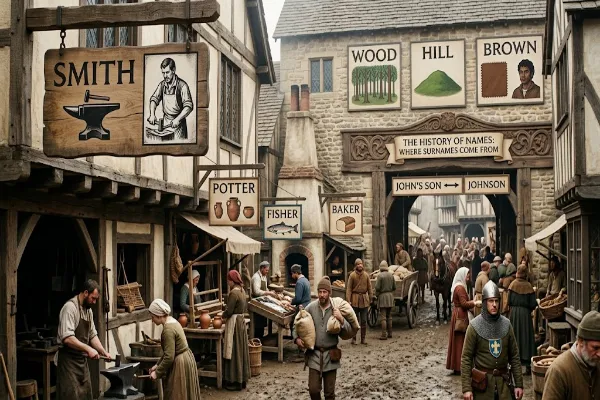
Imagine a medieval village containing several men called William. Simply saying “William” would no longer be enough. People might begin referring to them as William the blacksmith, William from the hill, William’s son, or William with the red hair.
These descriptions could eventually become surnames.
This process did not happen everywhere at the same time. Different societies developed hereditary surnames for different reasons and at different periods. Some cultures traditionally placed greater emphasis on patronymic naming, while others developed fixed family names relatively early.
The important point is that surnames were originally practical.
They helped answer a basic question:
Which person are we talking about?
Over generations, the description could become attached permanently to a family.
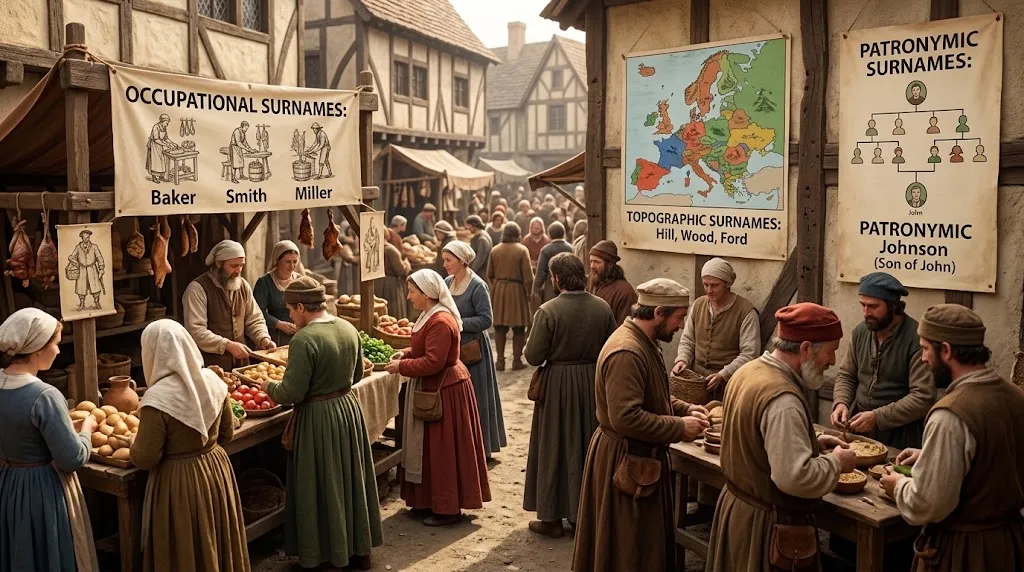
Surnames Based on Occupations
One of the most recognizable sources of surnames is occupation.
People were frequently identified by what they did for a living. A person who worked as a blacksmith might be called “the smith.” A baker could become known as “the baker,” while a carpenter might be identified by the equivalent occupational word in the local language.
Over time, such descriptions could become hereditary.
This is why occupational surnames appear in many different languages. The exact spelling and pronunciation vary, but the basic idea is remarkably universal.
Common examples include surnames associated with:
- Smith
- Baker
- Carpenter
- Fisher
- Miller
- Cooper
- Weaver
- Mason
- Cook
- Shepherd
Some occupational surnames are obvious to modern speakers, while others have become difficult to recognize because the original occupation disappeared or the language changed.
A surname that once had a very specific meaning may therefore survive long after the original profession has vanished.
Why Occupational Names Became Hereditary
An interesting feature of occupational surnames is that the surname did not necessarily describe the occupation of the person who carried it.
If someone’s ancestor was a miller, later generations might continue using the family surname even if nobody in the family worked at a mill.
Eventually, the surname stopped functioning as an occupational description and became simply a family name.
This illustrates one of the most important developments in surname history: names gradually became detached from their original meanings.
Surnames From Fathers and Ancestors
Another major source of surnames is ancestry.
In many societies, a person could be identified as the son or daughter of someone else. These names are called patronymic or matronymic names depending on whether they derive from the father or mother.
A name meaning “son of John” might eventually become a hereditary surname.
Different languages created different forms of these names.
In some naming traditions, a suffix was added to indicate “son of.” In others, the entire phrase was shortened or transformed into a family name.
Examples from European naming traditions include names such as Johnson, meaning historically “son of John,” and many other surnames formed from personal names.
Not every surname ending in a particular suffix necessarily has exactly the same historical origin, but patronymic naming is one of the most widespread sources of family names.
Patronymic Naming in Eastern Europe
Patronymic traditions are especially interesting in parts of Eastern Europe and the Balkans.
In some communities, a person’s identity could historically be expressed through their father’s name rather than through a fixed hereditary surname. As governments and administrative systems developed, these temporary identifiers increasingly became standardized.
A family might therefore acquire a surname that originally referred to an ancestor several generations earlier.
This is one reason that surnames can preserve the memory of individuals whose lives would otherwise have disappeared from historical records.
Surnames Based on Places
Geography has also produced countless surnames.
A person might be identified according to the village, town, region, river, hill, forest, or other geographical feature associated with them.
For example, someone who moved from one village to another might be described as “the person from [place].” Eventually, that geographical description could become a surname.
Some surnames therefore contain clues about where an ancestor lived.
These names may refer to:
- Villages
- Cities
- Regions
- Mountains
- Rivers
- Valleys
- Forests
- Fields
- Roads
- Castles
- Farms
Place-based surnames can be especially useful to genealogists, although they should not automatically be interpreted as proof that a family originated in the place suggested by its name.
A surname can travel.
A person may have received a geographical surname after moving away from the place associated with it. Once the surname became hereditary, later generations could live hundreds of kilometers away while retaining the same geographical reference.
Surnames From Physical Characteristics
Another fascinating category comes from physical appearance.
Before modern identification systems existed, people often distinguished individuals through visible characteristics.
Someone might be known for having:
- Dark hair
- Light hair
- Red hair
- A tall stature
- A short stature
- A particular complexion
- A distinctive facial feature
Words describing these characteristics could eventually become names.
Many modern surnames that appear to describe someone’s appearance may therefore have originated as nicknames.
The original meaning could be literal, but it could also have been figurative, humorous, ironic, or even teasing.
This makes interpretation difficult.
A surname that appears to mean “small,” for example, does not necessarily prove that the original ancestor was physically small. Historical nicknames could be used ironically or metaphorically.
Surnames From Nicknames
Nicknames are among the oldest sources of personal identification.
A community might give someone a nickname based on their personality, behavior, appearance, habits, or reputation.
Someone might be known as:
- The cheerful one
- The quiet one
- The strong one
- The wise one
- The young one
- The old one
- The red-haired one
- The fast one
If the nickname became associated with the person’s children or descendants, it could eventually become a hereditary surname.
This explains why some surnames have meanings that seem unusual or even humorous today.
A surname that sounds ordinary in modern society may once have been a vivid description of an individual.
Surnames From Animals
Animals have also played an important role in surname formation.
Families acquired names connected with animals for many possible reasons. An animal might have been associated with a person’s appearance, personality, occupation, nickname, coat of arms, home, or local landscape.
Names associated with animals such as wolves, bears, foxes, birds, horses, and deer appear in many cultures.
The original meaning is not always obvious.
A person called “Fox,” for instance, may not have owned foxes or worked with them. The name could have been a nickname referring to cleverness, appearance, behavior, or another association.
Animal-based surnames demonstrate how difficult it can be to reconstruct the precise story behind an old family name.
Surnames From Religion
Religion has also influenced naming traditions.
Personal names were frequently drawn from religious figures, saints, biblical characters, or other important spiritual traditions. Over time, some of these personal names became family names.
Religious institutions also played an important role in preserving names in written records.
Church registers documenting baptisms, marriages, and burials became particularly valuable sources for genealogists. Once these records became systematic, surnames were more likely to be recorded consistently.
In some historical situations, religious institutions also influenced the surnames assigned to people who lacked known family identities.
This means that a surname can sometimes reflect not only family ancestry but also the circumstances under which an individual entered a particular community.
Surnames and Social Status
Names can sometimes reveal something about historical social structures.
Some surnames originated from titles, ranks, positions, or relationships with powerful households.
Others were associated with land ownership, military service, administration, or particular social roles.
However, surname interpretation must be approached carefully.
A surname that sounds aristocratic does not necessarily mean that every person carrying it descended from nobility. Similarly, a surname associated with an occupation does not mean that every modern member of the family practiced that occupation.
Names survive much longer than the social circumstances that created them.
Why Surnames Became Hereditary
The transformation from temporary description to hereditary surname was gradual.
Imagine a man named Peter who lives near a mill. His neighbors might call him Peter Miller.
His son might also be called Miller’s son, even if he never works at the mill.
Eventually, the family becomes known by the surname Miller.
Several generations later, the name is simply part of the family’s identity.
The original explanation may no longer be remembered.
This process occurred repeatedly across different societies.
The crucial change was that the surname stopped describing one person and began identifying a lineage.
Government and the Rise of Permanent Surnames
Government administration played an important role in making surnames permanent.
As states became more organized, authorities needed reliable ways to identify individuals.
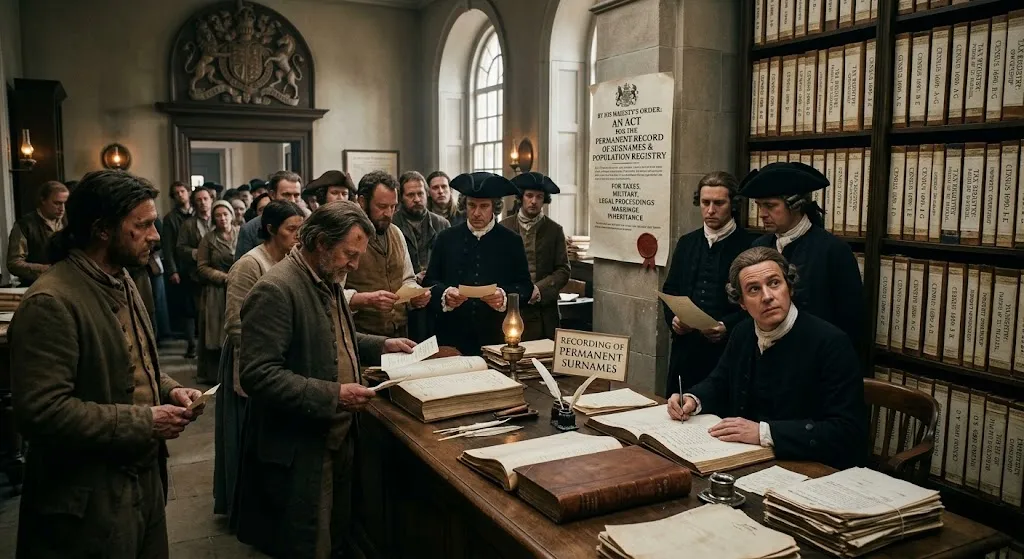
Records were required for:
- Taxes
- Property ownership
- Military service
- Legal proceedings
- Marriage
- Inheritance
- Population records
- Religious registration
- Census systems
A flexible naming system became increasingly inconvenient.
If a person’s identifier changed every generation, official records would become difficult to connect.
Permanent surnames solved this problem.
They made it easier for authorities to track families, property, obligations, and legal relationships.
The same system that helped governments also created valuable historical records for future generations.
Surnames and the Growth of Cities
Urbanization also encouraged the development of surnames.
In a small rural community, everyone might know one another personally. In a growing city, thousands of people could live close together without knowing each other.
A larger population meant more repeated first names.
A surname became increasingly useful.
Trades, neighborhoods, occupations, and places of origin provided convenient ways to distinguish people.
As cities expanded and commerce increased, written contracts and business records also became more common.
Surnames therefore became important not only socially but economically.
Why the Same Surname Appears in Different Places
A common misconception is that everyone with the same surname must belong to one ancient family.
That is not necessarily true.
The same surname may have developed independently in different places.
For example, an occupational surname equivalent to “Smith” could emerge separately in several communities because blacksmithing was common everywhere.
Similarly, a surname meaning “son of John” could arise independently in different families.
Migration creates another complication.
A family may carry its surname to another country, where the name is translated, shortened, respelled, or adapted to the local language.
As a result, related surnames may appear in several forms.
How Spelling Changed Over Time
Modern spelling can make surname research surprisingly difficult.
Before standardized spelling became widespread, names could be written in several different ways.
A clerk might spell a surname according to pronunciation. Another clerk might use a different spelling. A name written in one language could later be adapted into another.
Changes could occur because of:
- Different alphabets
- Dialect differences
- Illiteracy
- Clerical errors
- Immigration
- Translation
- Pronunciation changes
- Government standardization
This means that two surnames that look different today may sometimes have a historical connection.
Conversely, two surnames that look similar are not automatically related.
Genealogical research therefore requires more than simply searching for an identical modern spelling.
Surnames and Migration
Migration has had an enormous influence on surnames.
When people moved between countries, their names sometimes changed with them.
An immigrant might alter the spelling of a surname so that local officials could pronounce or record it more easily. A name might also be translated into the new language.
Over several generations, the original form could disappear.
Migration can therefore produce families with several versions of the same ancestral surname.
Historical records may contain one spelling in a birth register, another in a marriage certificate, and yet another in an immigration document.
This is one reason family-history research can become a detective story.
Women and Surnames
The history of surnames is also closely connected with marriage and family structure.
In many societies, women traditionally changed their surnames after marriage. In others, women retained their birth names, used both names, or followed different local customs.
These practices varied enormously across cultures and historical periods.
Marriage could therefore cause surnames to enter or leave a family line.
For genealogists, this is particularly important because women can become harder to trace after marriage when records change their surname.
Modern naming practices are much more varied. Some couples keep their own surnames, some combine them, and some choose entirely different arrangements.
The concept of the hereditary surname continues to evolve.
Surnames in the Balkans
The Balkans provide an especially interesting example of the complex history of surnames.
The region has experienced centuries of migration, changing political borders, different administrative systems, and interaction among numerous languages and cultures.
Surname formation has therefore been influenced by several traditions.
Names may originate from:
- Personal names
- Patronymics
- Occupations
- Places
- Nicknames
- Physical characteristics
- Family relationships
- Religious traditions
Historical documents may also record the same family differently depending on which administration, language, or writing system was being used.
A surname may therefore contain several layers of history.
The modern form of a Balkan surname may be relatively recent even when the family itself has much older roots.
The Difference Between a Name’s Meaning and Its Family History
One of the most important lessons in surname research is that the meaning of a surname is not the same thing as the complete history of the family.
Suppose a surname originally meant “miller.”
That does not tell us where the family lived, when they adopted the surname, whether all people with that surname are related, or whether the modern family actually descended from the first person who carried the name.
A surname provides a clue.
It does not provide an entire family tree.
The same principle applies to geographical surnames and patronymics.
A surname may suggest an origin without proving it.
How Genealogists Research Surnames
Modern genealogy combines surname research with historical documents.
Researchers may examine:
- Birth certificates
- Marriage records
- Death certificates
- Church registers
- Census records
- Property documents
- Military records
- Immigration documents
- Newspapers
- Wills
- Court records
- Gravestones
The objective is not simply to find the oldest person with a particular surname.
Instead, genealogists try to connect individuals through reliable evidence.
A surname becomes much more meaningful when it appears alongside dates, places, family relationships, and independent records.
DNA and the Study of Family Names
Modern genetic genealogy has added another dimension to surname research.
DNA testing can sometimes help researchers investigate whether people who share a surname also share a biological ancestor.
This can be particularly interesting for paternal surname lines because surnames have historically been passed through male family lines in many cultures.
However, DNA does not automatically prove that everyone with a surname belongs to the same family.
Non-paternity events, adoption, name changes, migration, independent surname formation, and other historical circumstances can complicate the picture.
DNA is therefore best treated as another piece of evidence rather than a complete replacement for historical records.
Why Some Surnames Disappear
Not every surname survives indefinitely.
A family name can disappear when there are no descendants continuing to use it, when people change their names, or when surnames are replaced through marriage and other naming practices.
Migration can also contribute to the disappearance of a traditional surname if it is translated or substantially altered.
Wars, political changes, persecution, and social pressures have sometimes caused families to change their names deliberately.
In this sense, surnames are not permanent in the absolute sense.
They survive only as long as people continue to use them.
Rare Surnames Can Be Especially Interesting
A rare surname may provide an unusually valuable starting point for family-history research.
If only a small number of people carry a name, researchers may be able to trace historical records more easily than with a very common surname.
But rarity does not automatically mean ancient origin.
A rare surname might have developed from a local nickname, an unusual occupation, a specific place, or a spelling change that occurred relatively recently.
Its story still has to be reconstructed from evidence.
Common Surnames Tell a Different Story
Common surnames can be more difficult to research.
If thousands of unrelated families share the same surname, simply finding the name in an old document proves very little.
Researchers must pay attention to location, dates, occupations, family relationships, and other details.
A common surname can actually be more historically complicated than a rare one because it may have multiple independent origins.
What Your Surname Can Tell You
A surname can sometimes provide clues about:
An occupation: An ancestor may have worked in a particular trade.
A place: The family may have lived near or originated from a particular geographical location.
An ancestor’s name: The surname may preserve the name of a father or earlier relative.
A nickname: The original family name may have described someone’s appearance or personality.
A language: The form of the surname can sometimes reveal the language in which it developed.
Migration: Changes in spelling may indicate movement between countries or linguistic communities.
Social history: The name may reflect historical occupations, institutions, or administrative practices.
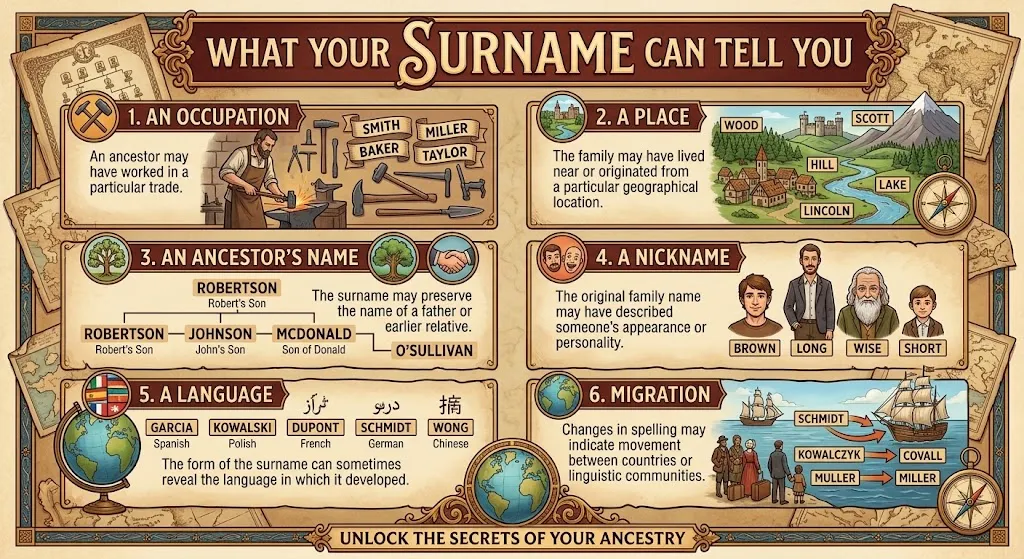
But a surname rarely tells the entire story by itself.
The Hidden History Inside Ordinary Names
One of the most fascinating aspects of surnames is how ordinary they have become.
For most people, a surname is simply the name written on an identity document, passport, school record, bank account, or family photograph.
Yet behind that familiar word may be centuries of history.
It may have started as the nickname of a farmer, the occupation of a craftsman, the name of a distant village, the identity of a father, or the description of an ancestor.
Over generations, the original meaning may have faded completely.
The surname remained while the story disappeared.
Names as Historical Time Capsules
A surname can be viewed as a small historical time capsule.
It may preserve traces of languages that are no longer spoken, occupations that have disappeared, settlements that have changed names, and family relationships that would otherwise be forgotten.
In this way, names connect ordinary people to the past.
A surname does not need to belong to a famous family to have an interesting history.
Every family name has passed through people, places, marriages, migrations, and generations.
Some stories are documented in archives. Others survive only in family traditions.
The Future of Surnames
Surnames are still changing.
Global migration, international marriages, changing family structures, legal name changes, and modern approaches to gender and identity are influencing how people use family names.
Some traditional surnames may become less common, while new combinations and naming practices appear.
Digital databases are also making historical research easier. Records that once required visits to archives can increasingly be searched from home.
At the same time, digital records can contain errors, duplicated information, or simplified spellings. Good research still requires careful comparison of sources.
The technology has changed, but the basic question remains the same:
Who were the people behind the name?
Conclusion
The history of surnames is ultimately the history of ordinary people.
A surname may have begun as a practical way to distinguish one person from another. It may have described an occupation, a place, a parent, an animal, a physical feature, or a nickname. As societies became more organized, these descriptions gradually became hereditary family names.
Over centuries, surnames traveled across borders, changed spelling, adapted to new languages, and survived political and social transformations.
Today, a surname can look like a simple word, but its origins may reach back many generations.
The next time you write your family name, it is worth remembering that you may be writing a small piece of history—one that began with a person whose name, occupation, home, or nickname was important enough for someone else to remember.
For more informative articles, practical guides, and interesting topics across a wide range of subjects, visit serdpestcp.org and explore more.