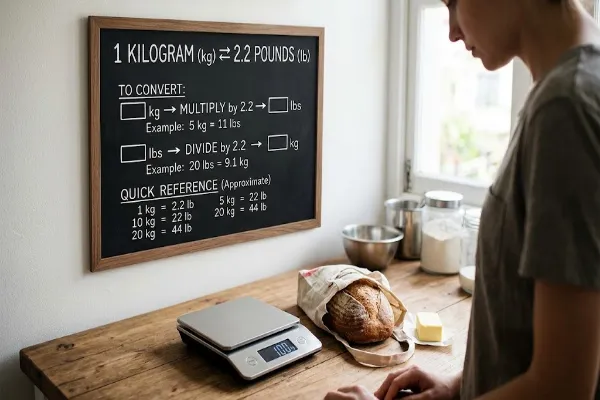
One kilogram equals approximately 2.20462 pounds. To convert kilograms to pounds, multiply the number of kilograms by 2.20462. To convert pounds to kilograms, divide the number of pounds by 2.20462. These simple formulas make it easy to convert weights for cooking, shopping, travel, fitness, and everyday measurements.
How Many Pounds Are in 1 Kilogram?
One kilogram (kg) is equal to approximately 2.20462 pounds (lb). For most everyday calculations, rounding this value to 2.2 pounds is accurate enough.
The kilogram is the standard unit of mass in the metric system, while the pound is commonly used in the United States and a few other countries. Understanding the relationship between these units helps when comparing product weights, following recipes, checking luggage limits, or tracking body weight.
Here is a quick reference:
- 1 kilogram = 2.20462 pounds
- 2 kilograms = 4.40924 pounds
- 5 kilograms = 11.0231 pounds
- 10 kilograms = 22.0462 pounds
- 50 kilograms = 110.231 pounds
- 100 kilograms = 220.462 pounds

How to Convert Kilograms to Pounds
Converting kilograms to pounds is straightforward. Multiply the kilogram value by 2.20462 to calculate the equivalent weight in pounds.
Formula:
Pounds = Kilograms × 2.20462
For example, if an item weighs 7 kilograms, multiply 7 by 2.20462.
7 × 2.20462 = 15.43234 pounds
Therefore, 7 kilograms is approximately 15.43 pounds.
For quick mental calculations, you can multiply the kilogram value by 2.2 instead. This produces a close estimate that works well for everyday situations when exact precision is unnecessary.
How to Convert Pounds to Kilograms
To convert pounds to kilograms, divide the number of pounds by 2.20462. You can also multiply the pound value by approximately 0.453592.
Formula:
Kilograms = Pounds ÷ 2.20462
For example, if a suitcase weighs 30 pounds, divide 30 by 2.20462.
30 ÷ 2.20462 = 13.6078 kilograms
Therefore, 30 pounds is approximately 13.61 kilograms.
This conversion is useful when comparing product specifications, checking international shipping information, or converting weight measurements between metric and imperial units.
Kilograms to Pounds Conversion Chart
The following table shows common kilogram values and their approximate equivalents in pounds.
| Kilograms (kg) | Pounds (lb) |
|---|---|
| 0.5 kg | 1.10 lb |
| 1 kg | 2.20 lb |
| 2 kg | 4.41 lb |
| 3 kg | 6.61 lb |
| 5 kg | 11.02 lb |
| 10 kg | 22.05 lb |
| 15 kg | 33.07 lb |
| 20 kg | 44.09 lb |
| 25 kg | 55.12 lb |
| 30 kg | 66.14 lb |
| 40 kg | 88.18 lb |
| 50 kg | 110.23 lb |
| 60 kg | 132.28 lb |
| 70 kg | 154.32 lb |
| 80 kg | 176.37 lb |
| 90 kg | 198.42 lb |
| 100 kg | 220.46 lb |
This chart provides a convenient reference for common weights without requiring a calculator for every conversion.
Practical Examples of Kilogram-to-Pound Conversion
Kilogram-to-pound conversions are useful in many everyday situations. Here are several examples that demonstrate how the formula works.
Example 1: Converting Body Weight
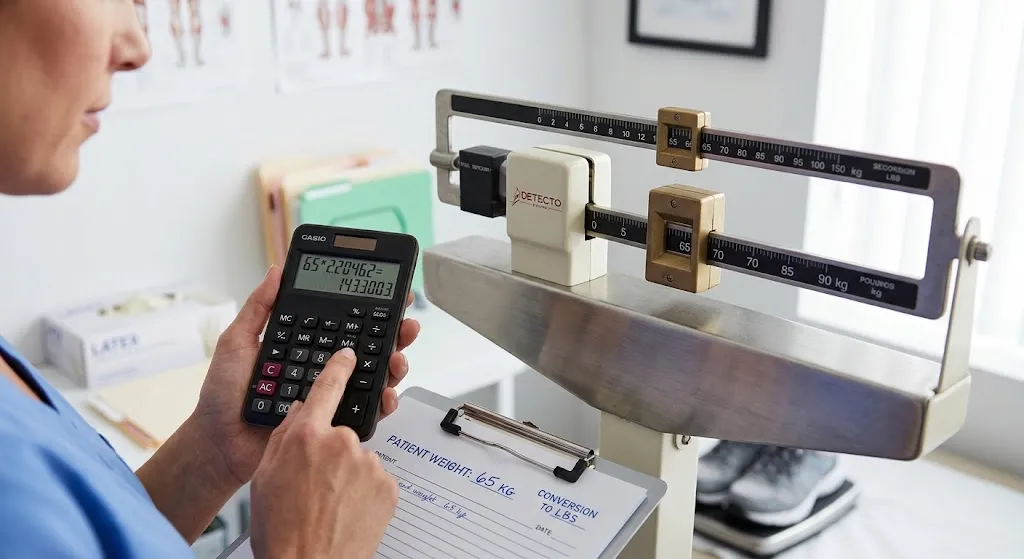
Suppose a person weighs 65 kilograms and wants to know their weight in pounds.
65 × 2.20462 = 143.3003 pounds
A weight of 65 kilograms is approximately 143.3 pounds.
This calculation is particularly helpful when medical records, fitness programs, or weight-management resources use different measurement systems.
Example 2: Converting Luggage Weight
Imagine an airline allows a checked suitcase weighing up to 23 kilograms. To determine the equivalent limit in pounds, multiply 23 by 2.20462.
23 × 2.20462 = 50.70626 pounds
A 23-kilogram luggage limit is approximately 50.7 pounds. Checking this conversion before traveling can help passengers understand baggage restrictions and avoid excess-weight fees.
Example 3: Converting Food Ingredients
A recipe calls for 2 kilograms of flour, but your kitchen scale displays pounds.
2 × 2.20462 = 4.40924 pounds
You would need approximately 4.41 pounds of flour.
Accurate conversions are especially useful when preparing large batches of food or following recipes from countries that use different measurement systems.
Example 4: Converting a Package Weight
Suppose a package weighs 12 kilograms and you need to enter its weight in pounds for a shipping form.
12 × 2.20462 = 26.45544 pounds
The package weighs approximately 26.46 pounds.
Depending on the shipping provider, you may need to follow its specific rounding rules when entering the final weight.
Example 5: Converting Gym Weights
A weight plate is labeled as 10 kilograms, but your workout plan uses pounds.
10 × 2.20462 = 22.0462 pounds
The plate weighs approximately 22.05 pounds.
This conversion helps when comparing equipment or workout instructions that use different units. However, the available weight plates may be rounded to standard commercial sizes.
Why Are Kilograms and Pounds Different?
Kilograms and pounds are units used in different measurement systems. The kilogram belongs to the International System of Units (SI), which is widely used around the world. The pound is part of the customary measurement system used in the United States and is also encountered in other countries.
A kilogram is defined using the Planck constant, a fundamental constant of physics. The international avoirdupois pound, used for most everyday weight measurements, is defined exactly as 0.45359237 kilograms.
Because this relationship is fixed, one kilogram equals approximately 2.20462 pounds. The conversion does not change based on the object being measured or the location where the measurement takes place.
Kilograms vs. Pounds: Key Differences
Although kilograms and pounds both describe mass in everyday use, they differ in their numerical values and the measurement systems in which they are commonly used.
| Feature | Kilogram | Pound |
|---|---|---|
| Abbreviation | kg | lb |
| Measurement system | Metric / SI | US customary and imperial usage |
| Equivalent value | 1 kg | 0.45359237 kg |
| Common use | Most countries worldwide | Primarily the United States |
| Smaller equivalent | 1 kg = 1,000 grams | 1 lb = 16 ounces |
It is important to distinguish mass from weight in scientific contexts. Kilograms and pounds, as defined above, are units of mass. In everyday conversation, however, people commonly use both to describe how heavy something is.
Tips for Converting Kilograms and Pounds Quickly
You do not always need a calculator to estimate a conversion. A few simple techniques can make the process faster.
- Remember 2.2: Multiply kilograms by 2.2 for a quick estimate in pounds.
- Use 0.45 for the reverse conversion: Multiply pounds by 0.45 to estimate kilograms.
- Round when appropriate: For everyday comparisons, two decimal places are usually sufficient.
- Use the exact factor when precision matters: For technical measurements, shipping requirements, or scientific calculations, use 2.20462 or the exact conversion factor.
- Check the units before calculating: Make sure the original measurement is in kilograms or pounds so you apply the correct formula.
For instance, 40 kilograms is approximately 88 pounds using the quick method: 40 × 2.2 = 88. The more precise answer is 88.18 pounds.
Frequently Asked Questions
No. One kilogram equals approximately 2.20462 pounds. The value 2.2 is a rounded figure used for convenient mental calculations.
Five kilograms equals approximately 11.02 pounds. Multiply 5 by 2.20462 to obtain the result.
One hundred pounds equals approximately 45.36 kilograms. Divide 100 by 2.20462 to convert the measurement.
Multiply the number of kilograms by 2.2. For example, 8 kilograms is approximately 17.6 pounds. This method is quick but slightly less precise than using the full conversion factor.
The abbreviation comes from the Latin word libra, which referred to a unit of weight or balance. The abbreviation lb remains in use today even though the English word is pound.
Strictly speaking, both are units of mass in the definitions used for these conversions. In everyday language, they are commonly used to express how heavy a person or object is.
Conclusion
One kilogram equals approximately 2.20462 pounds, making the conversion simple once you know the correct multiplier. Multiply kilograms by 2.20462 to obtain pounds, or divide pounds by the same number to obtain kilograms.

Whether you are converting body weight, checking luggage limits, measuring ingredients, or comparing package sizes, these formulas and the conversion chart provide a practical way to switch between metric and customary measurements accurately.




One thought on “How Many Pounds Are in a Kilogram? Conversion Guide With Examples”