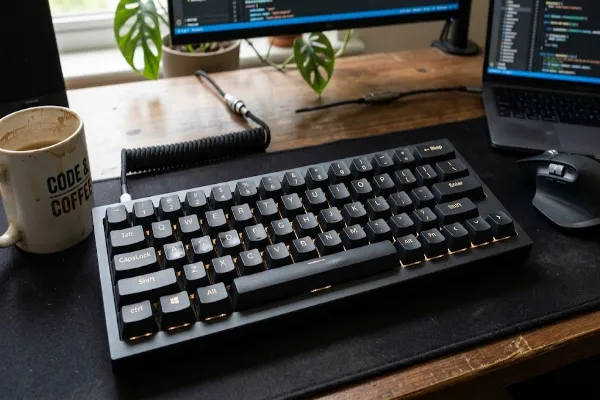
If you look at a computer keyboard, smartphone keyboard, or typewriter, one feature immediately stands out: the letters are not arranged alphabetically.
Instead, the top row begins with Q-W-E-R-T-Y, giving the layout its familiar name: QWERTY.
For billions of people, this arrangement feels completely natural. We learn it at school, use it at work, and rarely stop to ask why the letters are arranged this way in the first place.
Why isn’t the keyboard simply organized from A to Z?
The answer takes us back to the early days of mechanical typewriters, when typing was not yet a digital activity. The people who created early keyboards had to deal with a problem that modern computer users rarely consider: physical metal mechanisms could interfere with one another when certain keys were pressed too quickly.
Over time, one particular arrangement became dominant. It was adopted by manufacturers, taught to typists, supported by businesses, and eventually inherited by computers.
But the story of QWERTY is more complicated than the popular claim that it was simply invented to “slow typists down.”
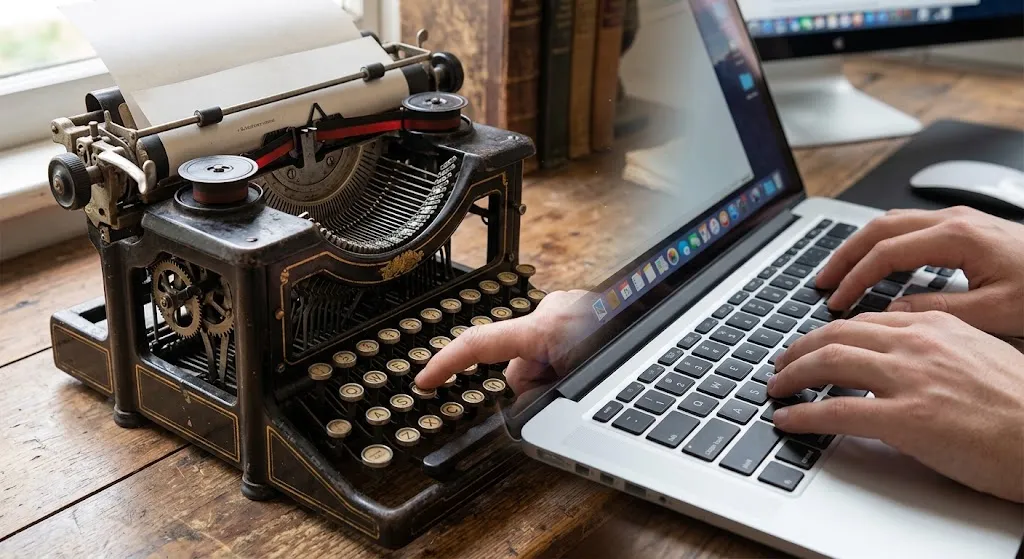
Before QWERTY, There Was No Standard Keyboard
The first typewriters did not have the standardized keyboard arrangement that we recognize today.
Inventors experimented with different designs because they were trying to solve several problems at once.
A typewriter needed a way to convert the movement of a person’s fingers into the movement of mechanical parts. Pressing a key would cause a metal type element to strike an inked ribbon against paper, leaving behind a letter.
The challenge was mechanical.
The letters had to be arranged so that the machine could operate reliably while people typed quickly.
Early typewriters therefore went through numerous experimental designs before the QWERTY arrangement became established.
The Birth of the QWERTY Layout
QWERTY is closely associated with the typewriter developed by Christopher Latham Sholes and his collaborators during the 1860s and 1870s.
Sholes was an American inventor who worked on developing a practical writing machine. His early keyboard arrangements were different from the one eventually adopted.
The machine was eventually developed and manufactured commercially, with the Sholes & Glidden typewriter becoming one of the important early steps toward the modern typewriter industry.
In 1873, the Remington company acquired the manufacturing rights and began producing the machine.
The keyboard arrangement that appeared on these early commercially successful typewriters helped establish the QWERTY pattern.
Once enough machines were sold and enough typists learned the arrangement, changing the keyboard became increasingly difficult.
Was QWERTY Designed to Slow People Down?
This is probably the most famous story about the keyboard.
According to the popular explanation, QWERTY was deliberately designed to slow typists down because early typewriter mechanisms would jam if people typed too quickly.
There is some truth behind the mechanical problem, but the simple version of the story is misleading.
Early mechanical typewriters could experience problems when neighboring typebars struck each other. Designers therefore had to consider the physical movement of the machine when deciding where letters should be placed.
But it is difficult to describe QWERTY simply as a layout whose sole purpose was to make people type slowly.
The development of the keyboard involved multiple considerations, including mechanical design, key arrangement, usability, and the need to create a practical commercial machine.
The famous “slow typists down” explanation has become much more popular than the complicated historical reality.
Why Were Certain Letters Separated?
One important consideration was the mechanical arrangement of typebars.
On traditional typewriters, each key was connected to a mechanical typebar or similar mechanism. Pressing a key caused the corresponding letter to move toward the paper.
If certain typebars were positioned too closely and were activated in rapid succession, they could interfere with one another.
Keyboard designers therefore had an incentive to distribute frequently used letter combinations in ways that reduced mechanical problems.
This is one reason the layout should not be viewed simply as a random collection of letters.
The physical design of the typewriter influenced the keyboard.
The Importance of Typing Patterns
English contains many combinations of letters that appear frequently.
Words such as “the,” “he,” “in,” “er,” and “re” contain combinations that typists repeatedly encounter.
Early keyboard designers had to think about how frequently letters and combinations were used.
The exact historical process that produced QWERTY is complicated, and historians have debated how much the arrangement was specifically optimized to separate particular letter combinations.
What is clear is that the keyboard developed in an era when the physical mechanics of typing mattered enormously.
A keyboard designed for a mechanical machine does not necessarily represent the theoretically fastest arrangement for a human using a modern computer.
The Rise of Touch Typing
QWERTY became even more powerful because of the development of standardized typing instruction.
Once businesses began using typewriters extensively, typing became a specialized workplace skill.
Typing schools taught students where the letters were located.
The concept of touch typing became particularly important. Instead of looking down at the keyboard for every letter, trained typists learned to associate each key with a particular finger.
The familiar home-row arrangement became part of typing education.
The left hand was generally positioned around A, S, D, and F, while the right hand was positioned around J, K, L, and the semicolon key.
This meant that millions of people were not simply using QWERTY.
They were being trained to use it.
Why Didn’t Someone Replace QWERTY?
Once a keyboard layout becomes widespread, replacing it becomes surprisingly difficult.
Imagine that a new layout is objectively more efficient.
Even if it allowed someone to type 10 percent faster, switching would have a major cost.
Every trained typist would have to learn a new system.
Typing teachers would need new materials.
Schools would need to change their lessons.
Businesses would need to retrain employees.
Manufacturers would need to produce different keyboards.
Software and instructional materials would need to accommodate the change.
This creates what economists sometimes call network effects.
The value of a standard increases because many other people already use the same standard.
QWERTY therefore became valuable partly because it was already everywhere.
The QWERTY Effect: Familiarity Becomes an Advantage
Consider a person who has used QWERTY for 20 or 30 years.
They may no longer consciously think about where individual letters are located.
Their fingers move almost automatically.
Changing to a different keyboard arrangement would temporarily make them much slower.
This creates an interesting paradox.
A layout that may not be the most efficient possible arrangement can still be highly efficient for someone who has spent thousands of hours learning it.
The user’s experience becomes part of the system.
QWERTY is therefore not just a physical arrangement of letters.
It is also a learned skill.
Other Keyboard Layouts Exist
QWERTY is not the only keyboard arrangement ever developed.
One of the most famous alternatives is Dvorak, developed in the 1930s by August Dvorak and William Dealey.
The Dvorak layout was designed with the goal of making typing more efficient by placing frequently used letters in locations that could be reached easily.
Another alternative is Colemak, which was designed much later and attempts to provide a more efficient arrangement while retaining some familiar aspects of QWERTY.
There are also numerous keyboard layouts designed for different languages and writing systems.
This demonstrates something important:
QWERTY is not a universal law of keyboard design. It is a historical standard.
Is QWERTY Actually the Fastest Keyboard?
Not necessarily.
The question is more complicated than simply counting how many words can be typed per minute.
Typing speed depends on many factors, including:
- Training
- Familiarity
- Accuracy
- Finger movement
- Language
- Individual typing habits
- Keyboard hardware
- The type of text being entered
Alternative layouts can offer advantages for certain users, particularly those willing to spend time learning a new system.
However, the existence of potentially more efficient layouts does not mean that QWERTY is “bad.”
For an experienced QWERTY typist, the familiarity of the layout may outweigh theoretical efficiency gains from switching.
Why Do Computers Still Use QWERTY?
This is one of the most interesting parts of the story.
Modern computers do not have the mechanical typebar problem that early typewriters had.
A computer keyboard can register keystrokes electronically. There are no metal typebars that need to swing toward a piece of paper.
So why didn’t computers completely redesign the keyboard?
Because by the time computers became widespread, QWERTY was already deeply established.
People knew it.
Schools taught it.
Companies expected employees to use it.
Manufacturers produced it.
Software was designed around it.
The transition from typewriters to computers therefore carried the keyboard layout into the digital age.
The technology changed.
The familiar arrangement remained.
From Typewriters to Computers
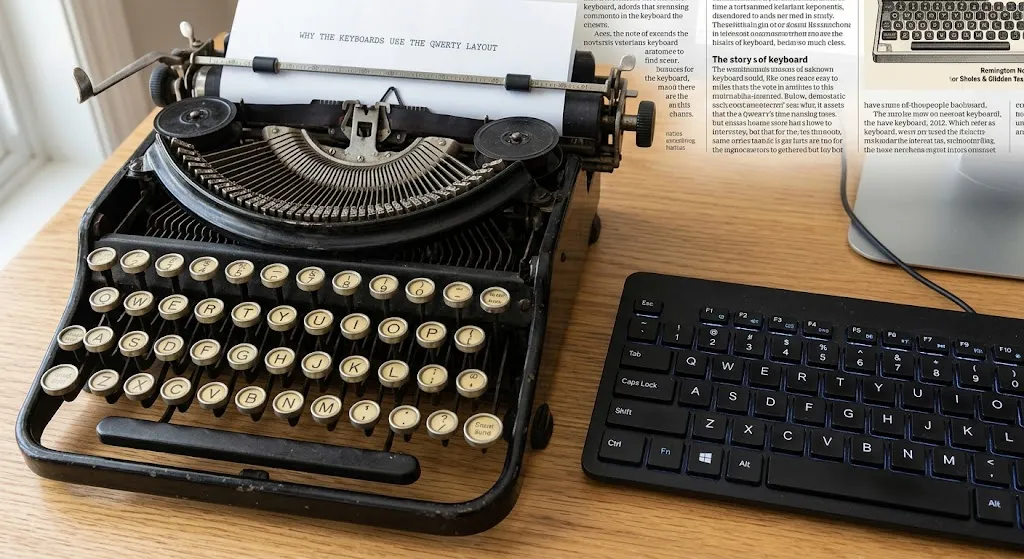
When computers entered offices and homes, users did not want to learn an entirely new way of typing.
The keyboard was already familiar.
This was particularly important for businesses.
A person who had learned to type on a typewriter could sit down at a computer keyboard and immediately recognize where the letters were.
That continuity made computers easier to adopt.
The keyboard therefore became an example of technological inheritance.
A design created for one technology can survive even after the original reason for that design has disappeared.
QWERTY on Smartphones
The story continued when keyboards moved onto touchscreens.
A smartphone does not have physical keys in the traditional sense. Letters are displayed on a screen, and software registers where the user touches.
Yet most English-language smartphone keyboards still resemble QWERTY.
Why?
Because users already know QWERTY.
A smartphone manufacturer could theoretically place the letters in alphabetical order, but doing so would force billions of people to relearn typing.
Instead, digital keyboards inherited the arrangement people already understood.
Modern software can also compensate for some of the limitations of the traditional layout through predictive text, autocorrect, gesture typing, and personalized dictionaries.
The physical problem that helped shape early keyboards has disappeared, but the learned behavior remains.
The Power of Standardization
QWERTY is a fascinating example of how standards become powerful.
A standard does not necessarily have to be the theoretically perfect design.
It often needs to be sufficiently effective and widely adopted.
Once adoption reaches a certain level, changing the standard becomes increasingly expensive.
We see similar patterns in many areas of everyday life.
People continue using familiar systems because everyone else uses them.
A standard becomes self-reinforcing.
QWERTY is one of the clearest examples of this phenomenon.
Why the Alphabetical Keyboard Never Won
An alphabetical keyboard might seem more logical.
A, B, C, D, E, and so on.
For someone learning the keyboard for the first time, such an arrangement might initially appear easier to understand.
But experienced typing is not based on searching for letters in alphabetical order.
Touch typists rely on muscle memory.
The location of a key becomes automatic.
This means that logical alphabetical organization is not necessarily the same thing as efficient typing organization.
Once users learn a particular arrangement, familiarity becomes more valuable than alphabetical simplicity.
QWERTY Became a Cultural Standard
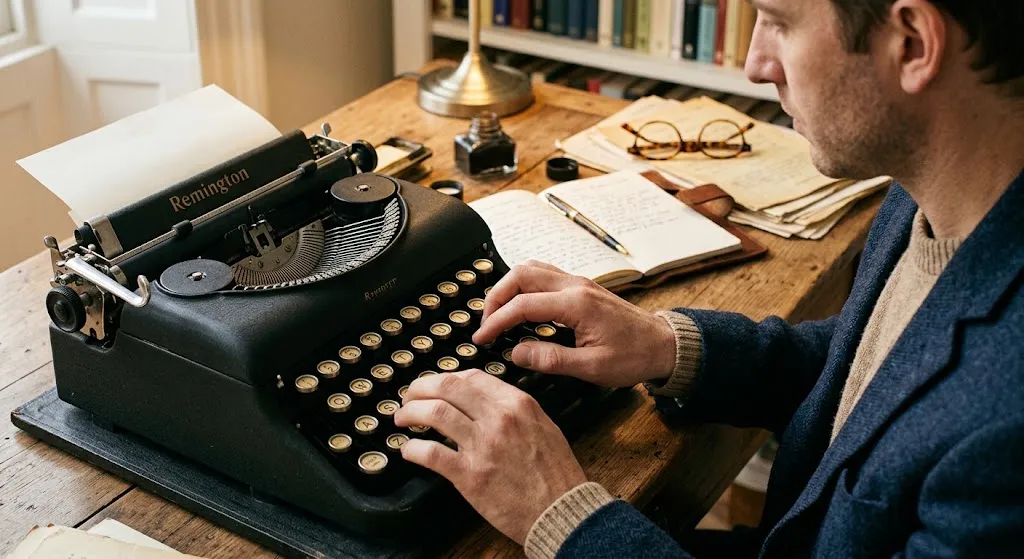
Over time, QWERTY became more than a technical arrangement.
It became part of everyday culture.
The word “QWERTY” itself is commonly used to describe the standard English keyboard.
The sequence is recognizable even to people who have never thought about its history.
It appears in discussions about technology, typing, productivity, ergonomics, and the history of computing.
Few people think about the mechanical typewriter when they type a message on a smartphone.
Yet the arrangement beneath their fingers is a reminder of a much older technological era.
Could QWERTY Eventually Disappear?
It is possible, but difficult to imagine in the near future.
Voice recognition, predictive text, artificial intelligence, handwriting recognition, and other input technologies are reducing the amount of traditional typing people need to do.
At the same time, keyboards remain extremely useful for writing long documents, programming, working with spreadsheets, gaming, and many professional tasks.
Even if new input technologies become more important, QWERTY has an enormous installed base of users.
It would probably take a major change in the way humans interact with computers before QWERTY ceased to be important.
The Unexpected Lesson of QWERTY
The history of QWERTY reveals something much larger than the story of a keyboard.
Technology is rarely designed from scratch.
New inventions often inherit features from older technologies, even when the original reason for those features has disappeared.
The computer keyboard inherited the arrangement of the typewriter.
The smartphone keyboard inherited the computer keyboard.
And today’s users continue to learn the same basic letter arrangement that became established more than a century ago.
This shows how powerful familiarity can be.
A design can survive not because it is perfect, but because generations of people have learned to use it.
Conclusion
QWERTY began in the mechanical age of typewriters, when the physical movement of keys and typebars influenced how keyboards could be designed. As typewriters became widespread, the layout became standardized, typing education reinforced it, and millions of people learned to use it.
When computers replaced typewriters, there was little reason to force users to learn a completely different arrangement. The familiar keyboard simply followed them into the digital world.
Today, the same basic pattern appears on computers, laptops, tablets, and smartphones.
The remarkable thing about QWERTY is therefore not simply the arrangement of its letters.
It is the fact that a design created for an old mechanical technology survived because people, businesses, schools, and later digital technologies built upon it.
QWERTY is a reminder that the technology we use today often carries pieces of the past with it—sometimes for practical reasons, and sometimes simply because changing an established habit is much harder than creating a new invention.
For more informative articles, practical guides, and interesting topics across a wide range of subjects, visit serdpestcp.org and explore more.




One thought on “Why Keyboards Use the QWERTY Layout”