Algorithms increasingly influence decisions that affect everyday life. They help determine which posts appear on social media, which job applications receive attention, what products online stores recommend, and how financial institutions assess applications for loans. In healthcare, education, policing, and public services, algorithmic systems can also influence decisions with serious consequences.
These systems are often described as objective because they rely on data, mathematical calculations, and predefined rules. However, an algorithm can produce unfair results even when it operates exactly as its designers intended.
This problem is known as algorithmic bias. It occurs when an algorithm or automated decision-making system systematically produces outcomes that disadvantage certain individuals or groups, or consistently favors others in ways that are unjustified for the task.
Algorithmic bias does not necessarily mean that a computer has developed prejudice in the human sense. Instead, it can emerge from the data used to train a model, the assumptions built into its design, the objectives it is optimized to achieve, or the environment in which it operates.
Understanding how algorithmic bias happens is essential as artificial intelligence becomes more deeply integrated into business, government, and daily life.
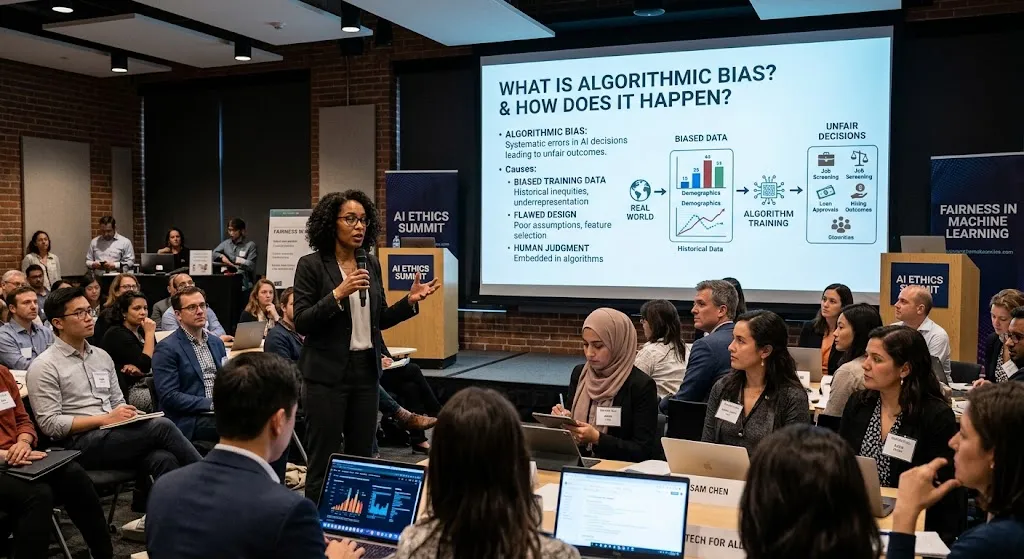
What Is Algorithmic Bias?
Algorithmic bias refers to systematic patterns in the outputs of an algorithm that create unfair or unjustified differences between people or groups.
An algorithm is a set of instructions or computational procedures used to solve a problem or perform a task. Some algorithms follow simple, explicitly written rules, while others use machine learning to identify patterns in large datasets and make predictions.
Bias can affect both types of systems, although the causes may differ.
For example, imagine a company using an automated system to screen job applications. The system analyzes previous hiring decisions and identifies characteristics associated with candidates who were hired in the past. If the company’s historical hiring practices consistently favored one demographic group, the algorithm may learn to reproduce that pattern.
The system might then rank equally qualified candidates differently because their profiles resemble different groups of past applicants.
No programmer needs to instruct the system to discriminate explicitly. The unfair pattern can emerge from the data and the relationships the model learns.
Algorithmic bias can appear in several forms:
- Historical bias: Existing inequalities are reflected in the data used to develop a system.
- Sampling bias: Some groups are underrepresented in the data, making the system less reliable for them.
- Measurement bias: The information collected does not accurately represent the characteristic the system is supposed to assess.
- Label bias: Training labels reflect subjective judgments or flawed decisions rather than reliable measures of the intended outcome.
- Design bias: The system’s objectives, rules, or assumptions favor certain outcomes over others.
- Deployment bias: A system is used in circumstances different from those for which it was designed and tested.
These categories can overlap. A single algorithm may inherit historical inequalities, learn from incomplete data, and then amplify the resulting patterns when deployed at scale.
How Does Algorithmic Bias Happen?
Algorithmic bias rarely has just one cause. It often develops through several stages, beginning before an algorithm is even created.
1. Biased Historical Data
Machine learning systems learn from examples. When those examples reflect unequal treatment or existing social disadvantages, a model may reproduce those patterns.
Consider a hypothetical company that has hired mostly men for senior technical positions over the previous 15 years. It decides to train an algorithm using its historical recruitment records to identify promising candidates.
The records contain information about applicants who were hired, their qualifications, and their subsequent performance. However, they also reflect the company’s earlier recruitment practices, including who received interviews, who was considered suitable, and who had access to professional opportunities.
If the model learns that characteristics associated with previously successful applicants are strong predictors of future success, it may favor similar profiles.
The problem is that historical hiring outcomes are not necessarily an unbiased measure of ability. Qualified candidates may have been overlooked because of unequal opportunities, subjective judgments, or discriminatory practices.
The algorithm can reproduce those earlier decisions even if the company has since adopted fairer recruitment policies.
This illustrates an important principle: data can accurately record what happened in the past without providing a fair standard for what should happen in the future.
Historical data is useful, but it must be examined critically before being used to automate consequential decisions.
2. Incomplete or Unrepresentative Data
An algorithm can also become biased when its training data does not adequately represent the population in which it will be used.
Suppose a facial-recognition system is trained primarily on images of people with lighter skin tones. If the system encounters individuals with darker skin tones, its performance may be less accurate, depending on the data, task, and implementation.
The issue is not necessarily that the algorithm deliberately favors one group. Rather, the system has had fewer representative examples from which to learn the visual patterns needed for reliable recognition.
Similar problems can occur in speech recognition when training recordings do not adequately represent regional accents, languages, or speaking styles. A voice-recognition system may perform well for some speakers but repeatedly misunderstand others.
In healthcare, a predictive model developed using data from a narrow patient population may perform poorly when applied to people with different characteristics, medical histories, or patterns of access to treatment.
The broader lesson is that the quantity of data alone does not guarantee quality. A dataset containing millions of examples can still be unsuitable if important populations are missing or poorly represented.
Developers need to examine who is included, who is excluded, and whether the available examples reflect the people who will actually use the system.
3. Choosing the Wrong Thing to Measure
One of the most subtle sources of algorithmic bias arises when developers use a convenient measurement as a substitute for the outcome they genuinely care about.
A computer can optimize a measurable target with great efficiency. However, the target may only imperfectly represent the real-world objective.
Imagine a healthcare organization developing an algorithm to identify patients who need additional medical attention. The organization uses previous healthcare spending as a measure of medical need.
At first glance, the choice seems reasonable. Patients with serious health conditions often incur higher medical expenses.
However, spending is not determined by medical need alone. It can also depend on insurance coverage, income, access to hospitals, local healthcare availability, and whether patients seek treatment in the first place.
Two patients with equally serious conditions may generate very different healthcare costs. A patient who has difficulty accessing medical services may spend less despite needing more care.
If the algorithm treats spending as equivalent to illness severity, it may underestimate the needs of patients who have historically received less healthcare.
The system can therefore make mathematically consistent predictions while reaching an unfair conclusion.
This type of problem is called measurement bias. It demonstrates why developers must ask whether a variable genuinely measures the concept they want to predict or merely reflects one consequence of that concept.
4. Biased Labels and Human Judgments
Many machine learning systems depend on labeled examples. A label tells the algorithm what an example represents or what outcome it should learn to predict.
For instance, a recruitment model may be trained on applications labeled as successful or unsuccessful. A content moderation system may use examples labeled as acceptable or prohibited.
If the labels are inaccurate, inconsistent, or influenced by prejudice, the algorithm may learn those weaknesses.
Consider a hypothetical moderation system trained on reports of abusive language. If some communities are more frequently reported because of prejudice or coordinated harassment, the dataset may contain a disproportionate number of reports about their members.
A model that treats reports as reliable evidence of misconduct could then incorrectly classify more content from those communities as harmful.
The same issue arises when historical performance evaluations, school grades, disciplinary records, or risk assessments are used as training labels. These records may contain subjective judgments rather than purely objective measurements.
Algorithms do not automatically distinguish between a trustworthy label and a misleading one. They learn from the information provided and from the structure of the training process.
Improving fairness therefore requires examining how labels were created, who assigned them, which standards were used, and whether errors affect some groups more than others.
5. Design Decisions and Optimization Goals
Algorithmic bias can originate in the system’s design, even when the training data is reasonably representative.
Developers must decide what an algorithm should optimize. It might be designed to maximize accuracy, minimize financial losses, increase engagement, reduce processing time, or identify people most likely to respond to an advertisement.
These objectives are not always compatible with fairness.
Imagine a social media platform that ranks content according to the likelihood that users will click, comment, or continue watching. The system may learn that emotionally charged material generates more engagement than calm, informative content.
If the platform rewards engagement without sufficiently considering other consequences, its recommendations may favor sensationalism, reinforce existing beliefs, or repeatedly expose users to polarizing material.
This does not mean that every engagement-based algorithm necessarily creates these outcomes. The result depends on the platform’s design, the content available, user behavior, and other safeguards.
However, the example shows that an algorithm can optimize its assigned objective successfully while producing broader consequences that its designers did not intend.
Fairness cannot always be added after development as a simple correction. Sometimes the original objective needs to be reconsidered.
6. Feedback Loops That Reinforce Bias
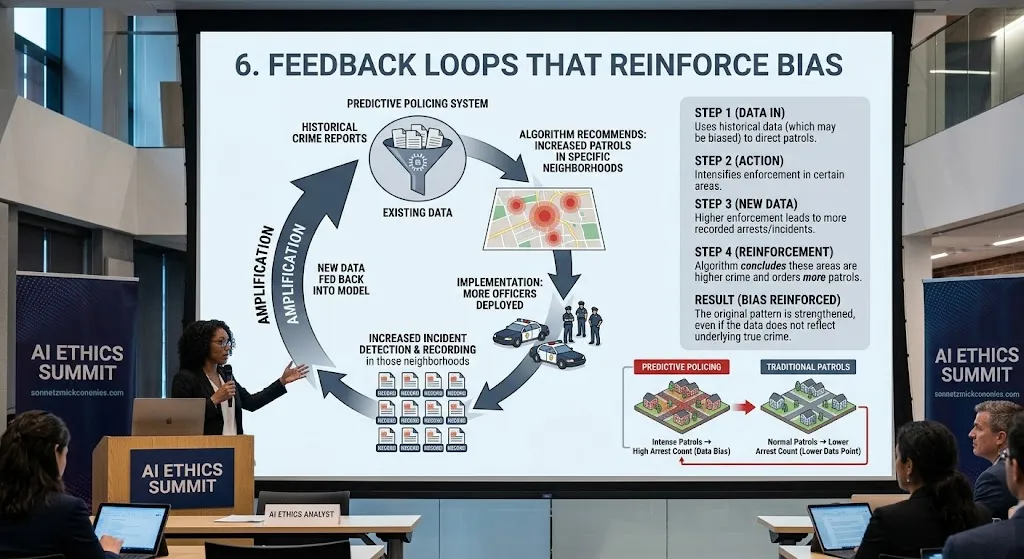
An algorithm can influence the environment from which it receives future data. This creates a feedback loop.
Suppose a predictive policing system uses historical crime reports to identify areas where additional police attention may be useful. The system directs more patrols toward neighborhoods that already have high reporting levels.
With more patrols, officers may detect and record more incidents in those neighborhoods. The additional records are then fed back into the model, which may conclude that the same locations require even more attention.
Meanwhile, other areas receive less scrutiny and may generate fewer recorded incidents.
The system can consequently reinforce the pattern that originally influenced its recommendations, even if the data does not accurately reflect the underlying distribution of harmful behavior.
A related problem can occur in recommendation systems. If an algorithm repeatedly shows a user a particular type of content, the user is more likely to interact with that content simply because it is visible. The resulting interactions can then persuade the algorithm to show even more of the same material.
Feedback loops are especially difficult to manage because the system’s predictions can change the data used to evaluate and retrain it.
Developers must therefore assess not only whether an algorithm predicts outcomes accurately, but also how its decisions alter future behavior and opportunities.
Real-World Examples of Algorithmic Bias
Algorithmic bias is not limited to one industry. Its effects can be seen wherever automated systems make predictions, classify information, rank people, or allocate resources.
Recruitment and Employment
Automated recruitment tools can rank applications, search for relevant qualifications, or help employers identify potential candidates.
These tools can improve efficiency, particularly when organizations receive large numbers of applications. However, they can also disadvantage applicants when the criteria used by a model reflect historical hiring patterns or poorly chosen proxies for job performance.
For example, a model might favor applicants whose educational backgrounds resemble those of previously successful employees, overlooking capable candidates who developed equivalent skills through alternative routes.
It might also disadvantage applicants when résumé gaps, career changes, or certain language patterns are treated as negative signals without sufficient justification.
The appropriate solution is not necessarily to abandon recruitment technology. Instead, employers should verify that the system evaluates job-relevant criteria, test outcomes across relevant groups, and provide meaningful human review.
Banking and Credit Decisions
Banks and lenders use algorithms to support decisions about creditworthiness, fraud detection, and financial risk.
Automated systems can analyze large amounts of information quickly and identify patterns that might otherwise go unnoticed. Yet their predictions can become unfair when the data or variables used reflect unequal economic opportunities.
For instance, income stability, previous borrowing history, and patterns of financial activity can be affected by employment opportunities, access to credit, and past financial hardship.
A model that relies heavily on historical outcomes may disadvantage applicants whose records reflect limited access to financial services rather than an inability to repay a loan.
This does not mean that all differences in credit decisions are discriminatory. Lenders have legitimate reasons to assess repayment risk. The important question is whether the criteria are appropriate, whether predictions are reliable, and whether particular groups experience unjustified disadvantages.
Financial institutions should test their models carefully and ensure that automated decisions comply with applicable lending, consumer protection, and anti-discrimination requirements.
Healthcare and Medical Diagnosis
Healthcare algorithms can assist clinicians by identifying patterns in medical images, estimating disease risk, or prioritizing patients who may need urgent attention.
However, a system developed using a narrow or unrepresentative patient population may be less accurate for other groups.
For example, a model trained primarily on records from one hospital may not work equally well in a different region with different patient demographics, clinical practices, or access to treatment.
Bias can also arise when historical diagnoses are treated as perfect indicators of disease. If some patients were less likely to receive appropriate testing, their records may contain fewer confirmed diagnoses even when the underlying condition was present.
The consequences can be significant. An inaccurate prediction might delay further investigation, influence treatment decisions, or cause a clinician to overlook a patient who needs additional assessment.
Medical AI should therefore be evaluated using clinically meaningful outcomes and representative data. Its results should be interpreted in context, and appropriate professional oversight must remain in place.
Facial Recognition and Computer Vision

Facial-recognition systems compare facial features to determine whether images may belong to the same person. Related computer-vision systems can detect objects, interpret images, or classify visual information.
Their accuracy can vary according to image quality, lighting, camera conditions, the task being performed, and the populations represented in training and testing data.
If a system performs less accurately for a particular demographic group, that difference can create practical risks when the technology is used for identity verification or other consequential purposes.
A false match could cause an innocent person to be incorrectly identified. A failure to recognize a legitimate user could prevent access to a service.
The seriousness of these outcomes depends on how the system is used. An error in an optional photo-filter application is not equivalent to an error in a law-enforcement identification process.
For this reason, organizations must consider both the system’s measured accuracy and the consequences of its mistakes.
Education and Student Assessment
Educational institutions may use algorithms to identify students who appear likely to struggle academically, recommend learning materials, or assist with grading.
These applications can help educators identify students who need support. However, a system may misinterpret differences in language background, disability, access to technology, or educational opportunity.
For example, a predictive model might identify students as high risk because their previous test scores are low, without adequately accounting for unequal access to tutoring, reliable internet, or appropriate learning resources.
If the prediction results in fewer opportunities rather than additional support, the algorithm may reinforce the disadvantage it was intended to address.
A fairer approach uses predictive information to guide further assessment and provide appropriate assistance, rather than treating a model’s output as a definitive judgment about a student’s potential.
Why Removing Sensitive Information Does Not Always Eliminate Bias
A common response to algorithmic bias is to remove sensitive characteristics such as race, sex, or age from the training data.
Although restricting the use of certain information can be important, removing these variables does not necessarily make an algorithm fair.
Other variables may act as proxies for the information that was removed.
For example, a person’s neighborhood, educational history, employment pattern, or purchasing behavior may correlate with demographic characteristics. An algorithm may use these variables to reconstruct patterns associated with a protected group without directly receiving that group’s identity.
Consider a hypothetical lending model that does not use an applicant’s race. If it relies heavily on residential location and that location reflects historical patterns of economic segregation, the resulting decisions may still differ substantially between demographic groups.
This does not mean that every correlated variable should automatically be excluded. Some variables are genuinely relevant to a decision, and their role must be evaluated in context.
The challenge is to determine which information is necessary, which relationships create unjustified disadvantages, and how the system performs across different populations.
Fairness requires examining outcomes and decision processes, not simply checking whether sensitive columns appear in a dataset.
Can an Algorithm Be Fair to Everyone?
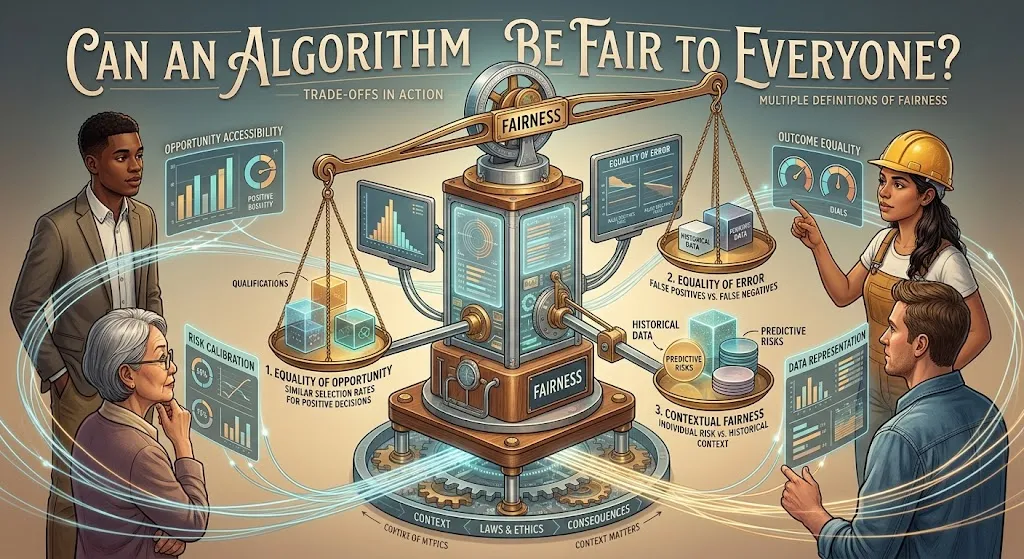
One of the most difficult questions in AI ethics is whether an algorithm can satisfy every reasonable definition of fairness simultaneously.
The answer is that fairness is not a single mathematical property that can always be maximized without trade-offs.
Different fairness measures focus on different concerns. Some examine whether groups receive similar rates of positive decisions. Others compare error rates or ask whether people with comparable underlying qualifications or risks receive comparable treatment.
These measures can conflict, particularly when groups differ in the distribution of relevant outcomes or when the outcomes themselves are measured imperfectly.
For example, a hiring algorithm might produce similar selection rates across groups while still making more errors for one group. Another model might achieve similar error rates but select candidates at different rates.
Which outcome matters most depends partly on the context, the legitimacy of the decision criteria, the consequences of errors, and applicable legal requirements.
This does not make fairness impossible. It means that organizations must define the relevant fairness goals openly rather than assuming that one statistical measure answers every ethical question.
The process should include domain experts, affected communities where appropriate, legal guidance, and independent evaluation.
How Can Algorithmic Bias Be Detected?
Detecting bias requires more than checking whether an algorithm produces plausible answers. Organizations need to investigate how the system performs across relevant groups and under different conditions.
Several methods can help.
Test the System on Representative Data
Developers should evaluate algorithms using data that reflects the population and conditions in which the system will operate.
The testing process should include groups that might otherwise be underrepresented and examine whether performance changes across relevant characteristics.
A model that performs well on a general test dataset may still make disproportionate errors for a particular subgroup.
Compare Error Rates and Outcomes
Organizations can examine false positives, false negatives, selection rates, prediction quality, and other relevant measures across groups.
For example, a fraud-detection system may incorrectly flag legitimate transactions more often for one group of customers. A medical model may miss important conditions more frequently in a particular patient population.
These differences do not automatically prove discrimination, but they can identify areas requiring further investigation.
Examine the Training Data
Auditors should ask how the data was collected, whether important populations are missing, how labels were assigned, and whether the information reflects historical inequalities.
They should also check whether the variables used by the algorithm are appropriate for the intended decision.
Test the System in Real-World Conditions
Laboratory performance does not always predict performance after deployment. Users behave differently, environments change, and the system may influence the data it later receives.
Monitoring real-world outcomes can reveal problems that were not apparent during development.
Provide a Way to Challenge Decisions
People affected by consequential automated decisions should have a meaningful way to request explanations, correct inaccurate information, or seek human review where appropriate.
An appeal process can reveal systematic problems and prevent an automated prediction from becoming an unquestioned final judgment.
How Can Algorithmic Bias Be Reduced?
No single technique eliminates every form of algorithmic bias. Effective prevention usually requires a combination of technical measures, organizational safeguards, and continuing oversight.
Improve data quality. Use representative datasets, investigate missing information, and examine whether labels reflect reliable outcomes. More data is not necessarily better if the underlying collection process is flawed.
Choose meaningful objectives. Ensure that the outcome being optimized genuinely reflects the problem the organization wants to solve. Avoid treating convenient measurements as complete substitutes for complex human needs.
Evaluate fairness before deployment. Test relevant groups and subgroups, assess error rates, and document limitations. Evaluation should be appropriate to the system’s purpose and potential consequences.
Use suitable fairness techniques. Depending on the application, developers may adjust sampling, revise labels, change model objectives, calibrate decision thresholds, or apply other methods. Each technique has limitations and should be tested rather than assumed to work.
Include human oversight. Human reviewers should have the authority, information, and training necessary to question automated recommendations. Oversight is ineffective if staff are expected to approve every result without examining it.
Monitor systems continuously. Data distributions, user behavior, and social conditions can change. Regular testing helps detect performance deterioration and emerging disparities.
Establish accountability. Organizations should assign responsibility for monitoring, documenting, and correcting problems. Independent audits may be appropriate when systems affect employment, finance, healthcare, public services, or fundamental rights.
Inform affected people. When appropriate, organizations should explain when automated systems influence important decisions and describe available review or complaint procedures.
The goal is not simply to make algorithms appear fair in a report. It is to reduce unjustified harm while maintaining the reliability and usefulness of the system.
The Role of Human Oversight and Accountability
Algorithmic systems are developed, purchased, configured, and deployed by people and organizations. Their outcomes should not be treated as unavoidable consequences of mathematics.
Human oversight matters because algorithms cannot independently determine every relevant ethical, legal, or social consideration. A model may estimate probability, but a responsible decision-maker must still consider whether the prediction is appropriate to use, whether the evidence is reliable, and what consequences may follow.
However, human involvement alone does not guarantee fairness. People can also make biased judgments, misunderstand technical results, or place excessive trust in computer-generated recommendations.
Effective oversight therefore requires clear procedures, suitable training, access to relevant evidence, and the authority to reject or correct automated decisions.
Organizations should also document how systems are used, identify who is responsible for their operation, and establish procedures for responding to complaints and discovered errors.
In high-impact settings, accountability should extend beyond the developers who built the model. Employers, financial institutions, healthcare providers, government agencies, and other organizations that rely on automated decisions must consider their own responsibilities.
Algorithmic Bias and the Future of Artificial Intelligence

As artificial intelligence systems become more capable, algorithmic bias is likely to remain an important challenge.
AI models can analyze enormous amounts of information and discover patterns that are difficult for humans to identify. At the same time, their complexity can make it harder to understand why a particular output was produced or which factors contributed most to a decision.
Generative AI introduces additional concerns. A language model may produce stereotypical descriptions, make assumptions about a person’s background, or provide different levels of assistance depending on how a request is phrased. These behaviors can reflect patterns in training data, model design, and the feedback used during development.
AI systems can also influence the information used to train future models. If machine-generated content is incorporated without suitable checks, existing errors or stereotypes may be repeated and amplified.
Addressing these problems will require improved evaluation methods, better documentation, stronger privacy and data-governance practices, and greater attention to how AI systems are used in real settings.
Regulation is also developing. In the European Union, the AI Act establishes requirements for certain AI applications, with obligations depending on the system’s classification, intended use, and implementation. The legal treatment of a particular system depends on its circumstances and the applicable provisions.
Technical improvements remain important, but responsible AI also requires decisions about where automation is appropriate, which risks are acceptable, and when a human decision-maker should remain directly involved.
Conclusion
Algorithmic bias occurs when automated systems produce systematic and unjustified differences in their outcomes. It can originate in historical data, incomplete samples, inaccurate measurements, biased labels, design decisions, or feedback loops that reinforce existing patterns.
Because algorithms operate at scale, even a relatively small weakness can affect many people when a system is widely deployed. In areas such as hiring, healthcare, lending, and education, these problems can influence access to opportunities and essential services.
Reducing algorithmic bias requires more than removing sensitive information or improving a model’s overall accuracy. Organizations must examine the quality of their data, the objectives they choose, the consequences of errors, and the ways their systems perform across different populations.
Ultimately, an algorithm is a tool designed to support a particular purpose. Its mathematical sophistication does not automatically make its decisions fair. Fairness depends on the quality of the evidence, the appropriateness of the design, the care taken during deployment, and the willingness of people and institutions to recognize and correct mistakes.
As AI becomes more influential, the central challenge is not simply to build systems that make predictions efficiently. It is to ensure that the decisions informed by those predictions remain reliable, accountable, and justifiable.
Frequently Asked Questions
The terms are closely related. Algorithmic bias refers broadly to systematic unfairness in the outputs of algorithms, while AI bias usually describes similar problems in artificial intelligence systems. AI bias can arise from data, model design, training methods, or the way a system is used.
Yes. An algorithm can learn patterns from historical data, rely on misleading measurements, or use variables that act as proxies for sensitive characteristics. Unfair outcomes can emerge even when developers did not explicitly instruct the system to discriminate.
No. More data can improve performance, but it does not automatically correct biased labels, unrepresentative samples, historical inequalities, or flawed objectives. Data quality and suitability matter as much as quantity.
Not necessarily. Other variables may correlate with those characteristics and reproduce similar patterns. Developers need to examine how the model uses information and whether its outcomes are justified, rather than relying solely on removing sensitive variables.
Responsibility depends on the circumstances, the applicable law, and the roles of the organizations involved. Developers, system providers, and organizations using automated decisions may each have relevant responsibilities. An algorithm’s output does not automatically remove human or institutional accountability.
Complete elimination cannot be guaranteed in every context because fairness depends on data quality, the task, competing objectives, and changing real-world conditions. However, systematic testing, suitable design, independent evaluation, and ongoing monitoring can help identify and reduce unfair outcomes.
Algorithmic bias matters because automated systems can influence employment, credit, healthcare, education, access to services, and the information people encounter. When an unfair pattern is repeated at scale, it can affect many individuals and reinforce existing inequalities.