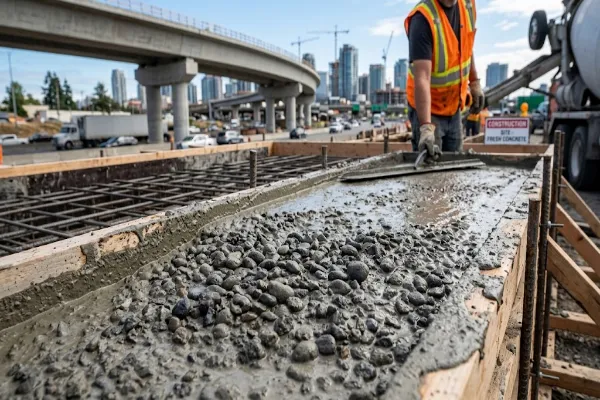
Concrete is one of the most important materials in the modern world. It forms the foundations of houses, the structures of skyscrapers, the surfaces of highways, and the supports of bridges. It is used to build dams, tunnels, airports, parking garages, and entire cities. Although people encounter concrete almost every day, few stop to consider what it is made of, how it works, or why it has become so essential to modern civilization.
Concrete is often described as the most widely used human-made material after water. Its popularity comes from a combination of affordability, strength, versatility, and the availability of its basic ingredients. However, concrete is more than a simple mixture of sand, stone, and cement. Its properties depend on chemical reactions, carefully controlled proportions, and the conditions under which it hardens.
What Is Concrete?
Concrete is a construction material made by combining cement, water, and aggregates such as sand, gravel, or crushed stone. When these ingredients are mixed together, they form a workable material that can be poured into molds or placed into prepared structures. Over time, a chemical reaction between cement and water causes the mixture to harden into a solid mass.
The resulting material can withstand substantial loads and maintain its shape for decades when properly designed and maintained. Concrete is used in applications ranging from small garden paths to massive hydroelectric dams.
One important distinction is that concrete and cement are not the same thing. Cement is a binding ingredient within concrete, while concrete is the finished composite material made from several components. Confusing the two is common, but understanding the difference helps explain why concrete can be manufactured in so many different forms and strengths.
What Is Concrete Made Of?
The performance of concrete depends on the materials used to produce it and the proportions in which they are combined. Each ingredient has a specific purpose, and changes in the mixture can significantly affect the final product.
Cement: The Binding Ingredient
Cement acts as the chemical binder that holds the other components together. The most common type is Portland cement, which is produced by heating a carefully prepared mixture of limestone and clay or other mineral materials at high temperatures. The resulting clinker is ground into a fine powder, usually with a small amount of gypsum to regulate setting time.
When cement comes into contact with water, it begins a series of chemical reactions that form compounds responsible for concrete’s strength. The most important of these reactions is hydration, which gradually creates a solid structure around the aggregate particles.
Cement production requires considerable energy, particularly because of the high temperatures involved and the chemical release of carbon dioxide from limestone. This makes cement one of the most environmentally significant components of the construction industry.
Water: The Essential Chemical Ingredient
Water does more than make concrete wet and easy to work with. It initiates the chemical reactions that allow cement to harden.
The amount of water used is particularly important. Too little water can make fresh concrete difficult to mix, transport, and place properly. Too much water can create a more porous hardened structure, reducing strength and increasing the risk of deterioration.
For this reason, concrete producers carefully control the water-to-cement ratio. Modern mixtures may also contain chemical admixtures that improve workability without requiring excessive water.
Sand and Gravel: The Aggregates
Aggregates typically make up most of the volume of concrete. Fine aggregates, such as sand, fill smaller spaces, while coarse aggregates, such as gravel or crushed rock, provide bulk and contribute to the material’s structural performance.
These particles form a dense internal framework, reducing the amount of cement paste required and helping control shrinkage. The size, shape, cleanliness, and grading of the aggregates all influence the final quality of concrete.
Suitable aggregates must be selected carefully. Certain minerals can react adversely with cement, while contaminated or poorly graded materials can weaken the finished product. The quality of the aggregate is therefore just as important as the proportions of cement and water.

How Does Concrete Harden?
Concrete hardens through a chemical process called cement hydration. This process begins when water reacts with the compounds in cement, producing new solid materials that bind the sand and stones together.
Fresh concrete initially behaves like a thick, moldable mixture. This allows construction workers to pour it into forms that define the shape of a foundation, column, beam, wall, or floor. As hydration progresses, the mixture loses its plasticity and becomes rigid.
Setting and hardening are related but different stages. Setting refers to the transition from a workable mixture to a rigid material, while hardening refers to the continued development of strength.
Concrete does not simply dry out like paint or mud. Hydration is a chemical reaction, and it can continue for weeks, months, and even longer when sufficient moisture and suitable conditions are available.
The first 28 days are commonly used as a reference period for measuring concrete strength. This does not mean that concrete reaches its absolute maximum strength on the twenty-eighth day. Strength development depends on the cement type, mixture proportions, temperature, moisture, and curing conditions.
Why Is Concrete the Most Used Material After Water?
Concrete is often cited as the world’s second-most-used material after water, particularly when considering its enormous role in construction and infrastructure. Its widespread use is not the result of one exceptional property but of several advantages that work together.
1. Its Ingredients Are Widely Available
Concrete can be produced using materials found in many parts of the world. Limestone, clay, sand, gravel, and various types of rock are available in numerous regions, although their quality, accessibility, and environmental costs vary.
This widespread availability makes concrete practical for construction projects of different sizes and budgets. Local production can also reduce the need to transport large quantities of finished building material over long distances.
However, not every type of sand or rock is suitable for concrete. Construction-grade aggregates must meet technical requirements, and growing demand has placed pressure on some natural sand and gravel resources.
2. It Is Relatively Affordable
Concrete offers a practical balance between cost, performance, and availability. Its ingredients can often be sourced locally, and the material can be produced in large quantities for residential, commercial, and public infrastructure projects.
Its economic value also comes from its adaptability. The same basic material can be used for foundations, floors, retaining walls, drainage channels, bridges, and industrial structures.
The total cost of a concrete structure still depends on many factors, including cement prices, transportation, reinforcement, labor, formwork, engineering requirements, and maintenance. Nevertheless, concrete remains an economical choice for many construction applications.
3. It Can Be Molded Into Almost Any Shape
One of concrete’s greatest advantages is that fresh concrete can be placed into a wide variety of forms before it hardens. This makes it possible to create simple rectangular foundations, curved architectural walls, decorative surfaces, complex bridge components, and massive engineered structures.
Builders can produce many shapes without manufacturing a separate solid material for every design. Reinforcement, formwork, and specialized casting techniques further expand the possibilities.
This flexibility has helped architects and engineers create buildings and infrastructure that would be difficult or expensive to construct using some other materials.
4. It Is Strong Under Compression

Concrete is particularly effective at resisting compressive forces, which occur when a material is squeezed or pressed. This makes it suitable for carrying the weight of buildings, supporting columns, and transferring loads into foundations.
However, ordinary concrete is comparatively weak in tension, meaning it does not resist pulling forces as effectively. Engineers address this limitation by combining concrete with steel reinforcement.
Reinforced concrete uses steel bars or other reinforcement to resist tensile stresses while the surrounding concrete provides compressive strength and protection. Together, these materials form one of the most widely used structural systems in the world.
5. It Can Last for Decades
Well-designed concrete structures can remain in service for many decades. Concrete is noncombustible, resistant to many forms of weather exposure, and capable of maintaining its structural performance when the mixture, reinforcement, design, and maintenance are appropriate.
Its durability makes it valuable for foundations, bridges, tunnels, water-treatment facilities, and other infrastructure expected to operate for long periods.
Nevertheless, concrete is not indestructible. Chlorides, moisture, freeze-thaw cycles, chemical attack, poor construction practices, and corrosion of reinforcing steel can cause serious deterioration. Proper design and maintenance are essential to achieving a long service life.
6. It Can Be Produced on a Massive Scale
Modern construction requires enormous quantities of material. Cities need housing, roads, schools, hospitals, water systems, and transport networks, often within limited construction schedules.
Concrete can be produced in large quantities at batching plants and delivered to construction sites in ready-mixed form. Specialized equipment allows it to be pumped into tall buildings, poured over extensive foundations, or placed in complex infrastructure projects.
This ability to combine mass production with flexible on-site placement is a major reason concrete has become indispensable to modern development.
The Role of Concrete in Modern Cities
Concrete has transformed the way cities are built. Many of the structures that support urban life depend on it, even when it is hidden from view.
Buildings and Foundations
Concrete foundations transfer building loads safely into the ground. Reinforced concrete is also widely used in columns, beams, floor slabs, staircases, retaining walls, and structural cores.
In apartment buildings and skyscrapers, these elements help support the weight of the structure and resist forces caused by wind, earthquakes, and everyday use. The specific structural system depends on the building’s height, location, design, and engineering requirements.
Concrete is also used in basements and underground parking facilities because it can be designed to resist soil pressure and, with appropriate waterproofing and detailing, limit water penetration.
Roads, Bridges, and Transport Infrastructure
Concrete is widely used for highways, airport pavements, bridges, tunnels, railway structures, and transport terminals.
Concrete pavements can withstand heavy traffic and may offer long service lives when properly designed. Bridges use concrete in foundations, piers, decks, and other structural elements, often in combination with steel.
Its ability to be formed into large, continuous components makes it particularly useful for infrastructure that must carry substantial loads over long periods.
Water and Sanitation Systems
Concrete plays a major role in water infrastructure. It is used to construct reservoirs, water-treatment facilities, wastewater plants, drainage channels, and some types of pipelines.
These structures help deliver clean water, manage stormwater, and treat wastewater before it is released back into the environment.
Its connection with water is especially significant: the same material that supports cities physically also helps maintain the systems that make urban life possible.
Dams and Large Engineering Projects
Large dams, flood-control structures, and hydroelectric facilities frequently use concrete because of its strength, mass, and ability to be placed in substantial volumes.
In massive concrete structures, engineers must carefully manage the heat generated during cement hydration. If temperature differences within the material become excessive, thermal stresses can cause cracking.
Special mixtures, controlled placement schedules, cooling systems, and careful curing may therefore be necessary for major projects.
Different Types of Concrete and Their Uses

Concrete is not a single, uniform product. Its composition can be adjusted to meet specific structural, environmental, and construction requirements.
Ordinary Concrete
Ordinary concrete is used for a wide range of everyday applications, including foundations, floors, driveways, sidewalks, and smaller structural elements. Its strength and workability depend on the mixture design and intended use.
Reinforced Concrete
Reinforced concrete contains steel bars, welded wire reinforcement, or other reinforcing materials. It is used extensively in buildings, bridges, retaining walls, and structural foundations because the reinforcement helps resist tensile forces.
The concrete also helps protect embedded steel from environmental exposure, provided that adequate cover and appropriate concrete quality are maintained.
Prestressed Concrete
Prestressed concrete is engineered so that compressive forces are introduced into the concrete before or during its service life. This helps counteract tensile stresses that develop under loads.
It is commonly used for long bridge spans, railway sleepers, parking structures, and precast building components. Prestressing can make structures more efficient by reducing cracking and allowing longer spans or slimmer components.
High-Performance and High-Strength Concrete
High-performance concrete is designed to meet demanding requirements, such as improved durability, low permeability, or enhanced workability. High-strength concrete is formulated to achieve particularly high compressive strength.
These materials are useful in tall buildings, heavily loaded columns, bridges, marine structures, and other applications where conventional concrete may not meet the design requirements.
Lightweight Concrete
Lightweight concrete uses lightweight aggregates or other techniques to reduce its density. It can lower the dead load of a building and may provide useful thermal or acoustic properties, depending on the mixture.
It is used in selected floors, walls, roof systems, and precast elements where reducing weight offers an engineering advantage.
Self-Compacting Concrete
Self-compacting concrete is formulated to flow into position and fill formwork under its own weight without conventional mechanical vibration. It can be especially useful in structures containing closely spaced reinforcement or complex shapes.
Its production requires careful control of mixture proportions and fresh-concrete properties to prevent segregation and ensure uniform quality.
What Is the Environmental Impact of Concrete?
Despite its advantages, concrete presents one of the construction industry’s major environmental challenges. Its widespread use means that even relatively small improvements in production can have significant effects.
The most important issue is cement manufacturing. Producing Portland cement requires high-temperature processing, which consumes energy. In addition, limestone releases carbon dioxide as it is chemically transformed into lime during production.
Because concrete is manufactured in enormous quantities, the emissions associated with cement production contribute substantially to global industrial carbon dioxide emissions.
The extraction of sand, gravel, and crushed stone can also affect rivers, landscapes, habitats, and groundwater systems when it is poorly managed. Transporting raw materials and finished concrete requires energy, while demolition produces large quantities of construction waste.
These impacts do not mean concrete can simply be eliminated. Modern societies depend on it for essential infrastructure, and alternative materials may not be suitable for every application. Instead, reducing its environmental footprint requires improvements throughout the material’s life cycle.
How Can Concrete Become More Sustainable?
Several approaches can reduce the environmental impact of concrete.
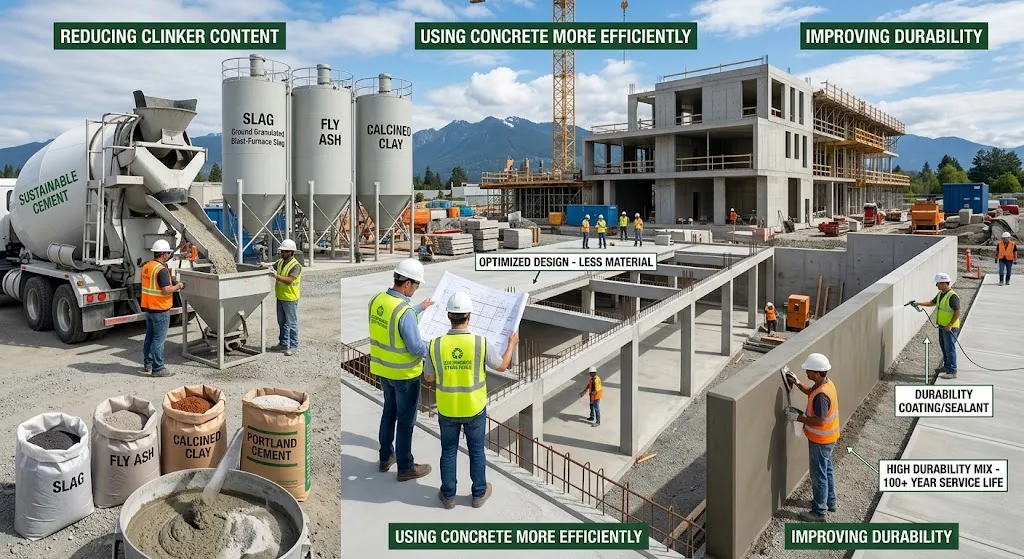
Reducing clinker content: Cement producers can use suitable supplementary cementitious materials, such as ground granulated blast-furnace slag, fly ash where available and appropriate, or calcined clay, to replace part of the clinker in certain formulations.
Using concrete more efficiently: Engineers can design structures to use less material without compromising safety, durability, or performance. Avoiding unnecessary overdesign and optimizing structural components can reduce demand for cement and aggregates.
Improving durability: Structures that last longer generally require fewer repairs and less frequent replacement. Proper curing, suitable mixture design, and protection against environmental damage can help extend service life.
Recycling construction materials: Crushed concrete from demolished structures can be reused as aggregate in suitable applications. Recycling can reduce demand for virgin materials, although recycled aggregate must be assessed for quality and intended use.
Developing lower-carbon cement technologies: Researchers and manufacturers are exploring alternative binders, improved production methods, carbon capture, and other approaches to reduce emissions. Their suitability depends on technical performance, cost, local material availability, and applicable standards.
The long-term challenge is to preserve concrete’s practical advantages while reducing the environmental costs of producing and using it.
Can Concrete Be Recycled?
Yes. Concrete from demolished buildings, roads, and other structures can be processed into reusable material.
Recycling facilities typically crush the concrete and separate out unwanted materials, such as wood, plastics, and metal. Steel reinforcement can often be recovered and recycled separately. The processed concrete can then be used as recycled aggregate in road subbases, drainage layers, fill, and, where standards permit, new concrete mixtures.
The quality of recycled concrete aggregate depends on its original composition, contamination, attached mortar, and processing method. For this reason, recycled material is not automatically suitable for every structural application.
Concrete recycling is particularly valuable because it can reduce landfill demand and conserve natural resources. However, it does not eliminate all environmental impacts, and preventing unnecessary material use remains important.
Why Does Concrete Sometimes Crack?
Although concrete is strong and durable, cracks can develop for several reasons. Some are relatively minor, while others may indicate a problem requiring professional assessment.
One common cause is shrinkage. As concrete loses moisture or undergoes chemical and thermal changes, it can contract. If this movement is restrained, stresses may develop and produce cracks.
Temperature changes can also cause expansion and contraction. In large structures, uneven temperature changes may create additional internal stresses.
Other causes include excessive loading, settlement of the ground, inadequate reinforcement, poor curing, incorrect mixture proportions, and corrosion of embedded steel.
Not every crack means a structure is unsafe. Hairline cracks may occur without seriously affecting performance, while wide, growing, displaced, or water-leaking cracks may require closer inspection. The location, pattern, depth, and progression of the cracking are important when determining its significance.
Proper structural design, construction quality, joint placement, curing, and maintenance help reduce cracking and improve long-term performance.
Concrete vs. Steel, Wood, and Other Building Materials
Concrete is not always the best choice for every construction project. Engineers select materials according to the loads, environmental conditions, design requirements, budget, and expected service life.
Steel has high tensile strength and can support long spans with relatively slender structural members. However, it requires appropriate protection against corrosion and may need fire-protection measures.
Wood is renewable when sourced responsibly and can store carbon during its service life. It is often lighter than concrete and can be efficient for residential construction, although moisture, fire, biological deterioration, and structural requirements must be considered.
Brick and stone remain useful for walls, facades, paving, and other applications. Their suitability depends on local resources, workmanship, structural design, and the performance required.
Concrete’s major advantage is its combination of compressive strength, moldability, broad availability, and compatibility with steel reinforcement. In many projects, the best solution is not to choose one material exclusively but to combine several materials so that each performs the tasks for which it is best suited.
The Future of Concrete
The future of concrete will depend on how effectively the construction industry responds to rising demand, resource constraints, and climate-related challenges.
One important direction is the development of lower-carbon binders and cement formulations. Another is the increased use of digital modeling, automated batching, sensors, and data analysis to improve quality control and reduce material waste.
Researchers are also investigating self-healing concrete, which can repair certain small cracks through biological, chemical, or mineral-based processes. Some of these technologies have demonstrated promising results, but their effectiveness, costs, and suitability vary by application.
Three-dimensional concrete printing is another developing technology. It can create complex shapes by depositing specially formulated cement-based mixtures layer by layer. Although it does not eliminate the need for reinforcement, engineering expertise, or conventional construction methods in every case, it may offer advantages for selected building components and projects.
Carbon capture and improved management of cement production are also being explored as ways to address emissions that are difficult to eliminate through energy efficiency alone.
The most important advances may come not from a single revolutionary material but from a combination of better engineering, more efficient designs, improved production, longer service life, and responsible material use.
Conclusion: The Material That Built the Modern World
Concrete is much more than a mixture of cement, water, sand, and stone. It is a fundamental material of modern civilization, supporting the buildings people live and work in, the roads they travel, the bridges they cross, and the water systems on which communities depend.
Its widespread use is explained by its availability, affordability, versatility, compressive strength, and ability to be produced on an enormous scale. When properly designed and maintained, concrete structures can serve for decades, making the material valuable for both everyday construction and major engineering projects.
At the same time, concrete has environmental costs that cannot be ignored. Cement production generates significant carbon dioxide emissions, while aggregate extraction and construction waste place pressure on natural resources.
The challenge for the future is therefore not simply to produce more concrete, but to use it more intelligently. By designing efficient structures, developing lower-carbon cement, extending service life, and recycling suitable materials, the construction industry can preserve concrete’s benefits while reducing its environmental footprint.
Few materials have influenced the physical shape of the modern world as profoundly as concrete. Its story illustrates how a relatively simple combination of natural resources and chemical science became one of the foundations of contemporary life.




2 thoughts on “What Is Concrete and Why Is It the Most Used Material After Water?”