
Artificial intelligence, commonly called AI, has moved from being a subject of science fiction to becoming part of everyday life. People encounter AI when they use search engines, receive recommendations on streaming platforms, interact with virtual assistants, unlock phones with facial recognition, or use software that can generate text and images.
Despite its growing presence, artificial intelligence can still seem complicated. What exactly is AI? How can a computer recognize an image, understand a question, recommend a product, or generate an answer? Does AI actually think like a human?
The short answer is no. Most modern AI systems do not think or understand the world in the same way people do. Instead, they use algorithms, data, mathematical models, and computing power to identify patterns and produce useful outputs.
Understanding these basic principles makes it easier to appreciate both the possibilities and the limitations of artificial intelligence.

What Is Artificial Intelligence?
Artificial intelligence is a field of computer science focused on creating computer systems that can perform tasks that normally require some form of human intelligence.
These tasks can include:
- Understanding and processing language
- Recognizing images and sounds
- Identifying patterns
- Making predictions
- Solving certain problems
- Recommending information
- Generating text, images, audio, or code
- Making decisions based on available information
The term artificial intelligence covers a very broad range of technologies. A simple system that identifies spam emails and an advanced language model are both examples of AI, but they work in very different ways.
AI should therefore not be understood as one particular program. It is better understood as a collection of methods and technologies designed to enable computers to perform tasks associated with intelligent behavior.
How Does Artificial Intelligence Work?
At a basic level, many AI systems work by processing information, identifying patterns, and using those patterns to produce an output.
A simplified process looks like this:
Data → Training → Model → Input → Prediction or Output
For example, imagine an AI system designed to recognize photographs of cats.
The developers could provide the system with a large collection of images labeled according to what they contain. During training, the system processes those examples and adjusts its internal parameters so that it becomes better at distinguishing relevant patterns.
Later, when it receives a new photograph, the trained model analyzes the image and produces a prediction about whether it contains a cat.
The computer is not necessarily following a simple rule such as “look for two ears and four legs.” Modern machine-learning systems can identify complicated statistical patterns across enormous numbers of examples.
The Role of Data
Data is one of the most important ingredients in modern artificial intelligence.
Depending on the application, data might include:
- Text
- Photographs
- Videos
- Audio recordings
- Numerical measurements
- Sensor information
- User interactions
- Historical records
The type and quality of data matter greatly. An AI system trained using incomplete, inaccurate, or poorly represented data can produce unreliable results.
For example, an image-recognition system trained primarily on photographs taken under particular lighting conditions may perform less accurately when presented with images from very different environments.
This is one reason AI development involves much more than simply writing computer code. Developers and researchers must also consider how data is collected, prepared, labeled, evaluated, and used.
What Is Machine Learning?
Machine learning is one of the most important approaches used in modern AI.
Instead of programming a computer with a detailed rule for every possible situation, machine-learning systems can learn patterns from examples.
Consider an email spam filter. It would be difficult to manually create a rule for every possible spam message because unwanted emails constantly change.
Instead, a machine-learning system can be trained using examples of messages that have been identified as spam and messages that are considered legitimate. The system learns patterns associated with those examples and can then estimate whether a new message is likely to be spam.
Machine learning can be used for:
- Classification
- Prediction
- Recommendation
- Fraud detection
- Image recognition
- Speech recognition
- Language processing
- Anomaly detection
Machine learning is therefore an important part of AI, but the two terms are not identical. AI is the broader concept, while machine learning is one method used to create AI systems.
What Is Deep Learning?
Deep learning is a specialized form of machine learning that uses neural networks with multiple layers.
These networks are loosely inspired by some aspects of biological neural systems, although artificial neural networks are mathematical and computational structures rather than digital copies of human brains.
Deep-learning systems have become particularly important because they can process very large and complex datasets.
They are used in areas such as:
- Computer vision
- Speech recognition
- Natural language processing
- Image generation
- Recommendation systems
- Autonomous systems
- Scientific research
A deep-learning model can contain a very large number of adjustable parameters. During training, those parameters are repeatedly modified so that the model becomes better at performing its assigned task.
What Is a Neural Network?
A neural network is a computational model made up of interconnected mathematical units, often organized into layers.
A simplified neural network contains:
- Input layer — receives information.
- Hidden layers — transform the information through mathematical operations.
- Output layer — produces a result.
For an image-recognition system, the input might be the numerical representation of an image. The network processes that information through its layers and eventually produces an output, such as a probability that the image belongs to a particular category.
Modern neural networks can be extremely complex, containing millions, billions, or even more adjustable parameters depending on the model.
How Does AI Learn?
The word “learn” can sometimes create a misleading impression.
When people learn something, they may understand meaning, connect experiences to broader knowledge, and consciously reflect on what they have learned. Machine-learning systems do not necessarily learn in this human sense.
Instead, learning generally involves adjusting mathematical parameters based on examples.
Suppose an AI system is trying to predict whether an image belongs to category A or category B. It makes a prediction and compares that prediction with the expected answer.
The difference between the prediction and the desired result can be measured using a mathematical function often called a loss function.
The system then adjusts its parameters to reduce the error. This process is repeated many times.
Over many examples, the model can become increasingly effective at the task.
Training and Inference
AI systems are often discussed in terms of two important stages: training and inference.
Training
Training is when a model learns patterns from data.
This can require:
- Large datasets
- Powerful processors
- Significant amounts of electricity
- Specialized software
- Mathematical optimization techniques
- Considerable time
For large AI models, training can involve enormous computational resources.
Inference
Inference occurs when a trained model receives new information and generates an output.
For example, when a user asks an AI assistant a question, the system is generally performing inference using a previously trained model.
The distinction is important because training a model and using the trained model are different computational processes.
How Does Generative AI Work?
Generative AI refers to systems designed to create new content based on patterns learned from training data.
Depending on the model, generative AI can produce:
- Text
- Images
- Music
- Audio
- Video
- Computer code
A text-generating AI system does not simply search a database and copy an existing paragraph whenever someone asks a question. Modern systems generate outputs by calculating likely sequences of tokens based on the input and the model’s learned parameters.
A token can represent a word, part of a word, punctuation, or another unit of text, depending on the system.
When generating text, the model repeatedly predicts what should come next based on the context it has received.
This can happen extremely quickly, creating the impression of a conversation.
How Do AI Chatbots Understand Questions?

Modern AI chatbots use language models trained on very large collections of text and other information.
When a user submits a question, the system converts the input into a form the model can process. The model analyzes relationships between the tokens and uses its learned statistical patterns to generate a response.
This is why a language model can respond to questions, summarize information, rewrite text, translate languages, or produce different writing styles.
However, saying that a language model “understands” language requires some caution.
The model can represent complex relationships between words, concepts, and contexts, but this does not necessarily mean that it possesses human consciousness or understanding.
Does Artificial Intelligence Think Like a Human?
Generally, no.
Modern AI can perform tasks that appear intelligent, but that does not mean it has a human mind.
Humans have:
- Conscious experiences
- Emotions
- Personal memories
- Physical experiences
- Biological needs
- Social relationships
- Subjective awareness
An AI system does not automatically possess these characteristics.
A language model can discuss happiness without experiencing happiness. An image-generation system can create an image of a beach without having ever visited one.
The distinction between intelligent behavior and human consciousness is important when discussing the capabilities of AI.
How Is AI Used in Everyday Life?
Many people use AI without realizing how frequently it appears in ordinary digital services.
Search engines
Search engines use sophisticated algorithms and machine-learning systems to understand queries, identify relevant information, and rank results.
Recommendation systems
Streaming platforms, online stores, and social networks can use machine-learning systems to recommend content or products based on patterns in user behavior.
Navigation
Navigation applications can analyze traffic information, historical patterns, road conditions, and other data to estimate travel times and suggest routes.
AI-powered systems can detect spam, suspicious messages, and potentially malicious content.
Smartphones
Modern phones can use AI for speech recognition, image processing, facial recognition, photography improvements, translation, and other functions.
Banking
Financial institutions use machine-learning systems for activities such as fraud detection, risk assessment, and transaction monitoring.
Healthcare
AI is being researched and used in areas such as medical imaging, clinical decision support, drug discovery, and analysis of biological data. These applications require appropriate validation and professional oversight because errors can have serious consequences.
What Are the Benefits of Artificial Intelligence?
AI can offer significant advantages when it is appropriately designed and applied.
Automation
AI can automate repetitive tasks and allow people to spend more time on activities requiring judgment, creativity, or human interaction.
Speed
Computers can process enormous amounts of information much faster than humans in many situations.
Pattern recognition
AI can identify statistical patterns in large datasets that might be difficult for a person to detect manually.
Personalization
Recommendation systems can adapt information, products, or services to individual users.
Accessibility
AI-powered speech recognition, translation, image descriptions, and other tools can help make digital information more accessible.
Scientific research
AI can assist researchers in analyzing complex datasets and exploring relationships that might otherwise be difficult to investigate.
What Are the Limitations of AI?
Artificial intelligence is powerful, but it is not infallible.
One major limitation is that AI systems can produce incorrect results.
A sophisticated AI model can sometimes generate an answer that sounds convincing but is factually wrong. In generative AI, this is sometimes described as a hallucination.

AI can also struggle when:
- Information is incomplete
- The question is ambiguous
- The situation differs significantly from training examples
- Context is misunderstood
- Data contains biases
- A task requires common-sense judgment
- The required information is recent or unavailable to the system
This is why AI-generated information should not automatically be treated as accurate.
What Is AI Bias?
AI systems can reproduce or amplify patterns found in their training data.
If the underlying data contains biases, those biases can potentially affect the system’s outputs.
Bias can arise from:
- Unbalanced datasets
- Historical inequalities
- Incomplete information
- Human decisions used to label data
- Design choices
- Differences between training and real-world environments
Reducing AI bias is therefore an important technical and social challenge.
Developers can use evaluation methods, diverse datasets, testing procedures, monitoring, and other techniques to identify and reduce problematic behavior.
Why Does AI Require So Much Computing Power?
Modern AI models can contain enormous numbers of parameters and may require substantial computational resources.
Training large models involves performing huge numbers of mathematical operations. Specialized hardware, including graphics processing units and other accelerators, can perform many of these calculations efficiently.
Computing resources are also needed when AI systems serve large numbers of users.
As AI becomes more widespread, researchers and technology companies are therefore working to make models more efficient, reduce energy consumption, and develop better hardware.
Is AI Going to Replace Human Workers?
AI is likely to change many jobs, but the effect will vary considerably between occupations.
Some tasks are particularly suitable for automation because they are repetitive, predictable, or based on large amounts of structured information.
Other work depends heavily on:
- Human relationships
- Physical skills
- Complex judgment
- Creativity
- Responsibility
- Leadership
- Communication
- Emotional understanding
In many cases, AI may change a job rather than eliminate the entire occupation.
A person might use AI to prepare a first draft, analyze information, organize documents, or identify patterns while retaining responsibility for reviewing the results and making final decisions.
The future of work is therefore likely to involve both automation and collaboration between humans and AI.
What Is the Difference Between Narrow AI and General AI?
Most AI systems available today can be described as narrow AI.
Narrow AI is designed to perform particular tasks or groups of related tasks. A recommendation system, speech-recognition system, or image-classification model may perform extremely well within its intended area without possessing general human intelligence.
Artificial general intelligence (AGI) is a theoretical concept referring to a system with much broader and more flexible intellectual capabilities.
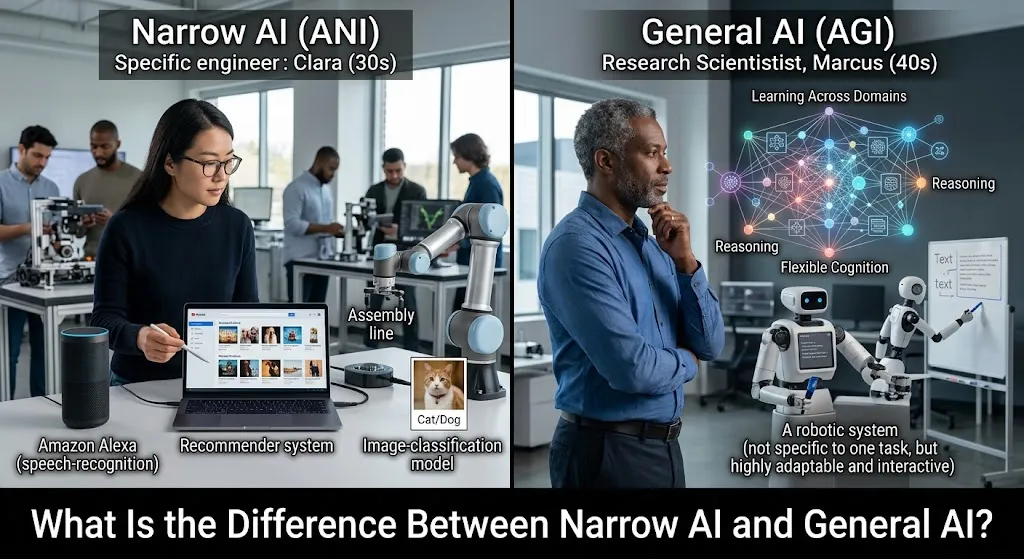
AGI remains a subject of significant research and debate. It should not be confused with the AI tools currently used for specific applications.
Can AI Be Creative?
AI can produce outputs that people may consider creative, including stories, illustrations, music, designs, and computer code.
However, the nature of AI creativity is different from human creativity.
AI systems generate outputs based on patterns learned from data and the instructions they receive. Human creativity involves personal experiences, emotions, intentions, cultural influences, experimentation, and conscious choices.
Whether machine-generated work should be considered “creative” is partly a philosophical question, but there is no doubt that generative AI has introduced new ways of creating and working with digital content.
Why Human Oversight Still Matters
The more important an AI-assisted decision is, the more important appropriate human oversight becomes.
For low-risk tasks, an incorrect recommendation may simply be inconvenient. In areas such as healthcare, law, finance, employment, or public safety, mistakes can have much more serious consequences.
Human oversight can help by:
- Checking AI-generated information
- Identifying errors
- Evaluating context
- Considering ethical consequences
- Making final decisions
- Taking responsibility for outcomes
AI can be a powerful tool without being the final authority.
What Does the Future of Artificial Intelligence Look Like?
AI development is likely to continue affecting education, business, science, healthcare, entertainment, communication, and many other areas.
Future systems may become more capable, efficient, multimodal, and specialized. AI may increasingly work with text, images, audio, video, software, sensors, and other types of information within the same system.
At the same time, questions about privacy, security, copyright, employment, misinformation, bias, accountability, and regulation will remain important.
The future of AI will therefore not be determined solely by technological progress. It will also depend on how societies choose to develop, regulate, and use these systems.
How Should People Learn About AI?
People do not need to become computer scientists to understand the basics of artificial intelligence.
A useful starting point is to learn a few fundamental concepts:
- AI — the broader field of creating systems capable of performing tasks associated with intelligent behavior.
- Machine learning — systems that learn patterns from data.
- Deep learning — machine learning based on multilayer neural networks.
- Generative AI — systems capable of generating new content.
- Training — the process through which model parameters are adjusted using data.
- Inference — using a trained model to produce an output from new input.
- Model — the mathematical system that represents patterns learned during training.
Understanding these concepts makes many discussions about artificial intelligence much easier to follow.
Final Thoughts
Artificial intelligence is not a single machine or program. It is a broad field involving algorithms, data, mathematical models, computing systems, and techniques that allow computers to perform tasks associated with intelligent behavior.
Modern AI can recognize patterns, process language, analyze information, make predictions, recommend content, and generate new material. Machine learning and deep learning have been particularly important in making these capabilities possible.
At the same time, AI has important limitations. It can make mistakes, reproduce biases, misunderstand context, and produce convincing information that is not necessarily correct. It also does not automatically possess human consciousness, emotions, or experiences.
The most useful way to think about artificial intelligence is therefore neither as magic nor as a replacement for human intelligence. AI is a powerful technology that can extend what people are able to do when it is used thoughtfully and responsibly.
As AI becomes increasingly integrated into everyday life, understanding how it works will become an important part of digital literacy. The better people understand both its capabilities and its limitations, the better prepared they will be to use it effectively.
For more informative articles, practical guides, and interesting topics across a wide range of subjects, visit serdpestcp.org and explore more.


One thought on “What Is Artificial Intelligence and How Does It Work?”