Glass is one of those materials that seems almost magical. It can be transparent or colored, strong or delicate, smooth or textured, and it can be shaped into everything from windows and bottles to laboratory equipment, smartphone screens, and optical fibers.
Yet one of its most important ingredients is something remarkably ordinary: sand.
Glass is made from silica-rich sand that is mixed with materials such as soda ash and limestone, heated to very high temperatures, refined, shaped while molten, and then slowly cooled. The silica provides the main glass-forming material, while the other ingredients help control melting temperature, durability, and other properties.
The connection between a handful of sand and a clear glass window may not seem obvious. Sand is rough, granular, and opaque, while glass is smooth, transparent, and solid. The transformation happens through a combination of carefully selected raw materials, extremely high temperatures, controlled cooling, and specialized manufacturing techniques.
But not just any sand can be turned into high-quality glass. The type of sand, its chemical composition, and the amount of impurities it contains are all important.
So how does an ordinary mineral material become one of the most useful substances in modern life?
What Kind of Sand Is Used to Make Glass?
The most important ingredient in ordinary glass is silica, or silicon dioxide (SiO₂).
Silica is found naturally in many rocks and minerals, and quartz is one of its most common forms. Because quartz is relatively resistant to weathering, it can accumulate in deposits containing large amounts of silica.
However, glass manufacturers need much more than simply “sand.”
For many types of glass, the silica sand must have a high degree of purity. Certain impurities can affect the color, strength, melting behavior, or other properties of the finished glass.
For example, iron compounds can give glass a greenish or brownish tint. While small amounts of coloration may be acceptable for some products, manufacturers producing very clear glass often need raw materials with particularly low levels of iron.
This is why a beautiful beach may contain enormous amounts of sand but still be unsuitable for producing certain kinds of commercial glass.
What Ingredients Are Used to Make Glass?
Although silica is the main component, ordinary glass is usually not made from sand alone.
A common type of commercial glass is soda-lime glass, which is widely used for windows, bottles, jars, and many everyday products.
Its basic ingredients include:
- Silica sand
- Soda ash
- Limestone
- Recycled glass, known as cullet
Each ingredient serves a purpose.
Silica forms the main glass-forming network.
Soda ash helps lower the temperature required to melt the silica, making the manufacturing process more practical.
Limestone helps improve the chemical durability and stability of the finished glass.
Recycled glass can be added because already-made glass melts more easily than raw materials and can reduce the amount of new raw material required.
The exact recipe varies according to the type of glass being manufactured.
Step 1: Selecting and Preparing the Raw Materials
Glass production begins long before anything enters a furnace.
Manufacturers first select raw materials according to the specifications of the final product.
Silica sand is examined for its chemical composition and particle characteristics. Other ingredients are also tested to ensure that they meet the required standards.
The materials may then be cleaned, dried, crushed, screened, or otherwise processed.
Contamination is carefully controlled because even relatively small amounts of unwanted material can affect the final product.
For high-quality glass, consistency is extremely important.
A factory producing millions of identical bottles cannot afford large variations in the chemical composition of its raw materials.
Step 2: Mixing the Ingredients
Once the raw materials have been prepared, they are measured and mixed in carefully controlled proportions.
This mixture is sometimes called the batch.
The objective is to create a uniform mixture so that the chemical composition remains consistent as the material moves through the melting process.
Recycled glass can also be incorporated into the batch.
This recycled material, called cullet, is extremely valuable to the glass industry because it has already undergone the chemical transformation required to become glass.
Instead of starting completely from raw minerals, manufacturers can melt existing glass again.
This can reduce energy consumption and the amount of raw material needed.
Step 3: Melting the Glass in a Furnace
The mixed batch is then transported into a glass-melting furnace.
This is where the transformation becomes dramatic.
The materials are heated to temperatures generally well above 1,400°C, with exact temperatures depending on the glass composition and manufacturing process.
At these temperatures, the raw materials begin to soften and melt.
Chemical reactions occur between the different components.
The crystalline structure of the original minerals breaks down, and the material gradually becomes a molten glass.
The furnace must maintain carefully controlled conditions because the quality of the final glass depends heavily on the melting process.
Step 4: Melting and Refining

Simply melting the ingredients is not enough.
The molten material may contain bubbles, undissolved particles, or other imperfections.
Manufacturers therefore use a refining stage to improve the quality of the molten glass.
As the material remains at high temperature, gases can escape and bubbles can rise toward the surface.
The molten glass must also become sufficiently homogeneous.
This is particularly important for products such as optical glass, where even tiny imperfections can interfere with the way light travels through the material.
The molten glass eventually becomes a relatively uniform liquid-like material.
At this point, the original sand is no longer recognizable.
Its chemical components have been transformed into a completely different physical structure.
Step 5: Forming the Glass
Once the glass is molten and refined, it must be shaped.
Different products require different forming techniques.
Making Glass Bottles
For bottles and jars, molten glass is divided into precise portions called gobs.
These pieces are transferred into molds, where compressed air and mechanical forces shape them into the desired container.
The process is extremely fast because modern factories may produce thousands of containers per hour.
The glass must be hot enough to flow but controlled enough to maintain the correct shape.
Making Window Glass
Modern flat glass is commonly produced using the float glass process.
In this method, molten glass is poured onto a bath of molten tin.
Because the glass is less dense than the liquid tin, it floats on the surface.
The molten glass spreads into a smooth, continuous sheet.
The result is remarkably flat glass with a high-quality surface.
This process revolutionized window manufacturing because it allowed manufacturers to produce large sheets of consistently flat glass.
Making Fiberglass
Glass can also be drawn into extremely fine fibers.
Molten glass passes through tiny openings and forms thin strands that are cooled and collected.
These fibers can be used for insulation, reinforcement materials, and other specialized applications.
Making Glass for Screens and Electronics
Specialized glass used in smartphones, tablets, televisions, and other electronic devices requires carefully controlled compositions and manufacturing processes.
Such glass may need exceptional clarity, smoothness, thinness, scratch resistance, or resistance to thermal shock.
The basic principle remains similar—raw materials are melted and transformed—but the formulation and processing become much more sophisticated.
Step 6: Cooling Without Breaking
One of the most important parts of glass manufacturing happens after the glass has been formed.
Hot glass cannot simply be removed from the furnace and left to cool rapidly.
If it cools unevenly, internal stresses can develop.
These stresses can cause the glass to crack or shatter.
Instead, manufacturers carefully control the cooling process.
This controlled cooling process is called annealing.
The glass passes through a specialized chamber called an annealing lehr, where its temperature is gradually reduced according to a carefully designed schedule.
The objective is to relieve internal stresses and create a stable finished product.
Step 7: Cutting, Inspection, and Finishing
Once the glass has cooled, it can undergo additional processing.
Flat glass may be cut into specific sizes.
Bottles may be inspected for defects.
Glass products can be polished, coated, tempered, laminated, or otherwise treated depending on their intended use.
Automated inspection systems are often used to detect tiny imperfections.
Cameras and sensors can examine glass at high speed, identifying cracks, bubbles, dimensional problems, and other defects.
Products that do not meet the required specifications can be rejected and, in many cases, recycled back into the production process as cullet.
Why Glass Is Transparent
One of the most fascinating properties of glass is its transparency.
Why can light pass through glass while it cannot pass through an ordinary piece of rock?
The answer lies in the way the atoms and electrons within the material interact with light.
Visible light can pass through many types of glass because its electronic structure does not strongly absorb the wavelengths of visible light.
The result is a material that appears transparent.
However, glass is not transparent to every type of electromagnetic radiation.
Different types of glass can block or transmit different wavelengths.
This is why specialized glass can be designed for applications involving ultraviolet radiation, infrared light, lasers, or optical communications.
Why Glass Can Be Strong
Glass has a reputation for being fragile, but its strength can be surprisingly high under certain conditions.
The problem is that glass is sensitive to surface defects.
A tiny scratch or crack can act as a starting point for fracture.
Manufacturers can improve strength through processes such as tempering.
Tempered glass is heated and then rapidly cooled in a controlled way, creating compressive stresses near the surface.
This can make it considerably more resistant to impacts and temperature changes.
When tempered glass does break, it tends to fracture into many smaller pieces rather than producing the large sharp shards associated with some ordinary glass.
Another method is laminated glass, in which layers of glass are bonded with a plastic interlayer.
Automobile windshields are a familiar example.
Why Recycled Glass Matters
Glass has another important environmental advantage: it can be recycled repeatedly without fundamentally changing its chemical identity.
Used glass containers can be collected, cleaned, sorted, crushed, and processed into cullet.
The cullet can then be melted again to manufacture new glass products.
This creates an important circular process.
Instead of extracting all-new raw materials every time a bottle is produced, manufacturers can use a portion of existing glass.
Recycling can also reduce the energy required for melting because cullet is already glass and therefore does not need to undergo the same initial chemical transformations as raw materials.
However, effective glass recycling depends on proper collection and sorting.
Different types of glass can have different compositions, and contamination can create problems during manufacturing.
Glass Is More Important Than It Looks
Most people encounter glass dozens of times every day without thinking about its manufacturing process.
Windows allow sunlight into homes.
Bottles protect food and beverages.
Eyeglasses help people see.
Laboratory glassware allows scientists to conduct experiments.
Fiber-optic cables transmit information over enormous distances.
Glass screens connect people to digital technology.
Solar panels use glass as a protective and structural component.
Medical equipment relies on specialized glass products.
The material is so familiar that its complexity is easy to overlook.
Yet behind a simple glass bottle is an industrial process involving geology, chemistry, heat, engineering, precision manufacturing, and quality control.
From Ancient Discovery to Modern Industry
Humans have been making glass for thousands of years.
Ancient glassmakers discovered that certain mineral mixtures could be melted and transformed into a hard, shiny material.
Early glass was often used for decorative objects, beads, containers, and other specialized products.
Over centuries, glassmaking techniques improved.
Modern industrial furnaces, automated forming machines, advanced chemical analysis, precision temperature control, and recycling systems have transformed glassmaking into a highly sophisticated industry.
The basic idea, however, remains remarkably similar to the ancient one:
Take mineral ingredients, heat them until they transform, shape the molten material, and cool it carefully.
The difference is the scale and precision.
The Journey From Sand to Glass
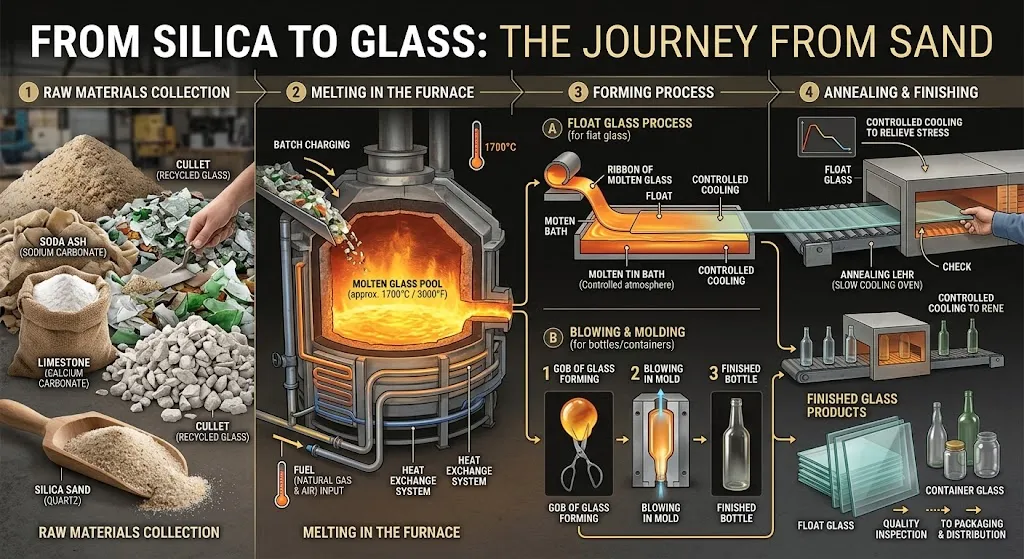
The transformation can be summarized simply:
Silica-rich sand → raw material preparation → mixing → high-temperature melting → refining → forming → controlled cooling → finishing → finished glass
What begins as tiny mineral grains eventually becomes a completely different material.
The sand itself does not simply melt into transparent glass in isolation.
Instead, its silica combines with other ingredients during a high-temperature chemical process. The resulting molten material is then shaped and cooled into a solid amorphous material.
That is what makes glass so fascinating.
Key Takeaways
- Glass is primarily made from silica-rich sand, but sand alone is not enough.
- Soda ash and limestone are commonly added to make soda-lime glass.
- The raw materials are melted at temperatures generally above 1,400°C.
- Molten glass is refined and then formed into bottles, windows, fibers, and other products.
- Controlled cooling, called annealing, helps prevent internal stresses and cracking.
- Recycled glass, or cullet, can be melted and used to make new glass.
Conclusion: From a Grain of Sand to a Window
Glassmaking is a remarkable example of how humans can transform ordinary geological materials into sophisticated products.
The story begins with sand containing silica. It continues with carefully selected ingredients, powerful furnaces, temperatures exceeding 1,400°C, controlled chemical reactions, precision forming, and carefully managed cooling.
The final result may be a simple bottle sitting on a kitchen shelf or a huge window in a modern building.
But that transparent object contains a history that reaches from ancient geological processes to modern industrial technology.
The next time sunlight passes through a window, it is worth remembering what lies behind that clear surface: minerals formed by the Earth’s geological processes, sand extracted from carefully selected deposits, intense industrial heat, precise engineering, and a manufacturing process that turns ordinary grains into one of civilization’s most useful materials.
In a very real sense, modern glass begins with sand—but it takes science, energy, and extraordinary precision to turn those grains into something transparent.
FAQ: How Glass Is Made From Sand
No. Glassmaking generally requires sand with a high silica content and low levels of unwanted impurities. The quality and chemical composition of the sand affect the properties and appearance of the finished glass.
Not by itself. Silica-rich sand is mixed with other materials, such as soda ash and limestone, before being heated to very high temperatures. Chemical reactions during melting create the glass.
Glassmaking furnaces commonly operate at temperatures above 1,400°C, although the exact temperature depends on the type and composition of the glass.
Highly clear glass requires carefully selected raw materials with very low levels of impurities. In particular, iron compounds can give glass a green or brown tint.
Manufacturers use controlled cooling called annealing. This gradually reduces the temperature and helps relieve internal stresses that could otherwise cause the glass to crack.
No. Different types of glass use different combinations of raw materials, and some specialized glasses have carefully engineered chemical compositions for particular applications.
Yes. Recycled glass, known as cullet, can be melted and used to manufacture new glass. It can reduce the need for virgin raw materials and can also lower energy requirements.