
Sand seems like one of the most ordinary materials on Earth. It covers beaches, fills deserts, lines riverbanks, and appears in gardens, playgrounds, construction sites, and countless everyday products. Because it is so common, it is easy to assume that sand is practically unlimited.
But sand is not simply something that exists in endless piles waiting to be collected.
The sand we use for construction, glassmaking, roads, concrete, electronics, and other industries comes from specific geological environments, and producing the right kind of sand can take thousands or even millions of years. At the same time, humanity is extracting enormous quantities of sand every year.
This creates a surprising problem: the world is not literally running out of every grain of sand, but it is increasingly running short of the types of sand that modern society can economically and safely use.
Understanding why requires looking at where sand comes from, how it is naturally created, how humans process it, and why something as simple as a grain of sand has become an important global resource.
What Exactly Is Sand?
Before asking how sand is made, it helps to understand what sand actually is.
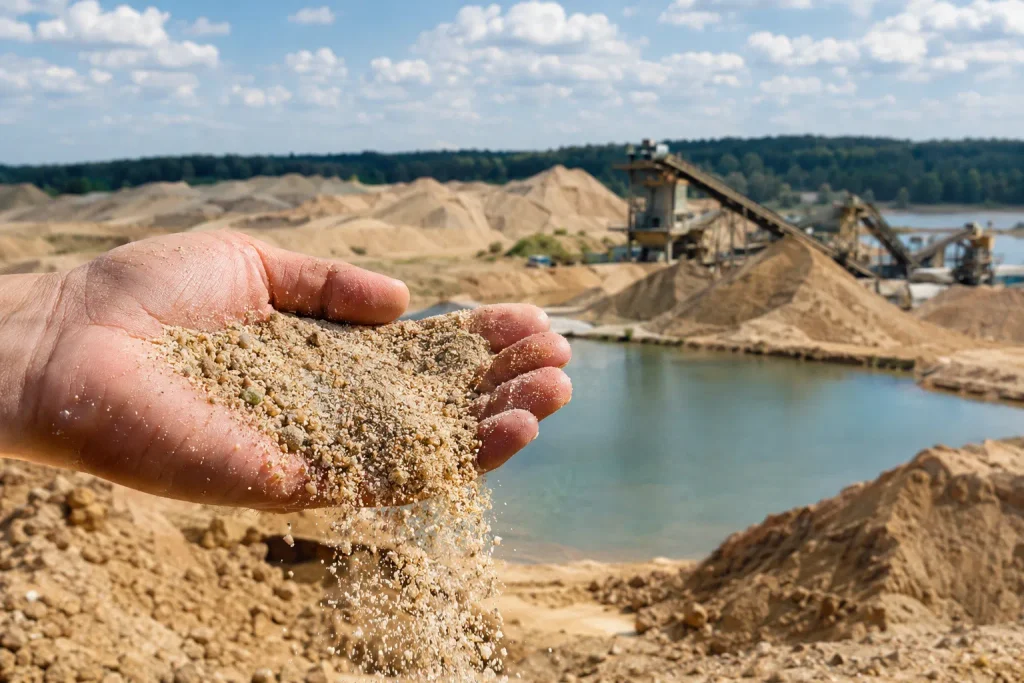
Sand is not a single mineral or substance. It is a collection of tiny particles of rock, minerals, shells, and other geological materials. By geological convention, sand-sized particles generally measure between about 0.0625 and 2 millimeters in diameter.
That means sand sits between silt, which is finer, and gravel, which is coarser.
The composition of sand depends heavily on where it comes from.
Some sand is dominated by quartz, one of the most common and chemically resistant minerals on Earth. Other sand contains feldspar, volcanic minerals, fragments of limestone, coral, shells, or even material produced by biological processes.
The color can also vary dramatically.
White beaches may contain large amounts of quartz, carbonate minerals, or fragments of shells and coral. Black sand can form from volcanic rocks. Some beaches have pink, red, green, or golden tones because of the minerals and biological material mixed into the sediment.
So when people talk about “sand,” they are actually talking about a huge family of different natural materials.
And that distinction becomes extremely important when sand is used by industry.
Sand Does Not Appear Overnight
Natural sand is the product of geological processes that can operate for incredibly long periods.
One of the most important sources is the gradual breakdown of rocks.
Mountains and exposed rock surfaces are constantly attacked by wind, rain, temperature changes, glaciers, rivers, chemical reactions, and other forces. Over time, large pieces of rock fracture into smaller pieces.
A boulder becomes a rock.
The rock becomes smaller fragments.
Those fragments are eventually reduced to gravel, sand, and finer particles.
This process is called weathering.
Mechanical weathering physically breaks rocks apart without necessarily changing their chemical composition. Water entering cracks can freeze and expand, roots can push rocks apart, and repeated heating and cooling can cause surfaces to fracture.
Chemical weathering works differently. Water and dissolved chemicals react with minerals, gradually altering or dissolving them.
Once particles are created, they can be transported by rivers, glaciers, wind, waves, and ocean currents.
During transportation, particles collide with one another and with rocks along their path. They may become smaller, smoother, and more rounded.
Eventually, they are deposited somewhere else.
A river may carry sediment downstream and leave it on a floodplain.
Waves may move sand along a coastline.
Wind may transport fine particles into enormous dune systems.
Glaciers can grind rocks into vast quantities of sediment.
Over geological time, these processes create many of the sand deposits that humans later discover and use.
Why Quartz Is So Common in Sand
One reason quartz is so important is its durability.
Quartz is relatively resistant to physical and chemical weathering. Other minerals may break down or dissolve more easily, while quartz survives transportation and repeated geological processing.
This means that after rocks have been weathered and transported for long periods, quartz can become concentrated in certain environments.
That is why many natural sands contain substantial amounts of quartz.
Quartz-rich sand is especially valuable for some industrial purposes because its chemical and physical characteristics make it useful in applications such as glass production and certain construction materials.
But not all sand is suitable for all purposes.
That is one of the biggest misconceptions surrounding the global sand shortage.
Desert Sand Is Not a Simple Replacement
If you hear that the world is running short of sand, a natural question is:
What about all the sand in the deserts?
The world’s deserts contain enormous quantities of sand. The Sahara alone covers a huge area and contains extensive dune fields.
So why not simply transport desert sand to construction sites?
The problem is that sand is not interchangeable.
Desert sand has often been shaped by wind over long periods. Individual grains can become relatively smooth and rounded.
For some construction applications, this shape is less useful than the rougher, more angular particles found in riverbeds, quarries, and other environments.
Concrete, for example, needs aggregates with appropriate physical properties so that the particles interact effectively and form a stable material when combined with cement and water.
Very smooth, rounded desert sand may not perform as well in some applications.
This is an important lesson:
A huge amount of sand can exist somewhere in the world without being the right sand for a particular job.
The issue is therefore not simply quantity. It is quality, location, composition, grain shape, accessibility, environmental restrictions, and cost.
How Humans Make Sand
Although natural processes create sand, humans can also produce sand-like material by crushing rocks.
This is known as manufactured or crushed sand.
Instead of waiting millions of years for geological processes to produce naturally deposited material, companies can extract suitable rock from a quarry and use machinery to break it into smaller particles.
The general process can involve several stages.
First, suitable rock is extracted from a quarry.
Large pieces are then fed into crushers that reduce their size.
Secondary and sometimes tertiary crushing stages further reduce the material.
Screening equipment separates particles according to size.
Additional processing may remove unwanted materials or adjust the final particle distribution.
The result can be manufactured sand designed for specific construction purposes.
This approach is becoming increasingly important because it allows societies to reduce their dependence on naturally occurring deposits of certain types of sand.
But manufactured sand does not eliminate the environmental costs of mining.
Quarrying rock requires energy, equipment, transportation, land, and infrastructure.
It can also produce dust, noise, vibration, and changes to landscapes.
In other words, making sand artificially does not mean producing it from nothing. The raw material still has to come from somewhere.
Why Construction Uses So Much Sand
The largest reason sand has become such an important resource is construction.
Modern cities consume extraordinary amounts of concrete, asphalt, mortar, glass, and other materials that depend on sand or other aggregates.
Concrete alone contains large quantities of aggregate.
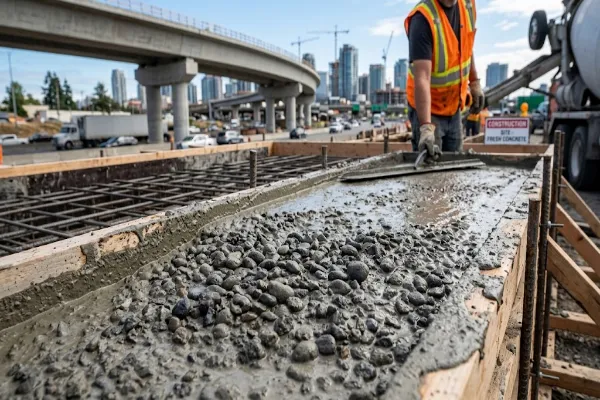
A typical concrete mixture combines cement, water, sand, and larger aggregates such as gravel or crushed stone.
The cement acts as the binding material, while the aggregates provide much of the volume and structural framework.
Because cities are constantly building apartment buildings, roads, bridges, airports, tunnels, dams, sidewalks, industrial facilities, and other infrastructure, enormous quantities of aggregate are required.
Sand is therefore embedded in the physical infrastructure of modern civilization.
When a new city expands, it does not merely require more buildings.
It requires foundations, roads, drainage systems, bridges, utilities, ports, railways, and countless other structures.
All of them consume materials.
Sand Is Also Used to Make Glass
Sand has another major industrial role: glass.
High-quality silica sand can be an important raw material for manufacturing glass.
When silica-rich material is heated to extremely high temperatures, it can melt and form glass when cooled under appropriate conditions.
Glass is used in windows, bottles, laboratory equipment, fiber optics, solar technologies, screens, and many other products.
The sand required for glassmaking must meet particular chemical and physical specifications.
Impurities can affect the final product, meaning that ordinary beach sand is not automatically suitable for making high-quality glass.
This again illustrates why saying “there is plenty of sand” can be misleading.
The relevant question is not simply whether grains between a certain size exist somewhere.
The question is whether the material has the right composition, purity, grain characteristics, location, and economic accessibility.
Sand Is Inside More Things Than You Think
Construction and glass are only part of the story.
Sand and silica-derived materials appear throughout modern industry.
They can be used in:
- Electronics manufacturing
- Solar panels
- Ceramics
- Foundries
- Water filtration
- Paints and coatings
- Certain chemical processes
- Abrasives
- Industrial flooring
- Asphalt
- Mortar
- Concrete
- Road construction
- Land reclamation
Silicon, which is closely associated with silica-rich raw materials, is particularly important to modern technology.
Semiconductors rely on extremely purified silicon.
That means the humble mineral resources associated with sand can eventually become part of the technological infrastructure behind computers, smartphones, vehicles, communications systems, and data centers.
The journey from a grain of sand to a computer chip is extraordinarily complex, but it illustrates how geological materials can become essential components of modern life.
Why Rivers Are So Important
Many of the sand deposits used by construction industries are associated with rivers and other sedimentary environments.
Rivers naturally transport enormous amounts of sediment.
As water flows from mountains and uplands toward the sea, it carries particles with it. Some sediment settles along river channels, floodplains, deltas, and other environments.
Humans have learned to extract useful aggregate from these deposits.
But removing too much sediment can interfere with the natural behavior of a river.
River systems are dynamic.
They continuously move sediment downstream and redistribute it across their channels and floodplains.
If humans remove sediment faster than natural processes replace it, the balance can change.
The consequences can include erosion of riverbanks, changes in channel shape, damage to habitats, and increased vulnerability to certain forms of coastal and riverine erosion.
The problem becomes particularly serious when extraction occurs on a large scale.
Beaches Are Not Giant Sand Warehouses
Coastal sand is also a valuable natural resource, but removing it can have serious consequences.
A beach is part of a larger sediment system.
Sand can move between beaches, dunes, offshore areas, and coastal waters.
Waves and currents constantly redistribute these particles.
If large quantities are removed, the system may not be able to replace them quickly enough.
This can contribute to beach erosion.
The consequences are not merely aesthetic.
Beaches and dunes can act as natural buffers against storms and waves. They can protect coastal communities and infrastructure from some forms of erosion and flooding.
Removing too much sediment can therefore weaken natural coastal defenses.
It can also destroy or disturb habitats for plants, birds, turtles, crustaceans, and many other organisms.
Sand Mining Can Transform Landscapes
Sand extraction can take place in rivers, floodplains, beaches, coastal areas, and quarries.
The environmental effects depend on the location, scale, extraction method, and geological conditions.
In some places, uncontrolled extraction has created major changes to landscapes.
Riverbeds can become deeper.
Banks can become unstable.
Vegetation can disappear.
Water systems can become disturbed.
Habitats can be damaged.
Coastal areas can become more vulnerable to erosion.
Groundwater conditions can also be affected in some environments.
The impacts may be difficult to reverse because natural sediment formation and transport operate much more slowly than industrial extraction.
A company may remove thousands of tonnes of material in a short period, while replacing that material naturally could take far longer.
The Difference Between Renewable and Nonrenewable at Human Timescales
Sand exists within natural geological cycles, so it might seem strange to call it a limited resource.
But the important question is the timescale.
A resource can technically be regenerated by nature while still being effectively nonrenewable for human purposes.
Consider a deposit that takes thousands or millions of years to form.
If humans remove it in decades, nature cannot replace it at the same rate.
In practical terms, that resource is nonrenewable on the timescale of human civilization.
The same principle applies to many geological resources.
Nature may eventually create more.
But “eventually” can mean far longer than the lifetime of a city, country, or civilization.
Population Growth Makes the Problem Bigger
The demand for sand is closely connected to population growth and urbanization.
As populations grow and more people move into cities, societies need more housing and infrastructure.
Developing economies often require especially large quantities of construction material as they build roads, hospitals, schools, factories, ports, airports, and housing.
At the same time, established economies continuously repair and replace aging infrastructure.
This creates a global demand that is difficult to reduce simply by asking people to use less sand in their daily lives.
Most people do not personally consume large quantities of sand.
Instead, sand is consumed indirectly.
It is hidden inside the buildings, roads, products, and infrastructure that make modern life possible.
Why Transport Is a Major Part of the Problem
Sand is heavy.
This creates a major economic and environmental challenge.
Moving large quantities of sand over long distances requires trucks, ships, railways, fuel, labor, roads, and ports.
If suitable sand exists hundreds or thousands of kilometers away, transportation can become expensive.
This is one reason local resources are so valuable.
A construction company may prefer to obtain aggregate relatively close to the construction site rather than importing it from a distant region.
As easily accessible local deposits become depleted or protected, however, companies may have to search farther away.
That increases transportation costs and can increase the environmental footprint of construction.
Illegal Sand Mining
Because sand has significant economic value, extraction can become a source of illegal activity in places where regulation is weak.
Illegal sand mining can involve extracting material without permits, exceeding legal limits, operating in protected areas, or using unauthorized methods.
In some regions, the financial incentives can be substantial because construction demand creates a large market.
Illegal extraction is especially difficult to control when the resource is spread across large rivers, coastlines, or remote areas.
The environmental damage can also remain hidden until significant changes have already occurred.
This has turned sand into an unexpected governance issue.
It is not simply a geological question.
It is also a question of regulation, property rights, environmental protection, infrastructure planning, and economic development.
Why Sand Became a Global Resource
For most of human history, sand was primarily something people encountered in nature.
Modern industrialization changed that relationship.
Factories learned how to transform mineral resources into standardized products.
Large construction industries developed.
Cities expanded rapidly.
Road networks connected regions.
Glass became a mass-produced material.
Concrete became one of the world’s most widely used construction materials.
As a result, sand changed from being an ordinary natural substance into a strategic industrial input.
The transformation is similar to what happened with many other resources.
Something can appear abundant in nature while becoming scarce when humans require it in a particular form, at a particular quality, in particular locations, and at enormous scale.
Can We Make Enough Sand?
In many cases, yes.
One of the most promising approaches is increasing the use of manufactured sand made from crushed rock.
Technology allows producers to control particle size and, to some extent, particle shape and grading.
This can provide an alternative to extracting naturally deposited sand.
Recycling construction materials can also reduce demand for virgin resources.
Old concrete can sometimes be processed into recycled aggregates.
Demolition waste can potentially be reused rather than sent directly to landfills.
Better construction design can also reduce material consumption.
And new building technologies may allow structures to achieve the required strength and durability with more efficient use of materials.
But there is no single solution.
The best strategy will depend on geology, local resources, infrastructure, environmental regulations, construction standards, and economics.
Recycling Could Become More Important
One of the simplest ways to reduce pressure on natural resources is to use materials more than once.
Buildings that are demolished contain enormous quantities of concrete, brick, stone, metal, glass, and other materials.
Instead of treating demolition waste as useless, some of it can be processed and returned to the construction cycle.
This is part of a broader movement toward a circular economy.
Instead of the traditional pattern—
extract → manufacture → use → discard
the goal is to move toward:
extract → manufacture → use → recover → reuse → manufacture again.
Sand cannot always be recovered in its original form, but aggregate recycling can reduce the need for new extraction.
Better Urban Planning Can Reduce Demand
Another solution is surprisingly simple: build more efficiently.
Poorly planned urban expansion can require enormous amounts of new infrastructure.
Longer roads, sprawling suburbs, duplicated utilities, and distant developments can increase material requirements.
More compact and efficient cities can sometimes provide infrastructure to more people with fewer resources per person.
Renovating existing buildings can also reduce the need for completely new construction.
The most sustainable building material is sometimes the one that does not need to be extracted because an existing structure can be reused.
Alternatives to Natural Sand
Researchers and engineers are investigating many alternatives.
These include:
- Manufactured sand
- Recycled concrete aggregate
- Quarry dust and processed fines
- Certain industrial by-products
- Recycled construction materials
- Alternative building materials
- More efficient concrete mixtures
However, substitutes must meet technical requirements.
A material that looks like sand is not necessarily suitable for concrete, glass, filtration, electronics, or another industrial application.
Engineers need to consider particle size, strength, chemical composition, durability, moisture behavior, contamination, and many other properties.
Replacing natural sand is therefore an engineering problem as much as an environmental one.
Why Not Ban Sand Mining?
A complete ban would create its own problems.
Modern society genuinely needs aggregates.
Hospitals, homes, roads, bridges, schools, water systems, and renewable-energy infrastructure all require physical materials.
The goal is therefore not necessarily to stop using sand.
Instead, the objective is to extract it responsibly, use it efficiently, recycle what can be recovered, and protect the natural environments that produce and transport sediment.
Good regulation can determine where extraction is permitted, how much can be removed, which ecosystems must be protected, and how damaged areas should be restored.
The challenge is finding a balance between development and environmental limits.
Sand and the Future of Construction
The sand problem may ultimately push the construction industry toward greater efficiency.
For decades, cheap raw materials made it possible to build on an enormous scale without much attention to the hidden geological cost.
As high-quality deposits become harder to access and environmental regulations become stricter, companies have stronger incentives to innovate.
Manufactured sand may become more common.
Recycled aggregates may become standard.
Concrete formulations may become more material-efficient.
Construction waste may increasingly become a valuable resource rather than disposable waste.
Digital design and engineering may also help architects and builders use materials more precisely.
The future may not involve a dramatic disappearance of sand.
Instead, it may involve a gradual realization that geological materials have value and limits.
The Paradox of an Apparently Endless Resource
Perhaps the most interesting thing about sand is the paradox it represents.
Walk along a beach and you can see billions of grains beneath your feet.
Travel through a desert and you may see dunes extending to the horizon.
Stand beside a river and you may see enormous quantities of sediment.
It is easy to conclude that sand must be practically infinite.
But resource scarcity is rarely just about whether something exists.
It is about whether the right material exists in the right place, in the right quantity, at the right quality, at an acceptable cost, and without causing unacceptable environmental damage.
That is why a planet covered with sand can still experience a shortage of usable sand.
The Hidden Value of a Grain
A single grain of sand has almost no economic value.
Billions of grains do.
The value appears when those grains are combined into roads, buildings, windows, computer components, water systems, and cities.
This is what makes the global sand story so fascinating.
Sand is simultaneously ancient and modern.
Its origins may lie in rocks that formed millions or even billions of years ago, while its final destination may be a skyscraper, highway, smartphone, solar panel, or glass window.
The grain itself seems insignificant.
The global system built around it is enormous.
What the Sand Shortage Really Means
The phrase “the world is running out of sand” can sound like an apocalyptic prediction.
That is not quite the right interpretation.
The world is not about to become a planet without sand.
There are enormous natural deposits around the globe.
The real concern is that human demand is increasingly putting pressure on accessible, economically useful, and environmentally safe sources of sand and aggregate.
In some regions, extraction is already causing serious environmental damage.
In others, regulations and geology limit what can be removed.
And in rapidly developing areas, demand can rise faster than responsible supply systems can adapt.
The challenge is therefore not to manufacture an infinite amount of sand.
It is to manage a resource that nature creates slowly but modern civilization consumes extraordinarily quickly.
Conclusion: The Ordinary Material That Built the Modern World
Sand is one of the best examples of how appearances can be misleading.
It looks simple.
It feels common.
It is easy to overlook.
Yet sand is part of the physical foundation of modern civilization.
It helps make concrete and glass. It supports roads and buildings. It contributes to industrial processes and technologies. It can eventually become part of the materials used in sophisticated electronic devices.
Nature creates sand through weathering, erosion, transportation, and deposition—processes that can take enormous amounts of time.
Humans, meanwhile, can remove huge quantities of usable material in a matter of years or decades.
That difference in timescale is at the heart of the problem.
The future of sand will therefore depend less on discovering an endless new supply and more on using existing resources intelligently.
Better regulation, responsible extraction, manufactured sand, recycling, efficient construction, and smarter urban planning can all reduce pressure on natural deposits.
The story of sand is ultimately a reminder that abundance is not the same as infinity.
A resource can be everywhere and still become scarce when civilization demands too much of the right kind of it.
And sometimes, one of the most important resources in the world is something we have been stepping on all our lives without ever thinking twice about it.
For more informative articles, practical guides, and interesting topics across a wide range of subjects, visit serdpestcp.org and explore more.



4 thoughts on “How Sand Is Made and Why the World Is Running Short of It”