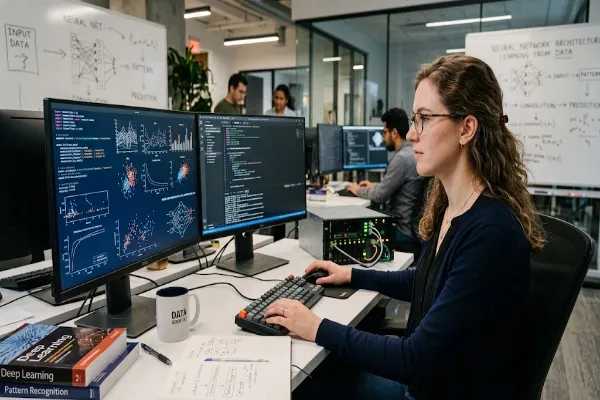
Computers are often described as machines that follow instructions. Traditionally, this has been exactly how computer programs worked: a person wrote a set of rules, the computer followed those rules, and the program produced an expected result.
Modern computing has become much more sophisticated. Computers can now examine enormous amounts of information, identify patterns, make predictions, recognize images and speech, recommend content, and improve their performance when they are exposed to more examples.
This process is commonly described as machine learning.
But how can a machine actually learn? Computers do not learn in the same way people do. They do not have human experiences, intuition, emotions, or understanding. Instead, they process information according to mathematical methods and use patterns in data to build models that can be used to make predictions or decisions.
Understanding how this process works helps explain many technologies that people encounter every day.
What Does It Mean for a Computer to Learn?
When people hear the word “learning,” they may imagine a student reading a book, understanding an idea, remembering it, and applying it later.
Computer learning is different.
A computer learns by finding useful patterns in data. Instead of being given every possible instruction for every situation, a system can be given examples and a method for analyzing those examples.
For example, imagine a system designed to distinguish between photographs of cats and dogs.
One approach would be to write thousands of rules describing what makes a cat different from a dog. Such a system would be extremely difficult to create because animals can look very different depending on their breed, age, position, lighting, and environment.
Another approach is to provide the computer with many photographs that have already been identified as either cats or dogs.
The computer analyzes those examples and searches for patterns that help distinguish the two groups. After training, it can examine a new photograph and estimate whether it is more likely to contain a cat or a dog.
The computer has not learned what a cat is in the human sense. It has learned mathematical patterns associated with the examples it was given.
Data Is the Foundation
Data is one of the most important components of computer learning.
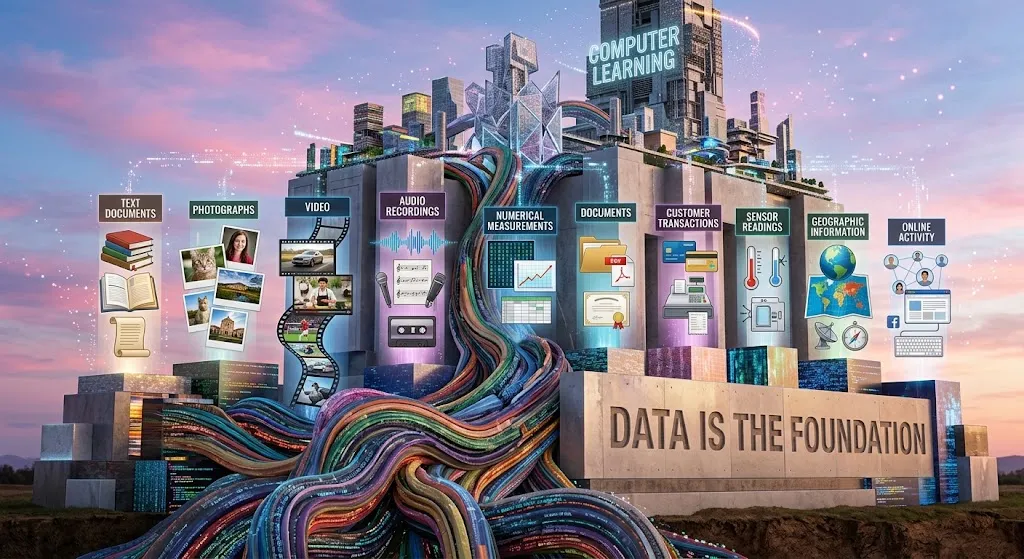
Data can take many forms, including:
- Text
- Photographs
- Video
- Audio recordings
- Numerical measurements
- Documents
- Customer transactions
- Sensor readings
- Geographic information
- Online activity
The type and quality of data have a major influence on the results produced by a learning system.
If a system is trained using incomplete, inaccurate, or heavily biased information, its results may also be unreliable.
This is why collecting, organizing, cleaning, and preparing information can be just as important as choosing the mathematical model used for learning.
How Training Works
The process through which a computer system learns from examples is generally called training.
During training, the system is presented with data and attempts to identify relationships or patterns within it.
Consider a simple example involving house prices.
Suppose a system receives information about thousands of homes, including:
- Location
- Size
- Number of rooms
- Age of the building
- Property type
- Previous selling price
The system can compare these characteristics with the actual prices of the properties.
Over many examples, it may identify relationships between certain characteristics and property prices.
A larger home, for example, may generally have a higher value than a smaller home in the same area. Location may also have a significant influence.
The system creates a mathematical representation of these relationships. Once training is complete, that model can be used to estimate the price of a property it has never seen before.
What Is a Model?
The word model is important in machine learning.
A model is essentially a mathematical representation of patterns discovered in data.
It can be thought of as a tool that takes information as input and produces an output.
For example:
Input:
House size, location, age, number of rooms
Model:
Learned relationships between these characteristics and property prices
Output:
Estimated property value
The model does not simply store every example it has seen. Its purpose is to identify patterns that can be applied to new information.
A useful model therefore needs to do more than remember its training data.
Learning From Examples
There are several different ways computers can learn from information.
One of the most common approaches is called supervised learning.
In supervised learning, the computer is given examples where the correct answer is already known.
For example, a collection of emails could be labeled:
- Spam
- Not spam
The system examines the examples and learns patterns associated with each category.
When a new email arrives, the model evaluates it and predicts which category it belongs to.
Supervised learning can be used for many tasks, including:
- Predicting prices
- Classifying documents
- Detecting certain types of fraud
- Recognizing objects in photographs
- Predicting customer behavior
- Identifying unwanted messages
Learning Without Predefined Answers
Another approach is unsupervised learning.
Here, the computer receives information without being given the correct categories in advance.
Instead of telling the system which customers belong to which groups, for example, a business could provide information about thousands of customers and allow the system to search for similarities.
The system might discover groups based on characteristics such as:
- Purchasing habits
- Frequency of purchases
- Spending levels
- Product preferences
- Geographic location
These groups can then help businesses understand different types of customers.
The important difference is that the computer is not told the answer beforehand. It searches for patterns and structures within the data.
Learning Through Feedback
Another approach is known as reinforcement learning.
In this type of learning, a system interacts with an environment and receives feedback about its actions.
An action that produces a desirable result can receive a positive reward, while an undesirable action can receive a negative result.
Over many attempts, the system can learn which actions are more likely to produce useful outcomes.
This approach has been used in areas such as games, robotics, simulations, and decision-making systems.
A simple example would be a computer learning to navigate a virtual environment.
If it reaches its destination efficiently, it receives a positive reward. If it moves in the wrong direction or encounters an obstacle, the result is less favorable.
By repeating the process many times, the system can learn strategies that improve its performance.
Why Computers Need So Much Data
Many modern learning systems require large amounts of information.
The reason is relatively straightforward: more examples can give a system more opportunities to identify useful patterns.
Imagine trying to recognize different types of birds after seeing only three photographs. It would be difficult to distinguish between many species.
Now imagine seeing thousands or millions of photographs taken under different conditions.
The system has more examples from which to learn.
However, more data does not automatically guarantee better results. The quality, relevance, accuracy, and diversity of the information are extremely important.
Millions of poor-quality examples may be less useful than a smaller collection of carefully prepared information.
The Importance of Good Data
Data can contain errors.
A database might have incorrect measurements. A photograph might be incorrectly labeled. A document might contain incomplete information.
There can also be hidden biases in the data.
For example, if a system is trained primarily using information from one geographic region, its performance may be weaker when it encounters situations from another region.
This means that developers need to carefully examine training data.
They may need to remove duplicates, correct errors, standardize information, check labels, and ensure that important groups or situations are adequately represented.
Good computer learning depends heavily on good information.
How Patterns Are Found
Computers are particularly good at performing mathematical calculations.
A learning system can examine large numbers of variables and search for relationships that may be difficult for a person to identify manually.
For example, when analyzing photographs, a system may detect patterns involving shapes, edges, textures, colors, and other visual characteristics.
When analyzing text, it may examine relationships between words, phrases, sentence structures, and other features.
The system does not necessarily use one simple rule. Instead, it can combine many mathematical relationships to produce a prediction.
This is one reason modern learning systems can perform tasks that would be extremely difficult to accomplish using traditional programming alone.
Neural Networks
One important technology used in modern machine learning is the neural network.
Neural networks are mathematical systems inspired loosely by the way biological nervous systems process information.
They contain interconnected computational units arranged in layers.
Information enters the network, passes through these layers, and is transformed along the way.
During training, the system adjusts internal parameters so that its outputs become increasingly useful for the task it is performing.
For example, a neural network trained to recognize objects in photographs may gradually become better at distinguishing different visual patterns.
Neural networks can contain many layers. Systems with particularly many layers are commonly associated with deep learning.
What Is Deep Learning?
Deep learning is a type of machine learning that uses neural networks with multiple layers.
These systems have become particularly important for handling complex forms of information such as:
- Images
- Speech
- Video
- Natural language
- Large collections of documents
Deep learning has helped computers perform increasingly sophisticated tasks involving recognition and prediction.
For example, a deep learning system can process large numbers of photographs and learn increasingly complex representations of visual information.
The early layers may identify relatively simple features, while later layers can combine those features into more complex patterns.
Learning Does Not Mean Understanding
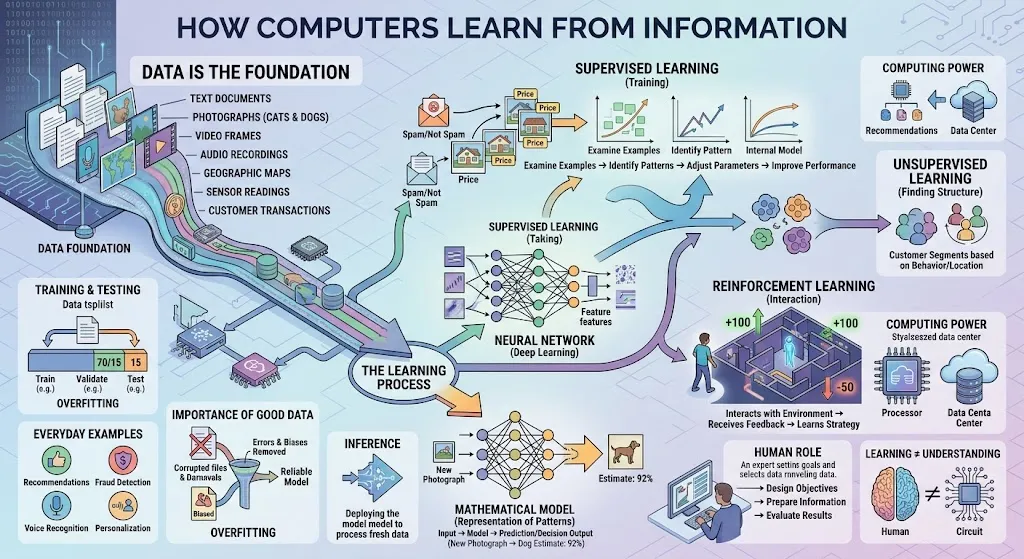
One of the most important things to remember is that computer learning is not identical to human understanding.
A person can understand that a photograph shows a dog and recognize the animal as a living creature with a particular place in the world.
A computer system may instead calculate that the visual patterns in the photograph correspond strongly with examples previously associated with the category “dog.”
The result can appear remarkably intelligent, but the underlying process is fundamentally different from human experience.
This distinction becomes particularly important when evaluating what computers can and cannot do.
Training and Testing
A learning system should not be evaluated only on the information it used during training.
If a model simply memorizes its training examples, it may appear highly accurate while performing poorly on new information.
This problem is known as overfitting.
To reduce this risk, developers commonly divide data into different groups.
A training set is used to build the model.
A validation set can help with adjusting the system and evaluating different approaches.
A test set is used to assess how well the final system performs on information it has not previously seen.
The goal is to create a system that can generalize from its examples rather than simply memorize them.
What Is Inference?
After training, a model can be used to process new information.
This stage is commonly called inference.
For example, suppose a system has been trained using thousands of photographs.
When a new photograph is presented, the trained model analyzes it and produces a prediction.
The system might determine that the photograph has a high probability of containing a particular object.
Training and inference are therefore different stages.
Training involves learning patterns from data.
Inference involves using the learned model to produce results from new information.
How Computers Learn From Text
Text provides another fascinating example.
A computer can process large collections of written material and analyze relationships between words and phrases.
Modern language systems can identify patterns involving vocabulary, grammar, context, and relationships between pieces of text.
This can support applications such as:
- Translation
- Text classification
- Search
- Summarization
- Question answering
- Writing assistance
- Speech-to-text systems
However, processing language remains challenging because human communication often depends on context, culture, humor, ambiguity, and information that is not explicitly stated.
A sentence can have different meanings depending on the situation in which it is used.
How Computers Learn From Images
Computer vision is another major area where learning systems are used.
Instead of manually programming a computer with rules for every possible photograph, developers can train systems using large collections of labeled images.
A system may learn to recognize patterns associated with:
- Faces
- Animals
- Vehicles
- Buildings
- Medical images
- Objects
- Handwriting
- Road signs
The same basic principle applies: examples are processed, patterns are identified, and a model is created that can be applied to new information.
How Computers Learn From Sound
Computers can also learn from audio.
Speech recognition systems, for example, process sound waves and attempt to convert spoken language into written words.
Training may involve very large collections of recordings together with corresponding transcripts.
The system can learn relationships between acoustic patterns and language.
This technology is now used in smartphones, vehicles, customer-service systems, accessibility tools, and voice-controlled devices.
Everyday Examples of Computer Learning
People interact with systems that use machine learning more often than they may realize.
For example, online services can use learned patterns to recommend products, videos, music, or articles.
Email services can identify messages that appear to be unwanted.
Maps can estimate travel times based on traffic patterns and historical information.
Banking systems can monitor transactions for unusual activity.
Smartphone cameras can automatically improve photographs.
Streaming platforms can recommend content based on previous behavior.
These systems can perform different tasks, but many rely on the same broad principle: analyzing information to identify patterns that can be used for future predictions or decisions.
Recommendations and Personalization
Recommendation systems are especially visible in everyday digital life.
Suppose someone regularly watches particular types of videos.
A service can examine the person’s activity and compare it with patterns found among other users.
If people with similar viewing habits often enjoy certain content, the system may recommend that content.
This does not necessarily mean the computer knows exactly what a person likes.
Instead, it calculates relationships between available information and estimates what might be relevant.
This is an example of prediction rather than human-style understanding.
Can Computers Learn on Their Own?
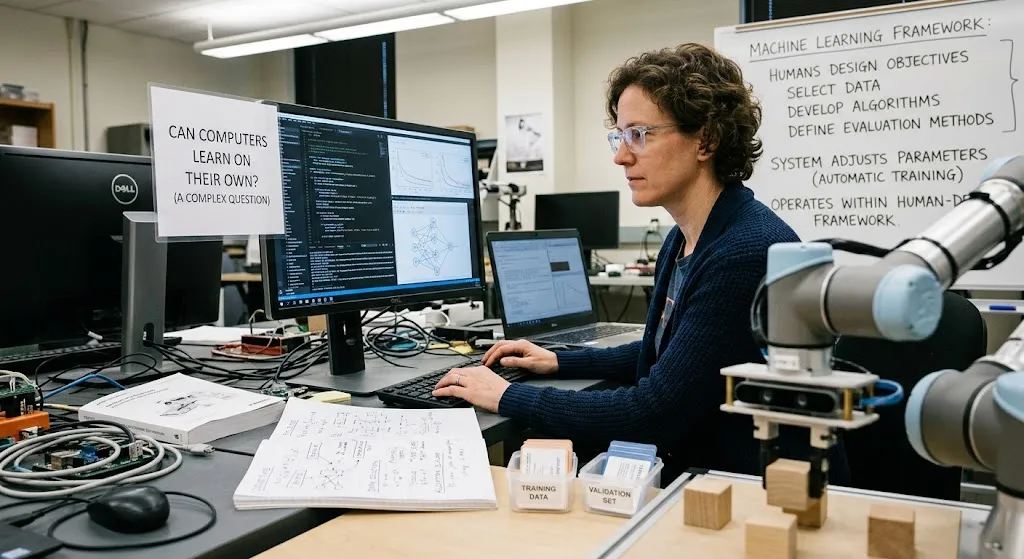
The phrase “learn on their own” can be misleading.
Computers do not independently decide what they should learn in the same way a person might decide to study a new subject.
People design the objectives, select data, develop algorithms, define evaluation methods, and provide computing resources.
Some systems can adjust their internal parameters automatically during training, but that process still operates within a framework designed by humans.
The system can be highly sophisticated without being completely independent.
Why Computing Power Matters
Training modern learning systems can require substantial computing resources.
Large datasets may contain billions or even trillions of individual pieces of information.
Processing them repeatedly can require powerful processors, large amounts of memory, and specialized hardware.
Computing power has therefore played an important role in the development of modern machine learning.
As hardware becomes faster and more efficient, researchers and companies can experiment with increasingly complex models.
Cloud computing has also made large-scale computing resources more accessible to organizations that do not own massive physical data centers.
Why Results Can Be Wrong
A computer-generated prediction is not automatically correct.
A system can make mistakes for many reasons.
The training data may be incomplete. The examples may contain errors. The environment may change. The model may not have encountered a particular situation before.
A system may also identify a pattern that appears useful during training but does not remain reliable in the real world.
For this reason, machine learning systems need evaluation and monitoring.
In important applications, human oversight can remain essential.
Bias in Computer Learning
Another important issue is bias.
If the information used to train a system contains existing biases, those patterns can potentially influence the resulting model.
For example, historical decisions may reflect unequal treatment or incomplete representation of certain groups.
If those historical patterns are used without careful examination, a system may reproduce or amplify them.
This is why responsible development involves more than technical performance.
Developers and organizations need to consider how data was collected, which populations are represented, how the system is evaluated, and what consequences errors might have.
Privacy and Personal Information
The use of large amounts of information also creates questions about privacy.
Some learning systems process information that can be sensitive, such as financial activity, location data, photographs, communications, or health-related information.
Organizations need to consider how such information is collected, stored, protected, and used.
People should also be aware that many digital services collect information about how their products are used.
Understanding data practices can help individuals make more informed decisions about the technologies they use.
Does More Information Always Mean Better Learning?
Not necessarily.
More information can be useful, but irrelevant, inaccurate, duplicated, or biased information can reduce the quality of a system.
Imagine trying to learn about world geography from a book containing thousands of incorrect maps.
Having more pages would not solve the fundamental problem.
The same principle applies to computer learning.
The goal is not simply to collect as much data as possible. The goal is to obtain information that is relevant, reliable, appropriately structured, and suitable for the task.
How Models Improve
Improvement usually comes through repeated experimentation and evaluation.
Developers may change:
- The training data
- The model architecture
- The learning method
- The parameters
- The evaluation process
- The amount of computing power
- The way information is represented
The resulting model can then be tested again.
This process may be repeated many times.
Improvement therefore does not necessarily happen because the computer suddenly “understands” something. It often happens because researchers and engineers develop better methods for finding useful patterns in information.
Can a Computer Learn From New Information?
Some systems can be updated or retrained when new information becomes available.
For example, a recommendation system may incorporate recent user activity.
A forecasting system may be updated with newer measurements.
A fraud-detection system may need to adapt as new forms of suspicious behavior appear.
However, continuously changing a model can also introduce problems.
New information may contain errors, unusual events, or unwanted patterns.
Therefore, updating a system requires careful monitoring and evaluation.
The Human Role Remains Important
Although computers can process information at extraordinary speed, humans continue to play an important role.
People decide what problems are worth solving.
They determine what information should be collected.
They define objectives.
They evaluate results.
They investigate unexpected behavior.
They decide how a system should be used.
They also remain responsible for many of the decisions surrounding technology.
The most useful approach is often not to think of computers and people as competitors, but as tools and decision-makers that can complement one another.
What the Future May Bring
Computer learning is likely to become increasingly integrated into everyday technology.
Future systems may become better at processing combinations of text, images, sound, video, and other forms of information.
They may also become more efficient, requiring fewer computing resources for certain tasks.
At the same time, society will continue to face important questions about privacy, employment, accuracy, responsibility, security, and the appropriate role of automated decision-making.
Technological progress does not eliminate these questions. In many cases, it makes them more important.
Why Understanding Computer Learning Matters
People do not need to become computer scientists to understand the basic principles behind modern learning systems.
Knowing how computers learn from information can help people better understand the technology they encounter every day.
It can also make it easier to recognize the difference between a prediction and a fact, understand why automated systems sometimes make mistakes, and think critically about information presented by digital platforms.
For anyone interested in the broader subject, understanding what artificial intelligence is and how it works provides useful additional context because machine learning is one of the central technologies behind many modern intelligent systems.
Final Thoughts
Computers learn from information by processing examples, identifying patterns, adjusting mathematical models, and using those models to make predictions or decisions about new information.
The process can involve supervised learning, unsupervised learning, reinforcement learning, neural networks, and deep learning. These technologies are already part of many everyday services, from search engines and recommendation systems to voice recognition, image analysis, navigation, and fraud detection.
However, computer learning is not the same as human learning. Computers rely on mathematical processes and the information provided to them. Their results can be extremely useful, but they can also be inaccurate, biased, or limited by the quality of their data and design.
As computers become increasingly capable of processing information, understanding the basic principles behind their learning will become increasingly valuable. It allows people to use technology more effectively while also maintaining a realistic view of what computers can—and cannot—do.
For more informative articles, practical guides, and interesting topics across a wide range of subjects, visit serdpestcp.org and explore more.


One thought on “How Computers Learn From Information”