
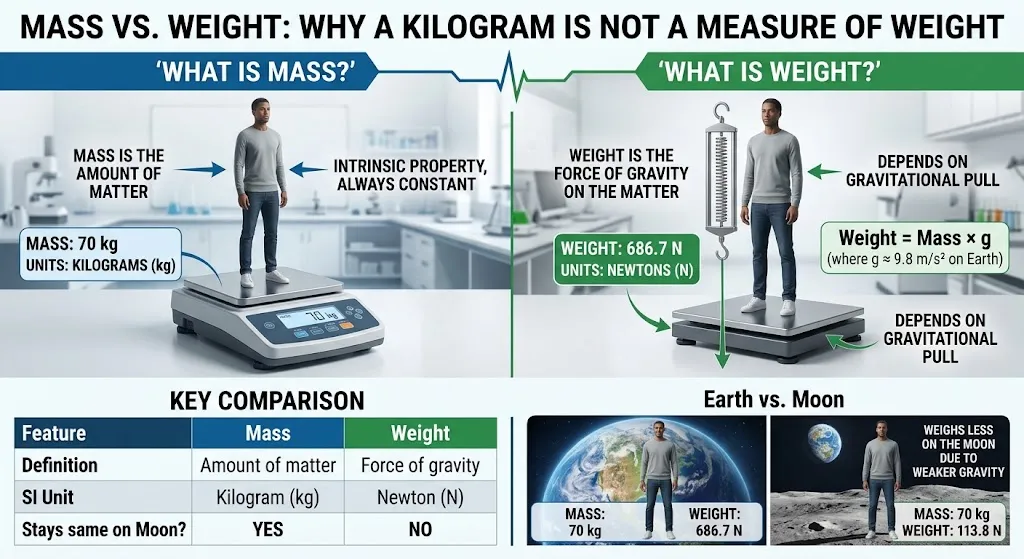
Mass and weight are often used interchangeably in everyday conversation, but they describe two different physical properties. A kilogram measures mass, not weight. Understanding the difference helps explain why an object has the same mass on Earth and the Moon but weighs less on the Moon because of its weaker gravitational pull.
What Is Mass?
Mass is the amount of matter in an object. It is an intrinsic property that remains the same regardless of where the object is located, whether on Earth, on the Moon, or in space.
The standard unit of mass in the International System of Units (SI) is the kilogram (kg). Smaller and larger units, such as grams and metric tonnes, are also commonly used to measure mass.
For example:
- A bag of rice may have a mass of 1 kilogram.
- A bicycle may have a mass of 12 kilograms.
- A car may have a mass of 1,500 kilograms.
These values remain unchanged when the objects are moved to another location, provided that no matter is added or removed.
Mass also relates to inertia, which is an object’s resistance to changes in its motion. An object with greater mass generally requires more force to accelerate than an object with less mass.
What Is Weight?
Weight is the force exerted on an object by gravity. Unlike mass, weight depends on the strength of the gravitational field acting on the object.
The standard SI unit of force, including weight, is the newton (N), not the kilogram.
Weight can be calculated using the following formula:
Weight = Mass × Gravitational Acceleration
Written mathematically:
W = m × g
Where:
- W is weight, measured in newtons (N).
- m is mass, measured in kilograms (kg).
- g is gravitational acceleration, measured in meters per second squared (m/s²).
Near Earth’s surface, gravitational acceleration is approximately 9.81 m/s². Therefore, an object with a mass of 1 kilogram experiences a gravitational force of approximately 9.81 newtons.
Weight can change when an object moves between locations with different gravitational fields, even though its mass remains constant.
Why Is a Kilogram Not a Measure of Weight?
A kilogram is a unit of mass because it describes how much matter an object contains. Weight, on the other hand, is a force caused by gravity and must be expressed in newtons under the SI system.
The confusion arises because everyday language often uses kilograms when discussing body weight, food packages, luggage, and other objects. In ordinary situations on Earth, this shorthand is convenient because gravity is relatively consistent.
For example, when a person says they weigh 70 kilograms, they usually mean that their mass is 70 kilograms. Their actual gravitational weight near Earth’s surface is approximately 686.7 newtons.
Scales commonly display kilograms because they measure a force or another physical effect and convert the result into an estimated mass, assuming a known gravitational environment. Properly calibrated scales can therefore report mass in kilograms, even though the physical force involved is weight.
Mass vs. Weight: Key Differences
| Feature | Mass | Weight |
|---|---|---|
| Meaning | Amount of matter in an object | Gravitational force acting on an object |
| SI unit | Kilogram (kg) | Newton (N) |
| Depends on gravity | No | Yes |
| Changes between Earth and Moon | No | Yes |
| Related property | Inertia | Gravitational force |
| Measurement | Balance or suitable mass-measuring instrument | Force meter or spring scale |
The most important distinction is that mass remains constant when gravitational conditions change, while weight changes according to the local gravitational field.
How Mass and Weight Differ on Earth and the Moon
The Moon provides a simple example of the difference between mass and weight. Its surface gravity is approximately one-sixth of Earth’s gravity.
Imagine an object with a mass of 60 kilograms. On Earth, its weight would be approximately 588.6 newtons. On the Moon, where gravitational acceleration is about 1.62 m/s², its weight would be approximately 97.2 newtons.
The object still has a mass of 60 kilograms on both worlds. Only the gravitational force acting on it changes.
| Location | Mass | Approximate Weight |
|---|---|---|
| Earth | 60 kg | 588.6 N |
| Moon | 60 kg | 97.2 N |
| Mars | 60 kg | 222.6 N |
These calculations use approximate surface gravitational accelerations. They demonstrate why an object can weigh much less on the Moon without losing any of its mass.
How Do Scales Measure Mass in Kilograms?
Most household scales display a person’s mass in kilograms, even though their operation involves physical forces.
A typical digital bathroom scale measures the force exerted on its sensors when a person stands on it. The scale then uses calibration and an assumed gravitational acceleration to convert that reading into a mass value.
A spring scale, by comparison, measures force through the extension of a spring. If it is marked in newtons, it directly reports the measured force. If it is marked in kilograms, it is displaying a mass-equivalent value based on an assumed gravitational field.

A balance compares an object’s mass with known masses. Because gravitational acceleration acts on both sides of the balance in the same location, its effect cancels out under ordinary conditions, allowing the balance to determine mass.
This distinction matters in scientific experiments, engineering, and space exploration, where gravitational conditions may differ significantly from those on Earth.
Why the Difference Matters in Science
Understanding mass and weight is essential because confusing them can lead to incorrect calculations in physics and engineering.
When calculating the force required to accelerate an object, mass is used in Newton’s second law:
Force = Mass × Acceleration
When calculating the gravitational force acting on an object near a planet’s surface, the relevant relationship is:
Weight = Mass × Gravitational Acceleration
Although the equations have a similar form, they describe different physical situations. In the first, acceleration may result from any net force. In the second, the acceleration is specifically associated with gravity.
The distinction is particularly important when designing spacecraft, calculating the loads on structures, determining how objects behave on other planets, and interpreting scientific measurements.
Frequently Asked Questions
In the SI system, weight is measured in newtons because weight is a force. Kilograms measure mass. Everyday language often uses kilograms to describe a person’s weight, but this is technically a reference to mass.
No. An object’s mass remains the same on the Moon as it does on Earth, provided no matter is added or removed. Its weight decreases because the Moon has weaker surface gravity.
Most bathroom scales are designed to display an estimated mass. They measure the force exerted by a person and convert it into kilograms using an assumed value for Earth’s gravitational acceleration.
An object can have mass while experiencing zero apparent weight, such as an astronaut and spacecraft in continuous free fall while orbiting Earth. However, Earth’s gravity is still acting on them. In a region where the gravitational field is negligible, the object’s gravitational weight can also be negligible.
Near Earth’s surface, an object with a mass of 1 kilogram has a weight of approximately 9.81 newtons.
Conclusion
Mass and weight are closely related but fundamentally different physical quantities. Mass measures the amount of matter in an object and is expressed in kilograms, while weight is the gravitational force acting on that object and is expressed in newtons.
An object’s mass remains constant when it moves between Earth, the Moon, and other locations, but its weight changes with gravity. Recognizing this distinction makes measurements easier to understand and provides a clearer foundation for learning physics, engineering, and astronomy.


