In the summer of 1858, London faced a public health and environmental crisis so severe that it became known as the “Great Stink.” The River Thames, which ran through the heart of the British capital, had become heavily polluted by human waste, household rubbish, and industrial discharge. As temperatures rose, the smell grew unbearable, reaching government buildings and forcing officials to confront a problem that had been ignored for decades.
Although London was one of the world’s most influential cities, its sanitation infrastructure had failed to keep pace with its rapidly expanding population. The Great Stink became a turning point in urban engineering, leading to the development of a modern sewer network that helped shape wastewater management systems used in cities around the world today.

London Before the Great Stink
During the early and mid-19th century, London experienced extraordinary population growth. People moved to the capital in search of work as industrialization transformed Britain, but public infrastructure struggled to accommodate the growing number of residents.
Many homes relied on cesspools, privies, and basic drainage systems. Human waste was frequently collected in underground pits, some of which leaked into the surrounding soil or overflowed during heavy rainfall. In poorer neighborhoods, sanitation facilities were often inadequate, and overcrowding made the situation even worse.
The River Thames served as a major source of water for households and businesses, but it also received enormous quantities of untreated sewage. Numerous drains and sewers discharged directly into the river, turning an essential waterway into a repository for the city’s waste.
This created serious public health concerns. Cholera outbreaks had repeatedly struck London, including devastating epidemics in 1832, 1848–1849, and 1854. At the time, many people still believed that diseases such as cholera spread primarily through foul-smelling air, an idea known as the miasma theory. Although this explanation was incorrect, the dangerous relationship between contaminated water and disease was beginning to receive greater scientific attention.
What Made the Great Stink of 1858 So Unbearable?

The immediate crisis developed during the exceptionally hot summer of 1858. High temperatures intensified the smell of sewage and decomposing organic matter accumulating in the Thames. The river had become so polluted that the stench spread across nearby streets and buildings.
The Houses of Parliament, situated beside the river at Westminster, were particularly affected. Efforts were made to cover windows and curtains with disinfectant-soaked materials in an attempt to reduce the odor. These measures provided little relief.
The crisis attracted urgent political attention because it directly affected the institutions responsible for governing the country. A sanitation problem that had long burdened ordinary Londoners could no longer be treated as a distant concern.
However, the Great Stink was not simply an unpleasant episode. It exposed the consequences of allowing a rapidly growing city to discharge its waste into a river that remained central to daily life, commerce, and water supply.
Public pressure and political urgency helped create the conditions for a major engineering response.
Joseph Bazalgette and the Plan to Transform London
The engineer at the center of London’s sanitation revolution was Sir Joseph Bazalgette, chief engineer of the Metropolitan Board of Works. He had already been developing plans for a comprehensive sewer network before the Great Stink reached its peak.
The crisis accelerated political support for the project. In 1858, Parliament approved legislation that enabled the authorities to move forward with major improvements to London’s sewerage infrastructure.
Bazalgette’s approach was ambitious. Rather than attempting to repair individual drains or eliminate unpleasant smells temporarily, he proposed a coordinated system that would collect wastewater from across the city and transport it away from densely populated areas.
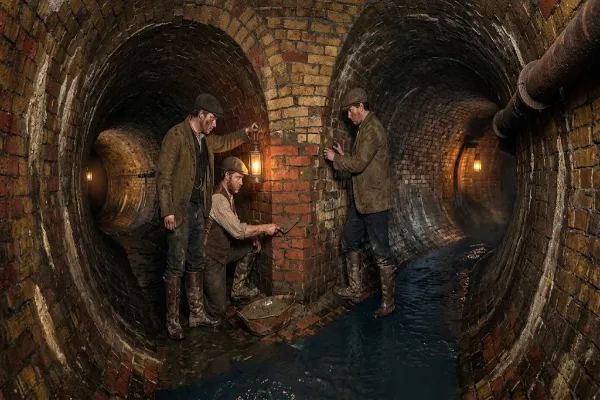
The project required thousands of workers, extensive excavation, new pumping facilities, and the construction of large underground conduits. It also involved sophisticated planning to make use of gravity wherever possible, reducing the need to pump wastewater throughout the entire network.
One of the project’s most important features was its use of large interceptor sewers. These intercepted existing drainage flows before they reached central sections of the Thames and carried the sewage eastward, away from the most densely populated parts of London.
The engineering challenge was immense. The network had to function across a large and uneven urban landscape while accommodating the city’s existing streets, buildings, and transportation routes.
How the Victorian Sewer System Worked
Bazalgette’s system was designed around a relatively straightforward principle: collect wastewater efficiently, transport it through a connected network, and discharge it farther downstream from central London.
Its main components included:
- Local sewers: Smaller underground channels collected wastewater from houses, streets, and local drainage networks.
- Interceptor sewers: Large conduits captured flows that would otherwise have entered the Thames in central London.
- Pumping stations: Where gravity alone could not move wastewater effectively, pumping facilities helped transport it through the network.
- Outfalls: The system carried sewage toward discharge points farther downstream, reducing the immediate concentration of waste in central London.
The project also incorporated major embankments along sections of the Thames. These works improved riverfront infrastructure, provided space for sewers and other utilities, and helped reshape parts of London’s urban landscape.
Construction continued over many years. Major sections of the system entered service during the 1860s, and the broader network was developed and expanded over subsequent decades.
The result was one of the most significant urban infrastructure projects of the Victorian era.
Why Bazalgette’s Design Was So Influential
The success of London’s sewer system depended not only on its scale but also on the principles behind its design.
Bazalgette understood that sanitation infrastructure had to serve an entire urban population rather than isolated streets or neighborhoods. A coordinated network could manage waste more effectively than a collection of disconnected drains.
He also planned for future population growth. The sewers were built with substantial capacity, reflecting his recognition that London’s population and wastewater volumes would continue to increase.
This long-term approach helped the system remain useful well beyond its original design period. Although parts of the network have required repairs, upgrades, and extensions, sections of Bazalgette’s Victorian infrastructure continue to operate today.
His work demonstrated that major public health improvements often depend on investments that are expensive, largely invisible, and difficult to appreciate until their benefits become clear.
Did the New Sewers Eliminate Disease?
The transformation of London’s sanitation infrastructure contributed significantly to improvements in urban public health, but the results were not immediate or attributable to a single intervention.
The Great Stink itself did not directly cause London’s major cholera epidemics. The city had already experienced severe outbreaks, and research by physician John Snow had provided important evidence linking cholera transmission to contaminated drinking water during the 1854 Soho outbreak.
Snow’s investigation challenged prevailing assumptions about disease and helped advance understanding of waterborne infection. Nevertheless, acceptance of germ theory and the relationship between contaminated water and disease developed gradually.
Bazalgette’s sewer network addressed a different but closely related problem: the uncontrolled accumulation and discharge of human waste. By intercepting sewage and moving it away from central London, the system helped reduce the contamination affecting heavily populated areas and made further improvements in water supply and sanitation possible.
It is important to recognize that the original system did not treat all sewage before discharge. Its principal purpose was collection and conveyance, and the release of untreated wastewater farther downstream created continuing environmental challenges. Modern treatment facilities, expanded infrastructure, and stricter environmental controls were needed to address those problems.
The Connection to Modern Sewer Systems

Many principles established during London’s Victorian sanitation revolution remain central to wastewater engineering.
Modern cities still rely on interconnected networks of underground pipes, gravity-fed drainage, pumping stations, and large trunk sewers. These components move wastewater from individual buildings toward treatment facilities or other designated destinations.
However, contemporary systems are generally more sophisticated than their 19th-century predecessors. Wastewater treatment plants remove pollutants and reduce harmful microorganisms before treated water is released or reused. Many cities also separate sanitary sewage from stormwater to reduce the risk of sewer overflows during heavy rainfall.
Older combined sewer systems, which carry both wastewater and rainwater in the same pipes, remain in use in some places. During intense storms, these systems can become overloaded and release mixtures of sewage and rainwater into nearby waterways. Managing these overflows is an ongoing challenge for urban authorities.
London has continued investing in its Victorian infrastructure while developing new facilities to cope with population growth and environmental regulations. The Thames Tideway Tunnel, a major modern infrastructure project, was designed to intercept a substantial proportion of the sewage overflows entering the Thames from the capital’s older sewer network.
These developments demonstrate how cities can preserve valuable historic infrastructure while adapting it to contemporary environmental and public health requirements.
Lessons Cities Can Learn From the Great Stink
The Great Stink offers several important lessons for modern urban planning and infrastructure management.
First, infrastructure must grow with the population. When cities expand faster than their water and sanitation systems, the resulting problems can threaten public health and environmental quality.
Second, preventive investment is more effective than temporary solutions. Attempts to mask the smell of polluted water could not solve the underlying problem. Lasting improvement required coordinated engineering, sustained public funding, and political commitment.
Third, public health and environmental protection are closely connected. The management of human waste affects drinking water, rivers, ecosystems, and the living conditions of entire communities.
Finally, major infrastructure requires long-term thinking. Bazalgette’s work illustrates the value of designing systems with future demand in mind rather than responding only to immediate pressures.
These lessons remain relevant as modern cities confront aging pipes, extreme rainfall, water scarcity, pollution, and the costs of maintaining essential public services.
Conclusion

London’s Great Stink of 1858 was a public health warning that transformed the way the city approached sanitation. The unbearable conditions along the Thames forced political leaders to confront the consequences of inadequate infrastructure and helped accelerate Joseph Bazalgette’s ambitious sewer construction program.
The resulting network represented a remarkable achievement in Victorian engineering. Although it was not a complete solution to wastewater pollution, it established principles of coordinated collection, large-scale drainage, and long-term infrastructure planning that remain important today.
More than a century and a half later, the story of the Great Stink demonstrates that some of the most consequential advances in urban life begin when a city can no longer ignore a problem. London’s response helped lay the foundations for modern sewerage engineering and showed why reliable sanitation is essential to healthy, sustainable cities.